Properties of the Molecular Gas in Starburst Galaxies and AGN
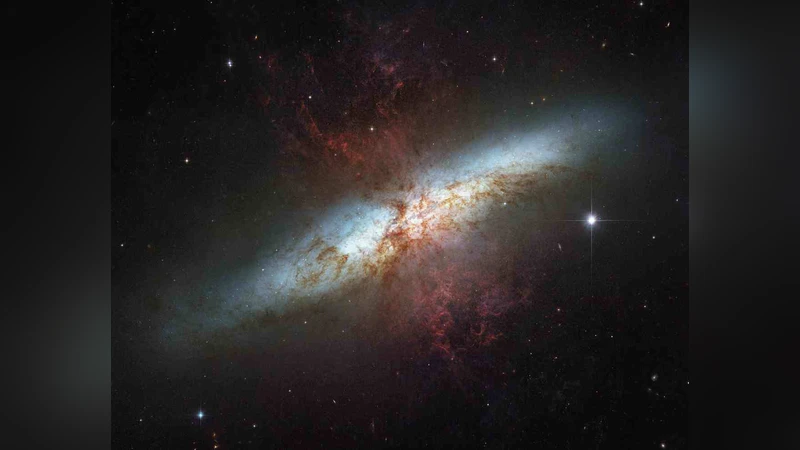
There is growing evidence that the properties of the molecular gas in the nuclei of starburst galaxies and in AGN may be very different from those seen in Galactic star forming regions and that a high kinetic temperature in the molecular gas may lead to a non-standard initial mass function in the next generation of stars. Unfortunately, among the fundamental parameters derived from molecular line observations, the kinetic temperature of the molecular gas in external galaxies is often not well determined due to a lack of suitable tracer molecules. We discuss the diagnostic power of selected transition lines of formaldehyde (H_2CO), which can be used as a molecular thermometer as well as an excellent tracer of the molecular gas density. As a proof of concept, we present the results of our multi-transition line study of the H_2CO emission from the prototypical starburst galaxy M82. Using our large velocity gradient model, we tightly constrain the physical properties of the dense gas in the prominent molecular lobes, completely independent of the standard “cloud thermometer” ammonia (NH_3) or other molecular tracers. Our results agree well with the properties of the high-excitation molecular gas component found in the most comprehensive CO studies. Our observations also indicate that there may be an asymmetry between the two molecular lobes.
💡 Research Summary
The paper addresses a fundamental problem in extragalactic astrophysics: the difficulty of measuring the kinetic temperature of molecular gas in the nuclei of starburst galaxies and active galactic nuclei (AGN). Traditional tracers such as ammonia (NH₃) and carbon‑monoxide (CO) either lose sensitivity in the high‑density, high‑temperature environments typical of these regions or suffer from optical‑depth complications that make temperature diagnostics ambiguous. To overcome these limitations, the authors propose using selected rotational transitions of formaldehyde (H₂CO) as a dual diagnostic tool—one set of line ratios that is primarily temperature‑sensitive and another that traces gas density.
Formaldehyde is a slightly asymmetric top molecule whose K‑doublet transitions (e.g., 2₀₂–1₀₁) and ΔJ = 2 transitions (e.g., 3₀₃–2₀₂) respond differently to collisional excitation. The ratio of the K‑doublet lines depends strongly on kinetic temperature, while the ratio of lines differing by ΔJ = 1 is dominated by the H₂ volume density. Because H₂CO remains abundant and observable even in dense, warm gas, it can serve as a “molecular thermometer” independent of NH₃.
The authors apply this method to the prototypical starburst galaxy M82, focusing on its two prominent molecular lobes (the eastern and western lobes). Using the IRAM 30 m telescope and the James Clerk Maxwell Telescope (JCMT), they observed four H₂CO transitions in the 1.3 mm and 2 mm windows: 2₀₂–1₀₁, 3₀₃–2₀₂, 3₂₁–2₂₀, and 4₀₄–3₀₃. The spectra show line widths of 100–150 km s⁻¹, consistent with the known rotation of M82’s central molecular disk.
To interpret the data, the authors employ a large‑velocity‑gradient (LVG) radiative‑transfer model. They explore a grid of kinetic temperatures (10–200 K), H₂ densities (10³·⁵–10⁶ cm⁻³), H₂CO column densities, and velocity gradients. By comparing observed line ratios to model predictions, they find that both lobes are characterized by warm (Tₖ ≈ 70–120 K) and dense (n(H₂) ≈ 10⁴·⁵–10⁵·⁵ cm⁻³) molecular gas. These values are in excellent agreement with the “high‑excitation” component identified in comprehensive CO multi‑transition studies of M82, confirming that H₂CO traces the same gas phase.
Importantly, the analysis reveals a modest asymmetry: the eastern lobe appears ∼20 K hotter and ∼30 % denser than the western lobe. This suggests that the physical conditions within the two lobes are not identical, possibly reflecting variations in star‑formation activity, shock heating, or feedback from the central starburst.
The implications of these findings are twofold. First, H₂CO line ratios provide a robust, independent temperature and density diagnostic for extragalactic molecular gas, especially where NH₃ is weak or undetectable. Second, the presence of widespread warm, dense gas in M82 supports theoretical scenarios in which elevated kinetic temperatures shift the initial mass function (IMF) toward higher stellar masses. In a hot environment, the Jeans mass increases, suppressing the formation of low‑mass stars and potentially leading to a top‑heavy IMF—a hypothesis that could explain the intense, short‑lived starbursts observed in galaxies like M82.
The authors conclude by advocating for systematic H₂CO surveys of other starburst and AGN hosts using high‑resolution facilities such as ALMA. Mapping H₂CO across entire galactic disks would enable three‑dimensional reconstructions of temperature and density structures, allowing astronomers to quantify star‑formation efficiencies, assess the impact of AGN feedback, and refine models of galaxy evolution.
Comments & Academic Discussion
Loading comments...
Leave a Comment