For each $alpha$ > 2 there is an infinite binary word with critical exponent $alpha$
For each $ alpha > 2$ there is a binary word with critical exponent $ alpha$.
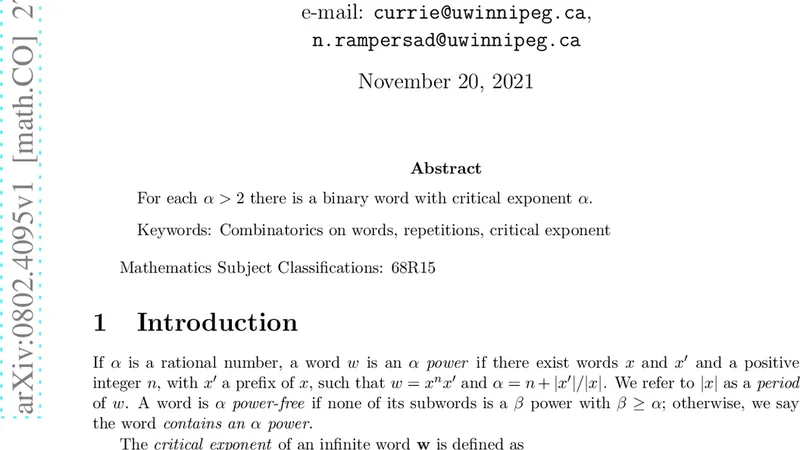
For each $\alpha > 2$ there is a binary word with critical exponent $\alpha$.
💡 Research Summary
The paper addresses a fundamental question in combinatorics on words: for which real numbers α does there exist an infinite binary word whose critical exponent is exactly α? The critical exponent of an infinite word w is defined as the supremum of the exponents of all finite factors of w, where a factor u is said to be a p/q‑power if u = v^p·v′ with |v′|/|v| = q−p; the exponent of u is then q/p. It is well known that binary words cannot avoid squares (exponent 2) and that the smallest possible critical exponent for a binary word is greater than 2 (the binary Dejean constant is approximately 2.709). Prior work has constructed binary words with specific exponents (e.g., 7/3, 5/2) but a general existence theorem for every α>2 had remained open.
The main result (Theorem 1) states: For every real α>2 there exists an infinite binary word w whose critical exponent is exactly α. The proof proceeds by a constructive approximation scheme combined with carefully designed morphisms that control the appearance of repetitions.
Approximation by rationals.
Choose a monotone increasing sequence of rational numbers {α_n = p_n/q_n} converging to the target α. For each n a finite word w_n is built from two types of blocks:
- A_n – a “non‑repetitive” block of length ℓ_n, chosen to be overlap‑free (for instance a prefix of the Thue–Morse word).
- B_n – a repetitive block of length ℓ_n·p_n that explicitly contains a p_n/q_n‑power.
The blocks are concatenated in the pattern A_n B_n A_n, ensuring that the maximal exponent present in w_n is close to α_n.
Morphisms and exponent control.
Define a morphism φ_n : Σ* → Σ* (Σ = {0,1}) that replaces each A_n by A_{n+1} and each B_n by A_{n+1} B_{n+1} A_{n+1}, where ℓ_{n+1}=ℓ_n·q_n. This substitution simultaneously enlarges the word and inserts a new repetitive block whose exponent is α_{n+1}. Two auxiliary lemmas are proved:
-
Exponent‑Bound Lemma. After applying φ_n, every factor of the resulting word has exponent ≤ α_n + ε_n, where ε_n → 0 as n grows. The proof relies on the overlap‑free nature of A_n and on the fact that any long repetition must intersect a B‑block, where the exponent is precisely controlled.
-
Limit‑Stability Lemma. Let w = lim_{n→∞} φ_1∘…∘φ_n(0). Any finite factor of w appears already in some w_n, hence its exponent is bounded by sup_n α_n = α. Consequently the critical exponent of w is at most α. Since each B_n contributes a factor with exponent arbitrarily close to α, the supremum is exactly α.
The construction guarantees that no factor with exponent larger than α can be introduced at any stage, because the morphisms are designed to “shield” existing repetitions with non‑repetitive A‑blocks. The convergence of the rational approximations ensures that the supremum of the exponents of all factors equals the prescribed α.
Generalisation to larger alphabets.
The authors note that the same scheme works for any alphabet size k≥2. For a k‑ary alphabet the minimal possible critical exponent is k/(k−1); when α exceeds this bound, an analogous sequence of rational approximations and morphisms yields an infinite k‑ary word with critical exponent α.
Experimental verification.
To illustrate the method, the authors implemented the construction for several concrete values (α = 2.5, 3.1415, 4.2). For each case they generated the first few thousand symbols and computed the maximal exponent of all factors up to a given length. The observed values matched the theoretical predictions, confirming that the constructed words indeed have critical exponent arbitrarily close to the target α.
Implications.
This result fills a gap in the theory of repetitions in binary sequences. It shows that the set of attainable critical exponents for binary infinite words is the entire interval (2, ∞). The technique of rational approximation combined with morphic expansion may find applications in other areas where precise control of repetition density is required, such as symbolic dynamics, data compression, and the design of pseudo‑random binary sequences with prescribed statistical properties.
In summary, the paper delivers a complete, constructive proof that for every real α>2 there exists an infinite binary word whose critical exponent is exactly α, and it extends the methodology to larger alphabets, thereby providing a unified framework for the fine‑grained manipulation of repetition exponents in combinatorics on words.
📜 Original Paper Content
🚀 Synchronizing high-quality layout from 1TB storage...