This papers develops a logical language for representing probabilistic causal laws. Our interest in such a language is twofold. First, it can be motivated as a fundamental study of the representation of causal knowledge. Causality has an inherent dynamic aspect, which has been studied at the semantical level by Shafer in his framework of probability trees. In such a dynamic context, where the evolution of a domain over time is considered, the idea of a causal law as something which guides this evolution is quite natural. In our formalization, a set of probabilistic causal laws can be used to represent a class of probability trees in a concise, flexible and modular way. In this way, our work extends Shafer's by offering a convenient logical representation for his semantical objects. Second, this language also has relevance for the area of probabilistic logic programming. In particular, we prove that the formal semantics of a theory in our language can be equivalently defined as a probability distribution over the well-founded models of certain logic programs, rendering it formally quite similar to existing languages such as ICL or PRISM. Because we can motivate and explain our language in a completely self-contained way as a representation of probabilistic causal laws, this provides a new way of explaining the intuitions behind such probabilistic logic programs: we can say precisely which knowledge such a program expresses, in terms that are equally understandable by a non-logician. Moreover, we also obtain an additional piece of knowledge representation methodology for probabilistic logic programs, by showing how they can express probabilistic causal laws.
Deep Dive into CP-logic: A Language of Causal Probabilistic Events and Its Relation to Logic Programming.
This papers develops a logical language for representing probabilistic causal laws. Our interest in such a language is twofold. First, it can be motivated as a fundamental study of the representation of causal knowledge. Causality has an inherent dynamic aspect, which has been studied at the semantical level by Shafer in his framework of probability trees. In such a dynamic context, where the evolution of a domain over time is considered, the idea of a causal law as something which guides this evolution is quite natural. In our formalization, a set of probabilistic causal laws can be used to represent a class of probability trees in a concise, flexible and modular way. In this way, our work extends Shafer’s by offering a convenient logical representation for his semantical objects. Second, this language also has relevance for the area of probabilistic logic programming. In particular, we prove that the formal semantics of a theory in our language can be equivalently defined as a prob
Logic based languages, such as logic programming, play an important role in knowledge representation. One of the known weaknesses of such languages is that they are not well suited for representing probabilistic or uncertain knowledge. This has prompted a significant amount of research into probabilistic logic programming languages, both in the knowledge representation community itself, as well as in machine learning, where such languages are developed for the purpose of stochastic relational learning.
Syntactically, such a language typically annotates a logic programming rule, or some part thereof, with a probability; the formal semantics of the language then somehow specifies a probability distribution-typically over a set of possible worlds-in terms of these individual probabilities. This is the way in which these probabilistic logic programming languages tend to be formally defined. However, such a formal definition still leaves one important question unanswered, namely that of how expressions in the langauge should be understood on the informal level, i.e., how would one explain their intuitive meaning to a non-logician?
For the two seperate components of logic programming and probability, this question has of course already been addressed at length. For instance, the informal meaning of logic programs-and in particular its negation-as-failure connectivehas been explained among others in epistemic terms, referring to the beliefs of a rational agent (Gelfond and Lifschitz 1991), and in terms of the well-known mathematical concept of an inductive definition (Denecker 1998). The meaning of statements in probability calculus, on the other hand, has been explained among others in frequentist terms, e.g. (Venn 1866), and in terms of degrees of belief, e.g. (De Finetti 1937).
So far, research on probabilistic logic programming languages has not yet paid a great deal of attention to this issue of the informal meaning of expressions. It tends to be assumed that one already has sufficient intuitions about the meaning of logic programs and that the probabilities can simply be tacked on top of that. This paper presents an effort to develop a probabilistic logic programming langauge, whose informal semantics1 is explained in full detail in a completely self-contained way. In general, the advantage of such an approach is that it gives more philosophical insight into the meaning of statements in the language, makes it easier to explain it to domain experts, and can help to provide a better modeling methodology for it.
One of the key tasks that such an effort needs to accomplish is to show convincingly that the formal semantics of the language indeed correctly captures the informal meaning that is attributed to its expressions, i.e., that these expressions indeed mean-formally-what we claim they-intuitively-mean. To ensure that this is done properly, we will adopt a constructive approach, where we first describe a particular kind of knowledge that we want to represent, then show how we can formalise the meaning of this knowledge in a way which is straightforward enough for its correctness to be intuitively obvious, and finally prove that the language we have thus defined is actually equivalent to a certain probabilistic logic programming construction.
The language that we develop will attempt to formalise probabilistic causal laws. The use of causal laws to compactly represent domains is commonplace in various
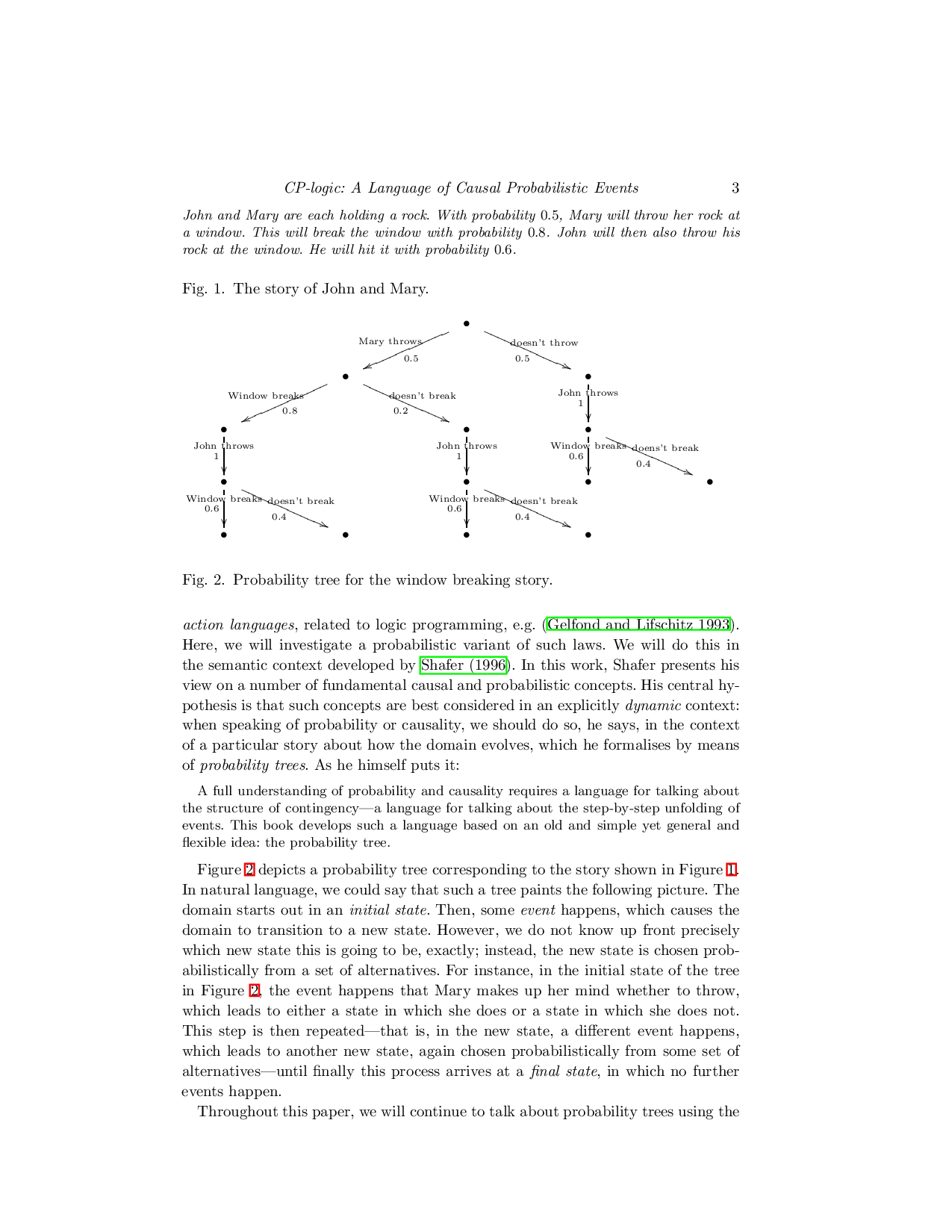
Fig. 2. Probability tree for the window breaking story.
action languages, related to logic programming, e.g. (Gelfond and Lifschitz 1993).
Here, we will investigate a probabilistic variant of such laws. We will do this in the semantic context developed by Shafer (1996). In this work, Shafer presents his view on a number of fundamental causal and probabilistic concepts. His central hypothesis is that such concepts are best considered in an explicitly dynamic context: when speaking of probability or causality, we should do so, he says, in the context of a particular story about how the domain evolves, which he formalises by means of probability trees. As he himself puts it:
A full understanding of probability and causality requires a language for talking about the structure of contingency-a language for talking about the step-by-step unfolding of events. This book develops such a language based on an old and simple yet general and flexible idea: the probability tree.
Figure 2 depicts a probability tree corresponding to the story shown in Figure 1. In natural language, we could say that such a tree paints the following picture. The domain starts out in an initial state. Then, some event happens, which causes the domain to transition to a new state. However, we do not know up front precisely which new state this is going to be, exactly; instead, the new state is chosen probabilistically from a set of alternatives. For instance, in the initial state of the tree in Figure 2, the event happens that Mary makes
…(Full text truncated)…
This content is AI-processed based on ArXiv data.