Varieties defined by natural transformations
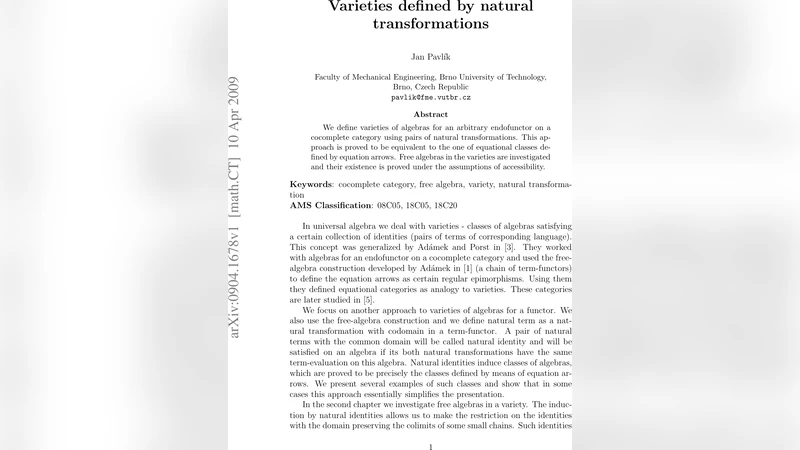
We define varieties of algebras for an arbitrary endofunctor on a cocomplete category using pairs of natural transformations. This approach is proved to be equivalent to the one of equational classes defined by equation arrows. Free algebras in the varieties are investigated and their existence is proved under the assumptions of accessibility.
💡 Research Summary
This paper revisits the notion of algebraic varieties from a categorical perspective, extending the classical equational approach to a setting where an arbitrary endofunctor F acts on a cocomplete category C. The authors introduce a new definition of a “variety” by means of a pair of natural transformations σ, τ : F → G (with G another endofunctor). An F‑algebra (A, α : F A → A) belongs to the variety precisely when the two induced morphisms G α ∘ σ_A and G α ∘ τ_A coincide. This condition captures the idea that the two natural transformations behave identically on the algebra, and it yields a full subcategory of the category of F‑algebras.
The central technical contribution is a proof that this natural‑transformation‑based definition is equivalent to the traditional definition of an equational class via equation arrows. By constructing a bijective correspondence between pairs (σ, τ) and families of equation arrows e : F X → Y, the authors show that both approaches generate exactly the same subcategory of F‑algebras. The proof relies on standard categorical tools: the formation of congruences, quotients, and the universal property of free algebras.
Having established the equivalence, the paper turns to the existence of free algebras within such varieties. The authors assume that the endofunctor F is λ‑accessible (i.e., it preserves λ‑directed colimits for some regular cardinal λ) and that the ambient category C is cocomplete. Under these hypotheses they construct free algebras as follows: first, for each λ‑small object K they build the free F‑algebra (F K, μ_K). Then they impose the variety’s equations by factoring through a representable congruence that forces σ and τ to agree on the algebra. Finally, they take the λ‑directed colimit of these quotiented free algebras, obtaining a free object in the variety. This construction demonstrates that, whenever F is accessible and C has the required colimits, every variety defined by natural transformations admits free algebras.
The paper illustrates the theory with concrete examples. In the category of sets, the list functor L yields the familiar variety of monoids when σ and τ encode the associativity and unit equations; the free monoid obtained by the construction coincides with the classical free monoid on a set. In the category of directed graphs, a suitable pair of natural transformations defines a variety of “graph algebras,” and the free graph algebra is built by the same colimit process.
Compared with earlier work that treats varieties mainly through signatures and equations or via monads, this approach foregrounds natural transformations as the primary syntactic device. This shift allows one to treat any endofunctor, not only those arising from algebraic signatures, and to work directly with the categorical structure of F. Moreover, the explicit use of accessibility conditions clarifies exactly when free objects exist, a point that is often left implicit in traditional treatments.
In conclusion, the authors provide a robust categorical framework that unifies the equational and natural‑transformation perspectives on varieties, and they give a general existence theorem for free algebras under accessible‑functor assumptions. The results open avenues for further research, such as extending the theory to non‑cocomplete settings, exploring higher‑dimensional monads, and applying the framework to logical model theory and computer‑science semantics.
Comments & Academic Discussion
Loading comments...
Leave a Comment