Mathematical and Statistical Opportunities in Cyber Security
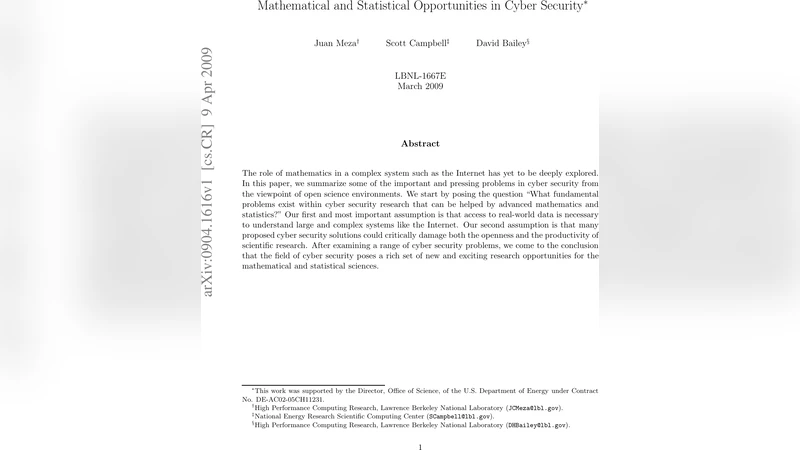
The role of mathematics in a complex system such as the Internet has yet to be deeply explored. In this paper, we summarize some of the important and pressing problems in cyber security from the viewpoint of open science environments. We start by posing the question “What fundamental problems exist within cyber security research that can be helped by advanced mathematics and statistics?” Our first and most important assumption is that access to real-world data is necessary to understand large and complex systems like the Internet. Our second assumption is that many proposed cyber security solutions could critically damage both the openness and the productivity of scientific research. After examining a range of cyber security problems, we come to the conclusion that the field of cyber security poses a rich set of new and exciting research opportunities for the mathematical and statistical sciences.
💡 Research Summary
The paper “Mathematical and Statistical Opportunities in Cyber Security” surveys the landscape of cyber‑security research through the lens of open‑science and highlights how advanced mathematics and statistics can address its most pressing challenges. It begins by stating two foundational assumptions: (1) access to real‑world data—traffic logs, intrusion records, user behavior traces—is indispensable for building models that faithfully represent the Internet’s massive, dynamic topology; and (2) many existing security solutions, if implemented without transparency, risk undermining the openness and collaborative productivity that scientific research depends on.
From these premises the authors identify a set of research directions where mathematical rigor can make a decisive impact. First, probabilistic graph models and Bayesian networks are advocated for real‑time inference of traffic flows and attack propagation, allowing uncertainty to be quantified and hidden variables (e.g., attacker intent) to be estimated. Second, high‑dimensional statistical techniques—including sparsity‑inducing regularization (LASSO, Elastic Net) and modern dimensionality‑reduction tools such as t‑SNE, UMAP, and PCA—are proposed to extract salient patterns from massive log datasets while suppressing noise, thereby improving anomaly‑detection accuracy and reducing false‑positive rates.
Third, the paper argues that the attacker‑defender interaction should be framed as a strategic game. By combining Stackelberg‑type game theory with reinforcement‑learning agents, adaptive defense policies can be learned that respond dynamically to evolving attack strategies, while simultaneously providing a testbed for evaluating offensive tactics. Fourth, the authors discuss the privacy‑utility trade‑off inherent in sharing security data. Differential privacy mechanisms and information‑theoretic measures (entropy, mutual information) are presented as quantitative tools for designing data‑sharing policies that protect individual privacy without crippling the statistical power needed for research.
Beyond methodological proposals, the paper stresses the necessity of open, reproducible research infrastructures. It recommends blockchain‑based integrity verification, publicly released benchmark suites (e.g., ATT&CK matrices, OpenCTI datasets), and standardized APIs that enable seamless data exchange across institutions. Such infrastructure would preserve scientific openness while still allowing security practitioners to test and validate new algorithms on realistic data.
In its conclusion, the authors reiterate that cyber security is fundamentally a complex‑systems problem. Consequently, the convergence of classical mathematical disciplines—probability, statistics, optimization, game theory—with contemporary data‑science techniques—machine learning, reinforcement learning, privacy‑preserving analytics—offers a fertile ground for novel, high‑impact research. By leveraging these tools, the community can move from reactive, signature‑based defenses toward proactive, mathematically grounded strategies that anticipate threats, adapt in real time, and do so without sacrificing the collaborative ethos of open science.
Comments & Academic Discussion
Loading comments...
Leave a Comment