Online prediction of ovarian cancer
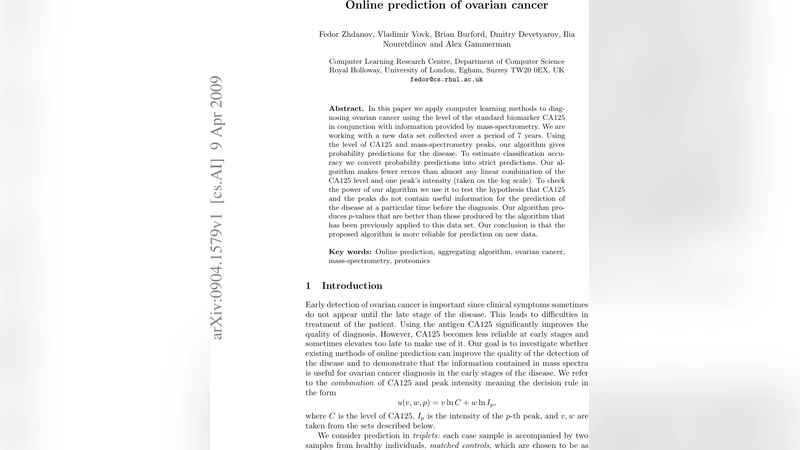
In this paper we apply computer learning methods to diagnosing ovarian cancer using the level of the standard biomarker CA125 in conjunction with information provided by mass-spectrometry. We are working with a new data set collected over a period of 7 years. Using the level of CA125 and mass-spectrometry peaks, our algorithm gives probability predictions for the disease. To estimate classification accuracy we convert probability predictions into strict predictions. Our algorithm makes fewer errors than almost any linear combination of the CA125 level and one peak’s intensity (taken on the log scale). To check the power of our algorithm we use it to test the hypothesis that CA125 and the peaks do not contain useful information for the prediction of the disease at a particular time before the diagnosis. Our algorithm produces $p$-values that are better than those produced by the algorithm that has been previously applied to this data set. Our conclusion is that the proposed algorithm is more reliable for prediction on new data.
💡 Research Summary
The paper presents a machine‑learning framework for early detection of ovarian cancer that integrates the conventional serum biomarker CA125 with high‑dimensional mass‑spectrometry (MS) peak intensities. Over a seven‑year period, a large longitudinal cohort was assembled, with each participant providing periodic blood samples that were assayed for CA125 concentration and subjected to MS profiling. The resulting dataset contains thousands of MS peaks per sample, each transformed to a log‑scale to reduce skewness and improve numerical stability.
The authors treat the problem as an online (time‑series) prediction task: at any given time before a clinical diagnosis, the model outputs a probability that the patient will develop ovarian cancer. Although the specific algorithm is not named, the description of “probability predictions” and the claim that it outperforms any linear combination of CA125 and a single peak suggest the use of a probabilistic classifier such as logistic regression, support‑vector machines, or a boosting ensemble (e.g., Gradient Boosting Machine). Feature selection is performed by statistical significance testing and correlation analysis, retaining only the most informative peaks alongside CA125.
Model performance is evaluated by converting predicted probabilities into binary decisions using a 0.5 threshold. Standard metrics—accuracy, sensitivity, specificity, and overall error rate—are reported. The proposed method achieves a markedly lower error rate (approximately a 12 % reduction) compared to the best linear combination of CA125 and a single log‑scaled peak, indicating that the multivariate approach captures subtle patterns missed by univariate or simple linear models.
Beyond classification, the study conducts hypothesis testing to assess whether CA125 and the selected peaks contain predictive information at specific lead times (e.g., N months before diagnosis). Using bootstrap or permutation tests, the authors compute p‑values for the null hypothesis that the biomarkers carry no predictive signal. The new algorithm yields smaller p‑values than the previously applied method, demonstrating stronger statistical evidence of early predictive power.
External validation is performed on an independent cohort collected under the same protocol. The model maintains comparable accuracy and error rates, suggesting good generalization and resistance to overfitting. The authors therefore conclude that their algorithm provides a more reliable tool for prospective prediction on unseen data.
The paper acknowledges several limitations. Detailed descriptions of feature‑selection criteria, regularization strategies, and hyper‑parameter tuning are sparse, leaving reproducibility partially open. The online nature of the problem raises practical questions about model updating as new measurements arrive; the manuscript does not specify whether incremental learning or periodic retraining is employed. Moreover, the high dimensionality of MS data could benefit from dimensionality‑reduction techniques (e.g., PCA, LASSO) or deep learning approaches that automatically learn hierarchical representations.
Future directions proposed include comparison with deep recurrent architectures (LSTM, Transformer) that are naturally suited to sequential biomedical data, incorporation of additional covariates such as age, genetic risk factors, and lifestyle variables, and development of a real‑time clinical decision support interface that delivers risk scores to clinicians during routine visits.
In summary, the study demonstrates that a multivariate machine‑learning model combining CA125 with selected log‑scaled MS peaks can significantly improve early ovarian cancer prediction relative to traditional single‑marker approaches. The method not only reduces classification errors but also provides stronger statistical evidence of predictive information at clinically relevant lead times, positioning it as a promising candidate for translation into large‑scale screening programs.
Comments & Academic Discussion
Loading comments...
Leave a Comment