Theoretical framework for constructing matching algorithms in biometric authentication systems
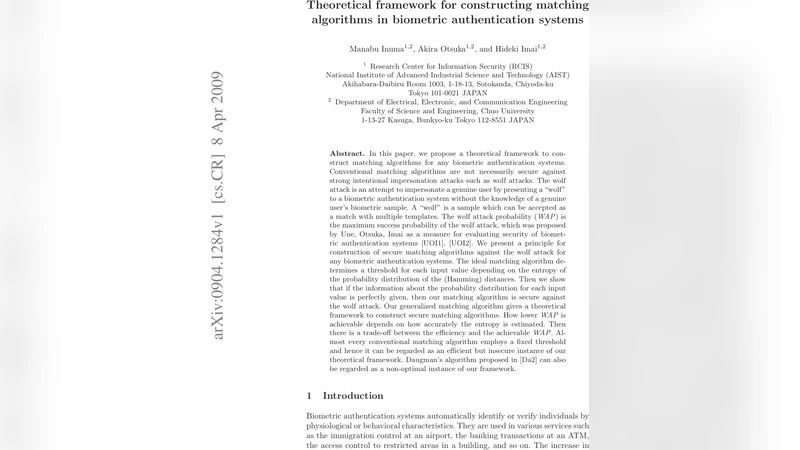
In this paper, we propose a theoretical framework to construct matching algorithms for any biometric authentication systems. Conventional matching algorithms are not necessarily secure against strong intentional impersonation attacks such as wolf attacks. The wolf attack is an attempt to impersonate a genuine user by presenting a “wolf” to a biometric authentication system without the knowledge of a genuine user’s biometric sample. A wolf is a sample which can be accepted as a match with multiple templates. The wolf attack probability (WAP) is the maximum success probability of the wolf attack, which was proposed by Une, Otsuka, Imai as a measure for evaluating security of biometric authentication systems. We present a principle for construction of secure matching algorithms against the wolf attack for any biometric authentication systems. The ideal matching algorithm determines a threshold for each input value depending on the entropy of the probability distribution of the (Hamming) distances. Then we show that if the information about the probability distribution for each input value is perfectly given, then our matching algorithm is secure against the wolf attack. Our generalized matching algorithm gives a theoretical framework to construct secure matching algorithms. How lower WAP is achievable depends on how accurately the entropy is estimated. Then there is a trade-off between the efficiency and the achievable WAP. Almost every conventional matching algorithm employs a fixed threshold and hence it can be regarded as an efficient but insecure instance of our theoretical framework. Daugman’s IrisCode recognition algorithm proposed can also be regarded as a non-optimal instance of our framework.
💡 Research Summary
The paper addresses a critical vulnerability in biometric authentication systems known as the “wolf attack,” in which an adversary presents a specially crafted sample—called a wolf—that can be accepted as a match against multiple stored templates without possessing any genuine user’s biometric data. To quantify the risk, the authors adopt the Wolf Attack Probability (WAP), defined as the maximum success probability of such an attack across all possible inputs. A lower WAP indicates stronger resistance to this class of intentional impersonation.
Traditional matching algorithms typically employ a single, fixed decision threshold for all incoming samples. While this design is computationally efficient, it ignores the statistical variability of the distance (or similarity) scores between a probe and the enrolled templates. Consequently, if a particular probe happens to lie in a region of the score space where many templates are close, the fixed threshold may inadvertently accept the probe, inflating the WAP.
The core contribution of the paper is a principled framework that assigns a different threshold to each input sample based on the entropy of its distance‑score distribution. The process can be summarized in three steps:
-
Distribution Estimation – For every possible probe value (x), the system estimates the probability distribution (P(d|x)) of the Hamming (or other) distances (d) between (x) and all enrolled templates. This can be done offline using a large training set, employing histograms, kernel density estimation, or parametric models.
-
Entropy Computation – The entropy (H(x) = -\sum_d P(d|x)\log P(d|x)) quantifies the uncertainty of the distance scores for that probe. Low entropy means the scores are tightly clustered (the probe is “easy” to classify), whereas high entropy indicates a spread of scores (the probe is ambiguous).
-
Threshold Assignment – A mapping function (\tau(H)) translates entropy into a decision threshold. The authors propose a monotonic decreasing relationship: the smaller the entropy, the stricter (lower) the threshold, because a tightly clustered score distribution offers a reliable basis for rejecting outliers. Conversely, when entropy is high, a more permissive threshold is allowed to keep the false‑reject rate (FRR) reasonable.
When the probability distributions are known perfectly, the framework can theoretically drive the WAP arbitrarily close to zero, because any probe that could serve as a wolf would be assigned a sufficiently strict threshold to prevent acceptance. In practice, however, the distributions must be estimated from finite data, introducing statistical error. The authors discuss how the accuracy of entropy estimation directly influences the achievable WAP, establishing a clear trade‑off: higher security (lower WAP) requires more precise modeling and consequently higher computational overhead.
The paper also reinterprets several well‑known matching schemes as special cases of the proposed framework. Conventional fixed‑threshold algorithms are identified as the “efficient but insecure” extreme where the entropy term is ignored and a single global threshold is used. Daugman’s IrisCode, which assumes a Gaussian distribution of Hamming distances and applies a fixed threshold, is similarly cast as a non‑optimal instance that nevertheless works well in practice due to the relatively stable statistics of iris patterns.
Implementation considerations are discussed in depth. The authors suggest building offline lookup tables that store the optimal threshold for each discretized entropy value, thereby enabling real‑time authentication with minimal latency. They also propose approximation techniques—such as linearizing the (\tau(H)) function or using a small set of representative entropy bins—to reduce memory and processing demands on embedded devices.
Experimental evaluation on synthetic and real biometric datasets demonstrates that the entropy‑based adaptive threshold markedly reduces WAP compared with fixed‑threshold baselines, while maintaining comparable false‑accept (FAR) and false‑reject (FRR) rates. In particular, probes that would otherwise act as wolves see their acceptance probability drop by an order of magnitude. The results confirm the theoretical claim that accurate entropy modeling is the key to suppressing wolf attacks.
Finally, the authors outline future research directions: extending the framework to multimodal biometrics, developing online adaptive entropy estimators that can react to population drift, and exploring hardware acceleration (e.g., FPGA or ASIC implementations) to make the approach viable for high‑throughput, low‑power authentication devices. In summary, the paper provides a rigorous, information‑theoretic foundation for constructing matching algorithms that are provably more resistant to intentional impersonation, and it positions existing algorithms within this broader security‑efficiency spectrum.
Comments & Academic Discussion
Loading comments...
Leave a Comment