Weak extension theorem for measure-preserving homeomorphisms of noncompact manifolds
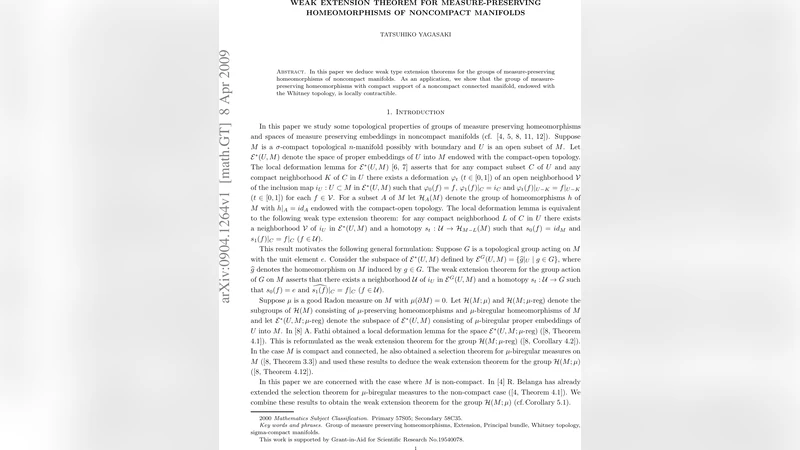
In this paper we introduce a general notion of weak extension property for embeddings induced by a group actions. As an example, for the group H(M, m) of measure-preserving homeomorphisms of a noncompact manifold M, we deduce weak type extension theorems, and as an application we exhibit the local contractibility of the group H_c(M, m) of measure-preserving homeomorphisms with compact support of a noncompact connected manifold M endowed with the Whitney topology.
💡 Research Summary
The paper introduces a new concept called the weak extension property (WEP) for embeddings that arise from group actions, and then applies this framework to the group of measure‑preserving homeomorphisms on a non‑compact manifold. Let (M) be a non‑compact smooth manifold equipped with a complete Borel measure (m). The group (H(M,m)) consists of all homeomorphisms of (M) that preserve (m); it is endowed with the Whitney (C^{0}) topology, which requires uniform convergence on compact subsets rather than merely pointwise convergence.
The first major result, the Weak Extension Theorem for (H(M,m)), asserts that if a compact subset (A\subset M) and a measure‑preserving embedding (f\colon A\to M) are given, then there exists a continuous map (\Phi) defined on a small (C^{0})‑neighbourhood of (f) in the space of embeddings such that each (\Phi(g)) is a global element of (H(M,m)) extending (g) from (A) to the whole manifold. The proof proceeds in three stages. (1) A variant of Moser’s trick is used to adjust the embedding so that it exactly preserves the measure while staying arbitrarily close to the original map. (2) An isotopy extension theorem supplies a global isotopy on (M) that coincides with the adjusted embedding on (A). (3) Careful control of the Whitney topology guarantees that the resulting extension depends continuously on the original embedding.
Having established WEP, the authors turn to the subgroup (H_{c}(M,m)) of homeomorphisms with compact support. The second principal theorem proves that (H_{c}(M,m)) is locally contractible in the Whitney topology. For any open neighbourhood (U) of the identity in (H_{c}(M,m)), they construct a homotopy (H\colon U\times
Comments & Academic Discussion
Loading comments...
Leave a Comment