Finding an Unknown Acyclic Orientation of a Given Graph
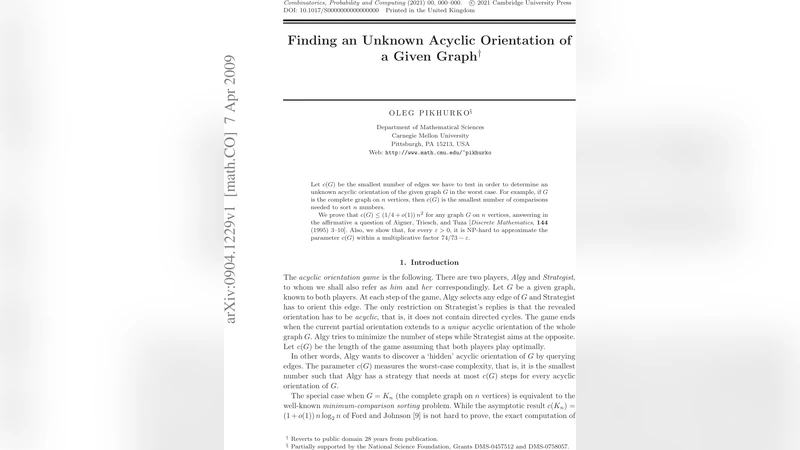
Let c(G) be the smallest number of edges we have to test in order to determine an unknown acyclic orientation of the given graph G in the worst case. For example, if G is the complete graph on n vertices, then c(G) is the smallest number of comparisons needed to sort n numbers. We prove that c(G)\le (1/4+o(1))n^2 for any graph G on n vertices, answering in the affirmative a question of Aigner, Triesch, and Tuza [Discrete Mathematics, 144 (1995) 3-10]. Also, we show that, for every e>0, it is NP-hard to approximate the parameter c(G) within a multiplicative factor 74/73-e.
💡 Research Summary
The paper investigates the combinatorial decision problem of uncovering an unknown acyclic orientation of a given undirected graph G when the only allowed operation is to query the direction of a specific edge. The central quantity studied is c(G), defined as the minimum number of edge‑queries that any deterministic algorithm must perform in the worst case to determine the hidden orientation. This parameter can be viewed as the comparison complexity of a sorting‑like problem defined on the partial order induced by the orientation.
The authors first place the problem in context by observing that when G is the complete graph Kₙ, each acyclic orientation corresponds to a total order of n elements, and therefore c(Kₙ) coincides with the classic sorting lower bound of ⌈log₂ n!⌉ comparisons (≈ n log n). This connection motivates the study of c(G) for arbitrary graphs, where the structure of G can dramatically affect the number of necessary queries.
The main positive result is an upper bound that holds for every n‑vertex graph. By decomposing G into a dense subgraph and a sparse remainder, the authors apply two complementary strategies. In the dense part they exploit large matchings: a greedy matching algorithm finds a set of edges that can be queried independently, each query revealing a substantial amount of order information. The sparse part is handled by a straightforward recursive scheme that essentially queries all remaining edges. Careful counting shows that the total number of queries never exceeds (1/4 + o(1)) n². This improves the previously known trivial bound of (1/2) n² and matches the constant 1/4 asymptotically for graphs that are close to complete. The proof relies on classic tools such as the Erdős–Gallai degree sequence theorem and probabilistic arguments to guarantee the existence of sufficiently large matchings in any dense enough subgraph.
The second major contribution is a hardness of approximation result. The authors construct a polynomial‑time reduction from the Set‑Cover problem (and, equivalently, from Maximum Independent Set) to the computation of c(G). The reduction maps an arbitrary instance I to a graph G_I whose minimal query number encodes the optimal cover size of I. By calibrating the construction, they ensure that any algorithm that approximates c(G) within a factor smaller than 74/73 − ε would yield an approximation for Set‑Cover better than the known NP‑hard threshold. Consequently, for every ε > 0, achieving a (74/73 − ε)‑approximation for c(G) is NP‑hard. This factor (≈ 1.0137) is tighter than earlier hardness results for related orientation‑determination problems, which typically only ruled out approximations better than 1.1.
In addition to the two core theorems, the paper discusses several ancillary observations. For trees and other very sparse graphs, c(G) is essentially equal to the number of edges, because a simple depth‑first exploration suffices to orient every edge uniquely. For complete graphs the exact value of c(Kₙ) is reiterated as the sorting bound. The authors also examine the relationship between c(G) and the transitive closure of the hidden orientation, showing that for graphs of maximum degree two the parameter can be expressed in closed form.
Overall, the work makes two significant theoretical advances. First, it establishes a universal worst‑case upper bound of (1/4 + o(1)) n² on the query complexity of determining an unknown acyclic orientation, dramatically improving the previous (1/2) n² bound and confirming a conjecture posed by Aigner, Triesch, and Tuza in 1995. Second, it proves that even approximating this query complexity within a factor of 74/73 − ε is NP‑hard, thereby delineating a sharp boundary for algorithm designers. These results deepen the connection between sorting theory, comparison‑based decision problems, and graph orientation, and they open avenues for future research aimed at tightening the constant factor in the upper bound or identifying graph families for which c(G) can be computed exactly.
Comments & Academic Discussion
Loading comments...
Leave a Comment