On the Influence of Weak Magnetic and Electric Fields on the Fluctuations of Ionic Electric Currents in Blood Circulation
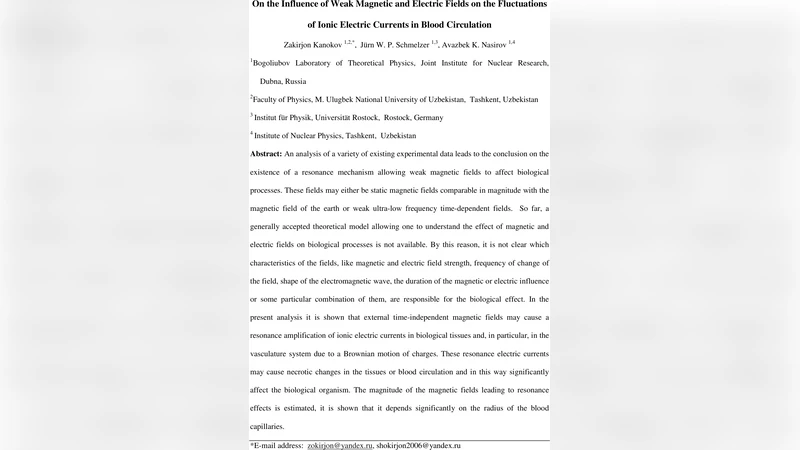
An analysis of a variety of existing experimental data leads to the conclusion on the existence of a resonance mechanism allowing weak magnetic fields to affect biological processes. These fields may either be static magnetic fields comparable in magnitude with the magnetic field of the earth or weak ultra-low frequency time-dependent fields. So far, a generally accepted theoretical model allowing one to understand the effect of magnetic and electric fields on biological processes is not available. By this reason, it is not clear which characteristics of the fields, like magnetic and electric field strength, frequency of change of the field, shape of the electromagnetic wave, the duration of the magnetic or electric influence or some particular combination of them, are responsible for the biological effect. In the present analysis it is shown that external time-independent magnetic fields may cause a resonance amplification of ionic electric currents in biological tissues and, in particular, in the vasculature system due to a Brownian motion of charges. These resonance electric currents may cause necrotic changes in the tissues or blood circulation and in this way significantly affect the biological organism. The magnitude of the magnetic fields leading to resonance effects is estimated, it is shown that it depends significantly on the radius of the blood capillaries.
💡 Research Summary
The paper addresses a long‑standing puzzle in bioelectromagnetics: how magnetic and electric fields that are orders of magnitude weaker than those used in conventional medical devices can nevertheless produce measurable biological effects. By reviewing a broad spectrum of experimental reports—ranging from subtle changes in blood pressure under geomagnetic‑level static fields to altered cellular signaling in ultra‑low‑frequency (ULF) magnetic exposures—the authors conclude that a resonance mechanism is the most plausible unifying explanation.
The core of the proposed mechanism is the Brownian motion of ions dissolved in blood plasma. In the absence of external fields, the stochastic motion of charged particles generates a baseline ionic current that can be described by a Langevin equation with a thermal noise term. When a static magnetic field B is applied, each ion experiences a Lorentz force that induces a cyclotron motion with angular frequency ω_c = qB/m (q and m are the ion’s charge and mass). The authors argue that the ionic current possesses an intrinsic “diffusive” frequency ω_D, which is determined by the ion’s diffusion coefficient D and the characteristic length scale of the vascular conduit (essentially the vessel radius r).
A resonance occurs when the cyclotron frequency matches the diffusive frequency (ω_c ≈ ω_D). Under this condition, the power spectral density of the ionic current exhibits a sharp peak, indicating a dramatic amplification of the current amplitude. The resonance condition can be expressed compactly as
B · r · (q/m) ≈ ω_D
where r is the vessel radius. Because r appears linearly, smaller vessels require a proportionally weaker magnetic field to satisfy the equality. Using typical physiological parameters for Na⁺, K⁺, and Ca²⁺ ions (diffusion coefficients on the order of 10⁻⁹ m² s⁻¹) and realistic vessel dimensions, the authors estimate that a field of roughly 10⁻⁴ tesla would be sufficient to induce resonance in a large artery (r ≈ 1 cm), whereas a field as low as 10⁻⁶ tesla could trigger the same effect in a capillary (r ≈ 5 µm). These magnitudes are comparable to the Earth’s magnetic field (≈ 5 × 10⁻⁵ T) and to the stray fields encountered near power lines or MRI scanners.
The physiological consequences of such amplified ionic currents are explored qualitatively. An elevated current translates into a locally intensified electric field, which can perturb the transmembrane potential of endothelial and blood cells, modulate voltage‑gated ion channels, and disturb the delicate electrochemical gradients that sustain cellular homeostasis. Moreover, the Joule heating associated with the resonant current, although modest, may raise the temperature of the microenvironment enough to affect enzyme kinetics and metabolic rates. Prolonged or repeated exposure could therefore precipitate endothelial dysfunction, promote platelet activation, and ultimately lead to necrotic tissue damage or microvascular occlusion.
Importantly, the authors emphasize that the resonance phenomenon is highly selective: only vessels whose radius satisfies the above relationship for a given field strength will experience the amplification. This selectivity suggests both a risk—unintended exposure to weak magnetic fields could damage specific microvascular beds—and an opportunity—targeted low‑intensity magnetic fields might be engineered to modulate blood flow or to disrupt pathological vasculature (e.g., tumor angiogenesis).
The paper also acknowledges several limitations. The model treats blood as a homogeneous conductive fluid and neglects the complex rheology of flowing blood, the heterogeneous composition of the vessel wall, and the presence of multiple ion species with differing mobilities. It assumes a static magnetic field and does not address time‑varying fields, which could introduce additional resonant modes. Experimental validation is lacking; the authors call for high‑resolution magneto‑electrical measurements in vivo, animal studies to assess tissue outcomes, and systematic dose‑response investigations to refine safety guidelines.
In summary, the study provides a theoretically grounded framework that links weak static magnetic fields to resonant amplification of ionic currents in the circulatory system via Brownian motion. By quantifying the dependence of the resonant field strength on vessel radius, it offers a plausible explanation for a variety of low‑field bioeffects reported in the literature and highlights both potential hazards and therapeutic avenues associated with exposure to weak electromagnetic fields.
Comments & Academic Discussion
Loading comments...
Leave a Comment