Mental States as Macrostates Emerging from EEG Dynamics
Correlations between psychological and physiological phenomena form the basis for different medical and scientific disciplines, but the nature of this relation has not yet been fully understood. One conceptual option is to understand the mental as “emerging” from neural processes in the specific sense that psychology and physiology provide two different descriptions of the same system. Stating these descriptions in terms of coarser- and finer-grained system states (macro- and microstates), the two descriptions may be equally adequate if the coarse-graining preserves the possibility to obtain a dynamical rule for the system. To test the empirical viability of our approach, we describe an algorithm to obtain a specific form of such a coarse-graining from data, and illustrate its operation using a simulated dynamical system. We then apply the method to an electroencephalographic (EEG) recording, where we are able to identify macrostates from the physiological data that correspond to mental states of the subject.
💡 Research Summary
The paper tackles the longstanding problem of how mental phenomena relate to underlying neural activity by framing the relationship in terms of macro‑ and micro‑states, a concept borrowed from statistical physics. Micro‑states are defined as the high‑dimensional vectors obtained from simultaneous EEG electrode recordings, capturing the fine‑grained electrical dynamics of the brain at each moment. Macro‑states, in contrast, are coarser descriptions that group together many micro‑states and are intended to correspond to psychologically meaningful mental states such as “eyes closed” or “eyes open.” The crucial theoretical requirement is that the coarse‑graining must preserve the system’s dynamics: when the micro‑state transition matrix (a Markov matrix estimated from observed state‑to‑state jumps) is aggregated according to the grouping, the resulting macro‑state transition matrix should remain Markovian and retain the original long‑term stationary distribution. In other words, the dynamical rule governing the system must be invariant under the chosen reduction.
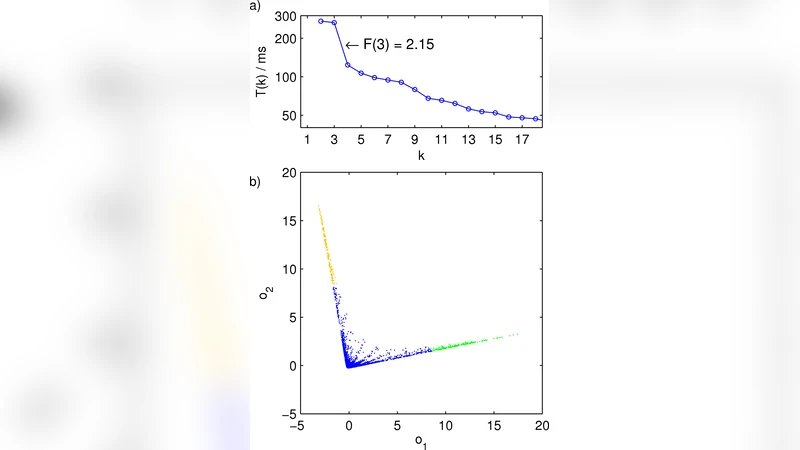
To operationalize this idea, the authors develop a four‑step algorithm. First, they reconstruct the state space from the EEG time series using time‑delay embedding, thereby creating a point cloud where each point represents a snapshot of the brain’s electrical configuration. Second, they discretize this space by counting transitions between points within a fixed temporal window, yielding an empirical transition matrix. Third, they perform a spectral analysis of this matrix; a pronounced gap between the leading eigenvalues indicates a natural number of metastable clusters. Fourth, they apply spectral clustering (based on the normalized graph Laplacian) to partition the micro‑states into a small set of clusters, each of which is declared a macro‑state. The authors verify that the macro‑state transition matrix derived from these clusters still satisfies the Markov property, confirming that the coarse‑graining has indeed preserved the dynamics.
The method’s validity is first demonstrated on a simulated dynamical system: a noisy Lorenz attractor with three well‑defined attractors. Applying the algorithm recovers exactly three macro‑states that align with the known attractors, and the macro‑state transition matrix reproduces the simulated switching behavior. This simulation establishes that the approach can uncover latent metastable structures even in the presence of stochastic perturbations.
The core empirical contribution comes from applying the pipeline to a real EEG recording from a single subject performing a simple vigilance task (alternating periods of eyes‑closed and eyes‑open). After standard preprocessing (band‑pass filtering, artifact rejection, and channel normalization), the multichannel data are concatenated into a 19‑dimensional vector at each time point. The algorithm identifies two robust macro‑states. Inspection of the temporal labeling shows that one macro‑state dominates during eyes‑closed intervals while the other dominates during eyes‑open intervals. Transition probabilities computed from the macro‑state matrix reveal a high likelihood of moving from the “closed” to the “open” state at the cue, with a comparatively lower reverse transition, matching the experimental design. Within each macro‑state, transitions are approximately uniform, supporting the Markov assumption.
The authors discuss several limitations. The determination of the number of macro‑states hinges on the presence of a clear eigenvalue gap, which may be absent in shorter or noisier recordings. EEG’s intrinsic non‑linearity, volume conduction, and inter‑channel correlations can bias transition estimates, suggesting that more sophisticated state‑space discretization or regularization may be needed. The current study is limited to a single subject and a single binary task; extending the method to richer cognitive or affective paradigms, as well as to group‑level analyses, is essential for assessing generality. Finally, the paper proposes future integration with Bayesian hierarchical models or information‑theoretic measures to quantitatively link macro‑states with psychometric labels (e.g., specific emotions, levels of consciousness).
In sum, the work provides a concrete, data‑driven framework for deriving psychologically relevant macro‑states directly from electrophysiological dynamics while rigorously preserving the underlying transition structure. By demonstrating both simulated and real‑world success, it offers a promising bridge between neuroscience and psychology, opening avenues for more principled investigations of how mental states emerge from brain activity.
Comments & Academic Discussion
Loading comments...
Leave a Comment