The DNA Inequality in Non-Convex Regions
A simple plane closed curve $\Gamma$ satisfies the DNA Inequality if the average curvature of any closed curve contained inside $\Gamma$ exceeds the average curvature of $\Gamma$. In 1997 Lagarias and Richardson proved that all convex curves satisfy …
Authors: Eric Larson
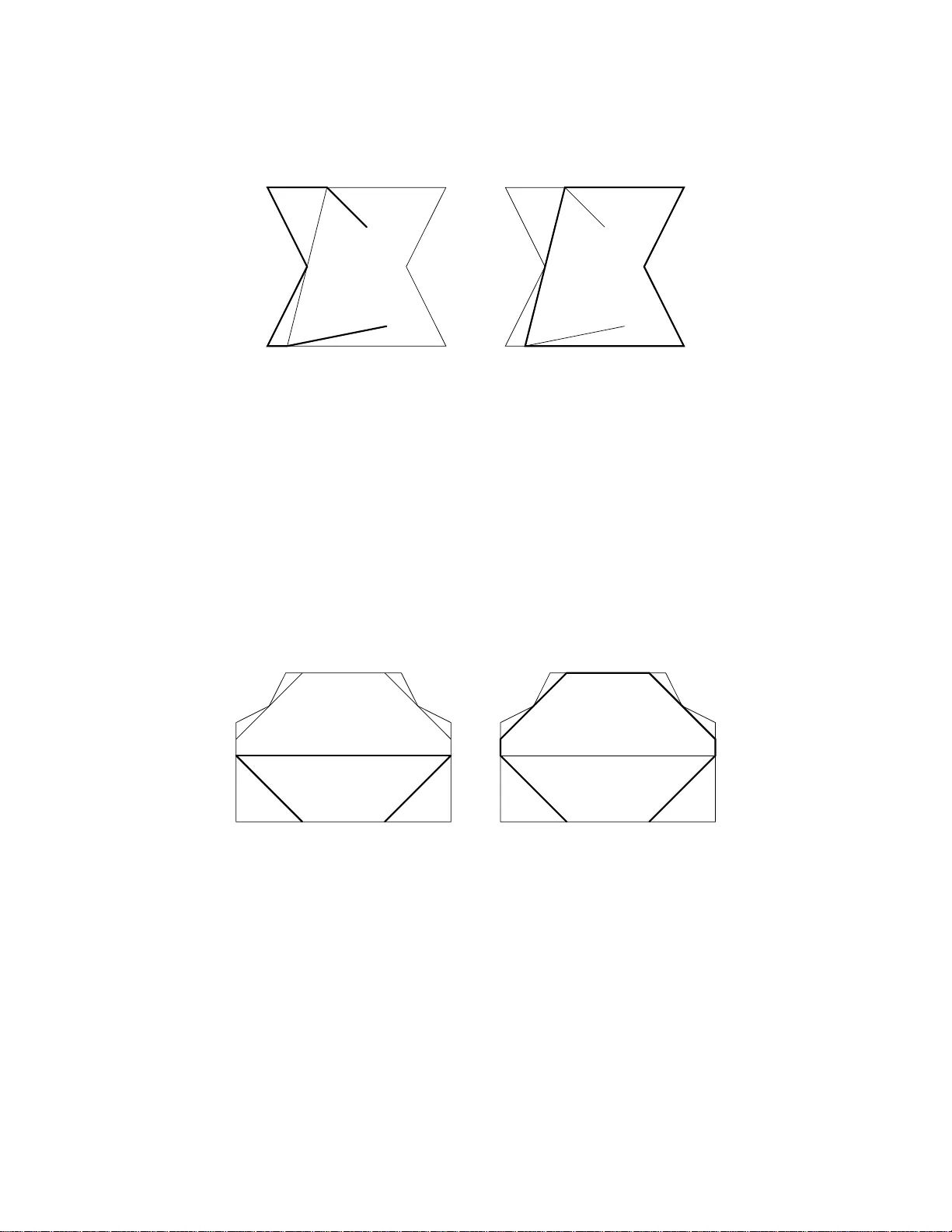
The DNA Inequalit y in Non-Con v ex Regions Eric Larson Abstract A simple plane closed curv e Γ sati sfies the DNA Ine quality if the a v erage curv a ture of an y closed curve co n tained insid e Γ excee ds the av erage curv ature of Γ. In 1997 Lagarias an d Ric h ard son p ro ved that all con v ex curves satisfy the DNA Inequ alit y and ask ed whether this is tr ue for some n on-con vex curv e. They conjectured that the DNA Inequalit y holds for certain L-shap ed curves. In this p ap er, w e dispro ve this conjecture for all L-Shap es and c onstruct a large class of non-con vex curves for wh ic h the DNA Inequalit y holds. W e also giv e a p olynomial-time procedu re for determining whether an y sp ecific curve in a muc h larger class satisfies the DNA Inequ alit y . 1 In tro ducti o n A simple plane closed curv e Γ is said to satisfy the DNA Ine quality if the av erage curv ature (whic h is the inte gral of the absolute v alue of curv ature divided b y the p erimeter) of any closed curv e contained within t he region b ounded b y Γ exceeds the av erage curv ature of Γ. (It is called the “DNA Inequalit y” b ecause the picture is akin to a little piece of DNA inside of a cell.) In the fo llo wing, w e will refer to the o ut side closed curve Γ as the “cell,” and the inside closed curv e as the “D NA” (denoted γ ). All cells considered in this pap er will b e (non-self-in tersecting) closed p olygons, but the D NA closed curv es are allo w ed to ha ve self-inters ections. The DNA Ineq ualit y has b een pro ve n to hold for all con ve x cells; see [1, 2, 3]. On the second page of the pap er b y Lagar ia s and R ichardson [1] t ha t pro ved it for con vex cells, they ra ised the question whether the DNA Inequalit y might hold for some non- con ve x cells . In particular, they suggested that some L-shap ed regions migh t satisfy the D NA inequalit y . Here an L-shap ed region is a rectangle with a smaller rectangle remo ve d from one corner of it, cf. Section 2. The question of when the DNA inequalit y migh t hold for non- con vex cells is the fo cus of this pap er. W e obta in three main results, stated b elo w. In pa rticular, for 1 (a) A p o lygon which satisfies the DNA Inequality (b) A p olygo n which doe sn’t satisfy the DNA Inequality Figure 1: Some P olygons the p olygons pictured in Figure 1, o ur results imply that the L-shaped polygon 1( b) do es not satisfy the DNA inequalit y , ho we v er the non- con ve x quadrila t eral 1(a) do es satisfy the DNA inequalit y . Our first r esult is as follo ws. Theorem 1.1. (Th e or em 2.1.) The DNA ine quality is false for al l L-Shap es. This resu lt dispro v es the suggestion of Lagarias and Richarson [Conjecture p.2, 1]. This is shown in Section 2. Our second result is the main result of this paper. It show s tha t the DNA Inequalit y do es hold for a class of non-con ve x p olygonal cells. These a r e cells obtained from particular con ve x p olygons by putting an “isosceles den t” in a part icular one of its sides. Namely , take some con v ex p olygon P , and fix a side AB of that p o lygon. Construct a p oint X such that ∠ X AB = ∠ X B A = δ . In Figure 2 is pictured this construction when P is an isosceles right triang le, and AB is the h yp oten use. Definition 1.1. F or an y con v ex p olygon P with a fixed side AB , we denote the curv e whic h is created from P , replacing AB with the tw o segmen ts AX and X B , whic h is pictured in Figure 2 as the b old curv e, b y P δ . (Th us, P δ is an “isosceles den ting of P along AB .”) Given a conv ex p olygon P and an edge E , we call ( P , E ) a deformable DNA-p olygon (called a DDNA-p olygon for short) if there exists a δ 0 > 0 suc h that δ ≤ δ 0 implies that P δ satisfies the DNA Inequalit y . In this paper, w e both classify all D DNA-p olygo ns and create a p olynomial time al- gorithm for determining if a giv en curv e in a larger class satisfies the DNA Inequalit y . The follo wing result classifie s all DDNA-p olygons. 2 δ X δ A B Figure 2: Example of P δ Theorem 1.2. (The or em 8.1.) If P is a c onvex p ol ygon with p erimeter p and we ar e denting an e dge with length l , a nd α is the lar ger of the two angles that the e dge makes with the two a djac ent e dges, then P is a DDNA-p olygon (w ith r esp e ct to this e dge) if a nd only if : 2 p ≤ π l 1 + cos α sin α . R emark. In this pap er, w e assume for simplicity that the den t X AB is isosceles. The metho ds of this pap er can still b e applied if the triangle is not isosceles, or ev en if there are m ultiple den ts all dep ending on one pa r a meter δ , so long as adjacen t sides are no t den ted and there exists ǫ > 0, whic h do es not dep end on δ , suc h that an y t wo ve rtices of P δ are at least ǫ apart. Our third result is a lg orithmic, a nd applies to a class of non-con v ex p o lygons whic h w e term separable p olygons. T o define these, w e sa y that an interior vertex of a p olygon Γ is a ve rtex contained in the in terior of the con v ex h ull o f Γ. A se p ar able p olygon Γ is a p o lygon ha ving the prop erty that for an y p oint p in the interior of the cell determined b y Γ, but not a v ertex of Γ, there is at most one in terior v ertex v of Γ such that the straigh t line determined b y p and v in tersects Γ in more than t wo p oints. W e find a polynomial time algor it hm, whic h when given a (non-con v ex) separable p olygon determine s whether it satisfies the DNA Inequalit y . Theorem 1.3. (The or em 6.1 . ) Ther e exists an algorithm which when given as input a sep ar able p olygon Γ sp e cifie d by its n vertic es, determines whether or n ot Γ satisfies the DNA ine quality, in numb er of elementary op er ations p olynomial in n . W e analyze this algo r ithm using a simplified mo del of computation describ ed in Section 6, in whic h a n “elemen tary o p eration” is defined. In Section 2, we pro v e Theorem 1.1. In Section 3 , w e set up the notation that w e will use fo r the pro o f of Theorem 1 .2 , and giv e an o ut line of the pro of. In Section 4, we 3 pro ve some useful Lemmas that a pply to any cell. In Section 5, w e turn our attention to a sp ecial class of p olygons (whic h we term “separable p olygons”); we pro v e that the D NA Inequalit y holds in any separable p o lygon if and only if it holds for some sp ecific t yp es of DNA. In Section 6 , w e see that this pro duces a p olynomial- time algorithm to determine whether an y separable p olygon satisfies the DNA Inequ alit y (Theorem 1.3). In Section 7, w e determine, using the results from Section 5 as w ell as t he results of [1] and [2], what happ ens when w e ha v e a sequence of non-conv ex p olygons which approach a con vex one. Finally , in Section 8 we state and pro v e Theorem 1.2, and a corollary whic h gives some sufficien t and necessary conditions for a p olygo n to b e a DD NA-p olygon. Ac kno wledgemen t s. This researc h started a t the P enn State REU, su pp orted b y NSF Grant No. 0505 430. I w ould lik e to thank Misha Guysinsky and Serge T abac hniko v for bringing the this problem to m y atten tion, Ken R oss fo r helpful discussions and help editing this pap er, and the anon ymous r eferees for their useful critique and n umerous suggestions for improving the presen tatio n. 2 Dispro of of the DNA Inequalit y for L-Shap es Here, w e presen t the pro of of Theorem 1.1. Theorem 2.1. The DNA ine quality is false f o r al l L-Sha p es . Pr o of. W e pro ceed to construct a counte rexample to the DNA Inequalit y for any L-Shap e. Cho ose some sufficien tly small θ . (The size of θ is b ounded ab o v e by the dimensions of the L-Sha p e, but it will b e clear that some nonzero θ can alw a ys b e c ho- sen.) Construct p oints P ∈ ( A, B ) and Q ∈ ( C , D ) suc h tha t ∠ AY P = ∠ D Y Q = θ . W e consider the closed curv e A, P , Y , Q, D , Y , A . (see Figure 3) Its curv ature is clearly 3 π + 4 θ , and its p erimeter is clearly ( AY + Y D )( 1 + sec( θ ) + tan( θ )). The curv ature of the whole figure is 3 π , and the p erimeter is 2( AY + Y D ). Therefore, t o 4 Z A P B Q C D X Y θ θ Figure 3: Coun terexample for L-Shap es dispro ve the DNA Inequalit y , w e will sho w: 3 π + 4 θ ( AY + Y D )(1 + sec( θ ) + tan( θ ) ) < 3 π 2( AY + Y D ) ⇐ ⇒ 3 π + 4 θ 1 + sec( θ ) + tan( θ ) < 3 π 2 ⇐ = 3 π + 4 θ 2 + tan( θ ) < 3 π 2 ⇐ ⇒ 8 3 π < tan( θ ) θ T o v erify this, it suffices to note t ha t: 8 3 π < 1 ≤ tan( θ ) θ Th us, the DNA Inequalit y is false for all L-Shap es. R emark. Ev en if o ne w ere to require that the D NA w as not self-intersec ting, one could still construct a coun terexample by mo ving the ve rtex of t he curve that w e constructed ab ov e coinciding with Y , whic h o ccurs b et w een P and Q , a t in y bit to wards X . 5 3 Outline of th e Pro of of The o rem 1 . 2 The pro of of Th eorem 1.2 is quite in v olve d, and in the course of pro ving it w e establish Theorem 1.3. W e first set up some basic notation and then outline the pro of of Th eorem 1.2. T o pro ve the DNA Inequalit y for any curv e, it suffices to pro ve it for closed p olygonal lines. In this case , the integral of the absolute curv ature reduces to a sum of the exterior a ngles at t he vertice s (where the exterior ang les are measured so that they a r e in the in terv al [0 , π ]). F or an explanation of this reduction see [1], Section 2. (In particular, equ ation (2.3).) W e set our notation for polygo na l curv es. W e write γ for the closed p o lygonal “DNA.” W e denote the v ertex sequenc e of γ b y γ 0 , γ 1 , . . . , γ n = γ 0 , a nd the v ertex sequence of Γ by Γ 0 , Γ 1 , . . . , Γ m = Γ 0 . When w e refer to the num b er of v ertices of some polygon, w e shall mean the n um b er of v ertices with m ultiplicity , unless otherwise stated. W e consider indice s mo dulo n (mo dulo m for Γ), and assume that w e nev er hav e γ i , γ i +1 , γ i +2 collinear. (Under this assumption, the exterior angles are in the interv al (0 , π ].) Definition 3.1. W e define: f Γ ( γ ) = α · (curv ature of γ ) − (p erimeter of γ ) where 1 /α is the a v erage curv ature of Γ. Of course, Γ satisfies the DNA Inequalit y means that f Γ ( γ ) ≥ 0 for an y closed curv e γ con tained in Γ. Definition 3.2. W e t erm a closed p olygonal D NA γ contained within t he cell Γ with f Γ ( γ ) < 0 a C X Γ -p olygon. ( As it is a “coun terexample” to the DNA Inequalit y in Γ.) Definition 3.3. W e write d ( X , Y ) for the distance b et wee n X and Y , i.e. the length of the segmen t X Y . The notation X Y will usually refer to the line X Y , and o cca- sionally the ra y or segmen t if explic itly stated. Outline of Pro of of Theorem 1.2 Theorem 1.2 (Theorem 8.1 ) states that the dented p olygon describ ed there is a DDNA-p olygon if and only if the angle α is small. F or example, the isosceles triangle in Figure 2 is a DDNA-p olygon with r esp ect to its h yp oten use, but it is not a DDNA- p olygon with respect to its other sides. 6 Here is an ov erview of the pro o f of Theorem 8.1. A fundamen tal idea is that if Γ is a p olygon that do es not satisfy the DNA Inequalit y , then for any p olygonal DNA γ provid ing a coun terexample, w e can “simplify” it (using Lemmas 4.1 – 5.2) to obtain a special coun terexample. F o r DNA of this sp ecial t yp e, the v erification that the DNA Inequalit y fails or holds is m uc h easier. Lemmas 4.1 and 4.2 clarif y when w e can assume that the ve rtices of a coun terex- ample a r e on an edge of Γ o r ev en coincide with a ve rtex of Γ. If we could a ssume that a ll of the v ertices o f an y C X Γ -p olygon are v ertices of Γ, then the pro o f w ould b e relativ ely easy . Since w e cannot mak e this a ssumption, w e identify (Definition 5.2 ) manageable cells Γ, whic h w e call separable polygo ns, and a finite n um b er of useful p oin ts on the boundary of Γ that are not v ertices. Thes e p oints plus the v ertices of Γ f orm the finite set C of critical p oin ts. The tec hnical L emma 5.2 sho ws that w e ma y assume tha t the v ertices of our C X Γ -p olygon are all in the finite set C or else our C X Γ -p olygon has a sp ecial form in volvin g v ertices of Γ plus one or t wo other p o in ts on the b oundary of Γ. Th us Lemma 5.2 iden tifies sp ecial types of coun terexamples that any separable p olygon Γ, that do es not satisfy the DNA Inequalit y , mus t con tain. Similar to t he pro of of Theorem 5.1 from [1], w e do this by remo ving “jumps,” i.e. adjacen t pairs of v ertices suc h that the line segmen t connecting them is no t containe d in the b oundary of Γ. Suc h a line segmen t can in tersect the b oundary just at its endp oints, in whic h case it is termed a “jump”. (Since w e are trying to reduce to p olygo ns ha ving only critical v ertices, w e a lso require that at least one of the endp oin t s is not a critical p oint for it to be considered a jump.) How ev er, since the cell can b e non-conv ex, the interior of the line segmen t can in tersect the b oundary , in whic h case we call it a “leap”. The pro of of Lemma 5 .2 then pro ceeds b y des cen t: giv en a C X Γ -p olygon γ , w e construct a C X Γ -p olygon γ ′ whic h either has a smaller jump n um b er (this is the num b er of jumps, with jumps suc h that neither endp oint is a critical po in t double-coun ted), or the same jump n um b er and few er leaps. T o complete the pro o f of Lemma 5.2, w e again emplo y the metho d of descen t: w e sho w that giv en a C X Γ -p olygon γ with no jumps w e can construct another C X Γ -p olygon γ ′ ha ving no jumps and f ew er v ertices whic h are not critical p o in ts. Then, in Section 7 w e turn to the problem of determining if the DNA Inequalit y holds for o ur sp ecial ty p es of p olygons. If the D NA Inequalit y do es not hold for arbitrarily small dents of P , then w e ha v e a sequenc e P δ k of den ted p olygons, and a sequence of coun terexamples γ k , whic h w e ma y assume to b e of o ur sp ecial ty p e. The second fundamen tal idea is to observ e that all of these coun t erexamples hav e a b ounded num b er o f v ertices, and the set of all p olygons con tained in P with a b ounded n umber of v ertices is compact; therefore, our sequence of coun terexamples 7 has a limiting p oint, sa y γ . By studying whic h sequences can approach an equalit y case of the D NA Inequalit y (in Lemma 7.1), w e are able to sho w that infinitely many of the P δ k con tain coun terexamples of a v ery sp ecial type (whic h a re describ ed in Definition 7.2). P oten tial counterex amples of this t yp e are so sp ecial that it is easy to sp ecify an inequality tha t determines whether they are indeed coun terexamples, i.e., whether f Γ < 0. F r o m t hese inequalities, w e emplo y an analytic argumen t (in Section 8) t o ded uce Theorem 8.1. 4 Three Useful L e mmas In this section, w e give some useful mac hinery that will a pply in any ce ll Γ. Definition 4.1. W e mak e the follow ing imp ortant definitions concerning mo difica- tions to the DNA p olygon. • If replacing γ i with an y o t her po in t on the line γ i − 1 γ i sufficien tly close to γ i yields a curve contained within Γ, w e say tha t γ i is fr e e to move along the line γ i − 1 γ i . • If γ is a closed curv e suc h that, for all i , γ i is not f r ee to mo v e a lo ng γ i − 1 γ i or γ i γ i +1 , we say that γ is a 1-curve . Lemma 4.1. If γ is a close d curve wher e ther e ex i s ts i such that γ i is fr e e to move along lin e γ i − 1 γ i , then one c an always mo v e γ i one dir e ction along γ i − 1 γ i , d e cr e asing f Γ , until γ i b e c omes c ol line ar with γ i +1 , γ i +2 in that or der, or is no longer f r e e to move. If γ i is no l o nger fr e e to move, then one of the fol lowing o c curs: • γ i r e aches a vertex of Γ ; • γ i r e aches an e dge of Γ such that γ i − 1 do es not lie on the line c ontaining that e dge; • the line se gme n t γ i γ i +1 interse cts the b oundary at a p oin t o ther than γ i +1 or γ i . Pr o of. First note t ha t the bulleted items sim ply giv e a lis t of po ssibilities, suc h that it is necessary for one of them to hold if a v ertex is no longer free to mo v e. ( No t all of them are sufficien t.) W e distinguish 2 cases: 8 γ i − 1 γ i γ i +1 γ i +2 Figure 4: Diag ram for Case 1 Case 1: γ i − 1 and γ i +2 are on the same side of line γ i γ i +1 , a s pictured in Figure 4. Mo ving γ i along line γ i − 1 γ i in the direction that increases the distance to γ i − 1 increases the perimeter, but fixes the curv ature, therefore dec reasing f Γ . Case 2: The y are on differen t sides, as pictured in Figure 5. Let H b e the fo ot of the p erpendicular from γ i +1 to line γ i − 1 γ i . Define θ to b e angle ∠ H γ i +1 γ i . Let a b e the length of H γ i +1 . θ γ i − 1 γ i γ i +1 γ i +2 H a Figure 5: Diag ram for Case 2 W e will pro v e that d f Γ /dθ has at most one ro ot f o r θ ∈ ( − π / 2 , π / 2). 0 = f ′ Γ = α · d dθ (curv ature) − d dθ (p erimeter) = 2 α − d dθ ( a (sec( θ ) + tan( θ ))) = 2 α − a (1 + sin( θ )) cos 2 ( θ ) ⇐ ⇒ 1 + sin( θ ) cos 2 ( θ ) = 2 α a Therefore, it suffic es to sho w that d dθ ( 1+sin( θ ) cos 2 ( θ ) ) 6 = 0 on ( − π / 2 , π / 2). d dθ 1 + sin( θ ) cos 2 ( θ ) = (1 + sin( θ )) 2 cos 3 ( θ ) > 0 on ( − π / 2 , π / 2) . 9 No w, I claim that this finishes the pro of of this Lemma. T o see this, observ e that as θ → π / 2, w e ha ve f Γ → −∞ . Th us, as f ′ Γ has at most one ro ot on ( − π / 2 , π / 2), w e either hav e that f Γ is alw a ys decreasing, in which case we can mov e γ i to the righ t, or that there exists β ∈ ( − π / 2 , π / 2) suc h that f Γ is decreasing on ( β , π / 2), and increasing on ( − π / 2 , β ). In the lat ter case, w e can mo v e γ i to the r ig h t if θ > β and to the left if θ < β . Lemma 4.2. If γ is a C X Γ -p olygon, then ther e is a C X Γ -p olygon γ ′ which is a 1-curve. Pr o of. Assume there is some C X Γ -p olygon γ . Consider S = { γ ′ ∈ F Γ | l ( γ ′ ) ≤ l ( γ ) } , where F Γ is the set of all curv es contained within Γ, and l ( γ ) is the nu m b er of v ertices of γ . S is a non-empty (it contains γ ) compact set, a nd f Γ is a low er semi-con tinuous function, so there is some γ ′ ∈ S with f Γ ( γ ′ ) minimal. Now, as f Γ ( γ ′ ) ≤ f Γ ( γ ) < 0, γ ′ is a C X Γ -p olygon. But, if γ ′ w ere not a 1-curv e, then by Lemma 4.1, there w ould exist a γ ′′ with f Γ ( γ ′′ ) < f Γ ( γ ′ ), and this γ ′′ w ould b e in S because the pro of of Lemma 4.1 do es not add an y v ertices, providing a con tr a diction. Lemma 4.3. Write V γ for the set of vertic es o f γ . If f Γ ( γ ) < 0 f o r som e close d curve γ c ontaine d within Γ , then ther e is a curve γ ′ which sa tisfi e s V γ ′ ⊆ V γ , f Γ ( γ ′ ) < 0 , and has numb er of v e rtic es l e ss than or e qual to | V γ | 2 − | V γ | . Pr o of. It suffices to sho w that for any closed curv e γ with at least | V γ | 2 − | V γ | + 1 v ertices, w e can construct a curv e γ ′ whic h satisfies V γ ′ ⊆ V γ , f Γ ( γ ′ ) < 0 and has few er v ertices than γ . Suc h a curv e γ has a t least | V γ | 2 − | V γ | + 1 edges, coun ting m ultiplicit y . But, the n um b er of edges without m ultiplicit y is at most | V γ | 2 − | V γ | , if w e view our edges as directed. So b y the pigeonhole principle there is some directed edge re- p eated b y γ , i.e. there exists i and j with i < j suc h that γ i = γ j , γ i +1 = γ j +1 . No w, consider the t wo curv es γ 0 = γ 0 , γ 1 , . . . , γ i , γ j +1 , γ j +2 , . . . , γ n = γ 0 , and γ 1 = γ j , γ i +1 , γ i +2 , . . . , γ j − 1 , γ j = γ j , as pictured in Figure 6. W e ha v e f Γ ( γ 0 ) + f Γ ( γ 1 ) = f Γ ( γ ) < 0, so either γ 0 or γ 1 m ust satisfy the require- men ts ab ov e for γ ′ . 5 Separable P olygons This long section prov ides a detailed study of p ossible C X Γ -p olygons in a sp ecial class of cells, whic h we term separable po lygons. W e b egin with the definitions. 10 γ 1 = γ 4 γ 2 = γ 5 γ 3 γ 0 = γ 6 Figure 6: Picture for i = 1 , j = 4 Definition 5.1. A v ertex of a cell Γ is called an interior vertex if it is con tained in the in terior of the conv ex h ull of Γ. Definition 5.2. A p olygon Γ is called sep ar able if for an y p oint p in the in terior of the cell determined b y Γ, but not a v ertex of Γ, there is at most one in terior v ertex v of Γ such that the straigh t line determined b y p and v in tersects Γ in more than t wo p oin ts. Some examples of separable and non- separable p olygons ar e g iv en in Figure 7. Separable P olygons Non-Separable P olygons Figure 7: Examples of Separable a nd Non-Separable P olygons 11 Corollary to Lemma 4.2. In a sep ar able p olygon Γ , if we assume that we h a ve a C X Γ -p olygon, then we h a ve a C X Γ -p olygon, al l of w hose vertic es lie on the b oundary. Pr o of. An y v ertex in the in terior of a separable p o lygon is free to mo ve, along at least one of the t w o p ossible lines. Therefore, b y Lemma 4.2, w e ma y a ssume that w e hav e a C X Γ -p olygon, all of whose v ertices lie on the b oundary . Definition 5.3. The set of critic al p oints C is the set of all ve rtices of Γ plus any p oin t p in the in terior of an y edge of Γ whic h is collinear with tw o v ertices of Γ, ( v , w ), whic h are distinct fro m eac h other and the endp oin ts of the edge of Γ up on whic h p lies. Additionally , w e require tha t t he line segmen ts connecting pv , pw are con tained within Γ, and that p is not free to mo ve a lo ng the line pv (equiv alently pw , as p, v , w are collinear). F ig ure 8 giv es an example of a non- con ve x p en ta gon with 9 critical po in ts. p v w Figure 8: Examples of Critical Poin ts Lemma 5.1. | C | ≤ n 2 . Pr o of. Consider a non-v ertex critical p oin t p whic h is collinear with distinct v ertices v , w . Since pv , pw are containe d in Γ, so is v w . It fo llo ws that p mu st b e the furthest p oin t on the ra y v w su c h that the line segmen t v p is con ta ined within Γ, or similarly for ray w p . Th us, there are at most t wo no n- v ertex critical p oin ts for eac h set { v , w } of distinct v ertices. So there are at most 2 · n ( n − 1 ) / 2 no n-v ertex critical p o ints, f o r a total of n ( n − 1) + n = n 2 critical po in ts in all. R emark. One can sho w that, if the cell Γ is separable, | C | ≤ 2 n − 1. As w e shall only need that it is b ounded by a p olynomial f unction o f n , we will lea ve the pro of of this to an in terested reader. Definition 5.4. If Γ is separable, a nd γ is a 1-curv e, then we hav e a wa y to split Γ in to t w o pieces , whic h we shall refer to a s cutting along s e gm ent γ i − 1 γ i . W e sa y that 12 t wo p oin t p and q , b oth in the in terior of Γ but not o n line segmen t γ i − 1 γ i , a re o n the same piece of Γ if there is a (not necessarily closed) curv e c con tained within Γ with endp oin ts p and q suc h that c do es not cross the segmen t γ i γ i − 1 . W e sa y that c crosses the segmen t γ i γ i − 1 if there are tw o (p ossibly iden tical) p oin ts x and y whic h lie in the segmen t and on c suc h that there are p oin ts x ′ and y ′ on c , arbitrarily close to x and y resp ectiv ely , lying on opp o site sides of the line γ i γ i +1 . In F igure 9, tw o examples of this construction are giv en; cutting along the b old line splits the r egio n in to the shaded parts and the non-shaded parts. p q γ i γ i γ i − 1 γ i − 1 Figure 9: Examples of Cu tting Along γ i − 1 γ i W e also define a p oin t γ i of the curv e γ to b e a “turn-a r o und” if γ i +1 , γ i − 2 lie on opp osite sides of γ i − 1 γ i , and when you cut along segmen t γ i − 1 γ i , separating Γ in to t wo pieces, γ i +1 and γ i − 2 lie on differen t pieces (these are not in general the same thing, as Γ ma y b e non-con vex ). Additionally , w e require the same thing for γ i − 1 , γ i +2 with r espect to γ i γ i +1 . In Figure 1 0 is pictured a curve γ where γ i is a turn-around. γ i γ i − 1 γ i +1 γ i − 2 γ i +2 Figure 10: A “T urn- Around” Lemma 5.2. In an y sep ar able p olygon Γ which c o n tains a C X Γ -p olygon γ , ther e exists a C X Γ -p olygon γ ′ having one o f the fol lowi n g forms: 13 • γ ′ has al l vertic es in C ; • Γ 0 , Γ 1 , . . . , Γ i − 1 , Γ i , X , Γ j , Γ j +1 , . . . , Γ n = Γ 0 , wher e i ≤ j ; • Γ 0 , Γ 1 , . . . , Γ i − 1 , Γ i , X , Y , Γ j , Γ j +1 , . . . , Γ n = Γ 0 , wher e i < j ; wher e the vertic es of Γ , in clo ckwise or der, ar e Γ 0 , Γ 1 , . . . , Γ n = Γ 0 , X is some p oint on the b oundary of c el l Γ , and Y is so m e p oint in the se gment Γ j − 1 Γ j such that the line se gment X Y interse cts the b ounda ry in m o r e than two p oints. In either c ase, we may a s s ume that X is a turn-ar ound. Pr o of. W e b egin b y assum ing that there is some C X Γ -p olygon γ , but there are no C X Γ -p olygons in t he forms Γ 0 , Γ 1 , . . . , Γ i − 1 , Γ i , X , Γ j , Γ j +1 , . . . , Γ n = Γ 0 or Γ 0 , Γ 1 , . . . , Γ i − 1 , Γ i , X , Y , Γ j , Γ j +1 , . . . , Γ n = Γ 0 , where X is a turn-aro und, and prov e that there is some C X Γ -p olygon γ ′ ha ving v ertices only in C . In this pro of, a “jump” is when w e ha ve γ i , γ i +1 whic h a re not b ot h critical p oin ts suc h that the segmen t γ i γ i +1 in tersects the b oundary in exa ctly t w o p oints. A jump is called a “bad jump” if neither of the γ i are critical p oin ts. W e term the sum of the n umber of jumps and bad jumps ( so bad jumps get counted twice ) the jump num b er of γ . Additionally , we term a “leap” when we ha v e γ i , γ i +1 suc h that γ i γ i +1 is not con tained within the bo undary of Γ. Claim 5.2.1. Supp ose w e ha v e a C X Γ -p olygon (with at least one jump) that has a leap γ i γ i +1 suc h that γ i − 1 , γ i +2 lie on the same side of line γ i γ i +1 or cutting along γ i γ i +1 lea ve s γ i − 1 , γ i +2 on the same piece of Γ. Then, there exists another C X Γ - p olygon γ ′ whic h either has a smaller jump n um b er, or less leaps and the same j ump n umber. W e first do the case when γ i − 1 , γ i +2 lie on the same side of line γ i γ i +1 . Let γ i γ i +1 b e a leap with γ i − 1 , γ i +2 on the same side of line γ i γ i +1 . W e first examine the case whe re γ i γ i +1 is not a j ump, as pictured in Figure 11. Observ e that neither γ i nor γ i +1 ma y b e an interior v ertex, as Γ is separable. Define the closed curv e γ 0 (pictured on the righ t) to be the curv e whic h consists of follow ing the b oundary of Γ, minus the p ortion b et w een γ i and γ i +1 , and jumping instead from γ i − → γ i +1 . Also, define closed curv e γ ′ (a p ortion of which is pictured to the left) to b e the curve whic h consists o f followin g γ , min us γ i − → γ i +1 , and instead followin g the p ortio n of the b oundary whic h γ 0 do es not follow. Bec ause of 14 γ i γ i +1 γ i γ i +1 γ ′ γ 0 Figure 11: The case where γ i γ i +1 is not a jump the orien tatio n of the angles at γ i , γ i +1 (whic h must be similar to as pictured ab ov e as γ i , γ i +1 are not in terior v ertices a nd γ i − 1 , γ i +2 lie on the same side of line γ i γ i +1 ), w e ha v e f Γ ( γ ) = f Γ ( γ 0 ) + f Γ ( γ ′ ). (This equality uses f Γ (Γ) = 0.) Because f Γ ( γ ) < 0, either f Γ ( γ 0 ) < 0 or f Γ ( γ ′ ) < 0 . Now, b oth γ ′ , γ 0 ha ve a smaller or equal jump n umber than γ and few er leaps ( b ecause our leap w as not a jump), so w e ma y take one with a negativ e v alue of f Γ to be our C X Γ -p olygon γ ′ . W e no w turn to the case whe re γ i γ i +1 is a j ump such that γ i is not f r ee to mo v e along line γ i − 1 γ i and γ i +1 is not free to mo v e along line γ i +1 γ i +2 , as picture d in Figure 12. w v l v l w γ i γ i +2 γ i − 1 γ i +1 Figure 12: First Figure where γ i γ i +1 is a jump If w e cut alo ng the line γ i γ i +1 , this separates Γ in t o t w o pieces . On the side not con taining γ i +2 , γ i − 1 , thr o ugh every interior vertex v of Γ, w e construct a line l v whic h passes through v but do es not inters ect the in terior of the line segmen t γ i γ i +1 . No w, w e form a new curv e γ ′ b y replacing γ i γ i +1 with the path that go es along the b oundary and the l v , as pictured a b o ve. The resulting curv e has the same curv ature 15 (the orientation of the angles at γ i is similar to as pictured ab o v e b ecause γ i is not free to mov e along line γ i − 1 γ i ; similarly , the p ossible orien tatio ns of angles at γ i +1 are limited), but a greater perimeter, and t hus a smaller (and hence negative ) v alue of f Γ , while ha ving one less jump, completing the proo f of this case. No w, w e consider the case when (without loss o f gene ralit y) γ i γ i +1 is a jump and γ i is free to mov e along line γ i − 1 γ i . In this case, mo v e it along the line until it is no longer free t o mo v e; call the p osition that it reac hes γ ′ i . Because Γ is separable, line γ ′ i γ i +1 m ust in tersect the b oundary at o nly tw o p oints (the line γ i − 1 γ ′ i in tersects it in more than tw o). Th us, γ ′ i m ust ha v e reached the b oundary . If γ i +1 is free to mov e along line γ i +1 γ i +2 , then w e construct in a similar manner γ ′ i +1 (otherwise, define γ ′ i +1 = γ i +1 ). No w, the curve formed by using γ ′ i , γ ′ i +1 instead of γ i , γ i +1 has the same n umber of jumps, one of whic h is γ ′ i γ ′ i +1 . But, b y the previous case, w e can create a new curv e without that jump. Th us, this completes t he pr o of of the case when γ i − 1 , γ i +2 lie on the same side of line γ i γ i +1 . Next, w e do the case when γ i − 1 , γ i +2 lie o n different sides of γ i γ i +1 , but cutting along γ i γ i +1 lea ve s them on the same piece of Γ, as pictured in Figure 13. γ ′ γ 0 γ i − 1 γ i − 1 γ i γ i γ i +1 γ i +1 γ i +2 γ i +2 Figure 13: Second Figure wh ere γ i γ i +1 is a j ump Define the closed curv e γ 0 (pictured on the righ t) to be the curv e whic h consists of follow ing the b oundary of Γ, minus the p ortion b et w een γ i and γ i +1 , and jumping instead fro m γ i − → γ i +1 , and define closed curv e γ ′ (a p ortion of which is pictured to the left) to b e the curve whic h consists o f followin g γ , min us γ i − → γ i +1 , and instead followin g the p ortio n of the b oundary whic h γ 0 do es not follow. Bec ause of the orientation of the angles at γ i , γ i +1 (whic h must b e similar to as pictured ab o v e), w e ha v e f Γ ( γ ) = f Γ ( γ 0 ) + f Γ ( γ ′ ). Because f Γ ( γ ) < 0, either f Γ ( γ 0 ) < 0 or f Γ ( γ ′ ) < 0. If f Γ ( γ ′ ) < 0, then we are done. Otherwise, as the p oin t of γ 0 whic h coincides with γ i +1 is fr ee to mov e, w e can mov e it un til it coincides with a critical p oint, forming a curv e with a negative v alue of f Γ with no jumps, completing the pro of of this claim. Claim 5.2.2. W e may construct a curv e γ ′ with a j ump n umber of 0, whic h is also a C X Γ -p olygon. 16 It clearly suffices to sho w that give n a C X Γ -p olygon γ , we can construct another C X Γ -p olygon with a smaller jump n umber, or with the same j ump n umber but ha ving few er leaps. Consider some jump γ i γ i +1 . Without loss of generality , let γ i not b e a critical p oin t. By applying claim 5.2.1, w e ma y assume tha t for an y j suc h t hat γ j γ j +1 is a leap, γ j − 1 and γ j +2 do not lie on the same side of line γ j γ j +1 . W e may further assume that for an y j suc h that γ j γ j +1 is a leap, whe n we cut along segmen t γ j γ j +1 , γ j − 1 and γ j +2 are on differen t pieces. If γ i − 1 γ i is not a leap, then γ i − 1 m ust b e o n the same edge of Γ as γ i . By Lemma 4.1, w e can mo v e γ i along the line γ i − 1 γ i , un til one of the follow ing o ccurs: • It reache s a vertex : In this case, γ i γ i +1 either is no longer a jump if γ i − 1 is a critical p oint or no longer a bad j ump otherwise; either wa y , the jump num b er decreases. • The line segmen t γ i γ i +1 in tersects the b oundar y a t a p oin t o ther than γ i +1 : Th us γ i γ i +1 is no lo ng er a jump, decreasing the j ump n um b er. • γ i b ecomes collinear with γ i +1 , γ i +2 in that or der: This implies tha t w e dro p γ i +1 , and γ i γ i +2 is not a jump, b ecause it inters ects the b oundary of Γ in a third p o in t (the previous lo cation of γ i +1 ). Th us, w e may assume that γ i − 1 γ i is also a leap. F rom our earlier discussion a b out leaps, w e may assume that γ i +2 and γ i − 1 lie o n opp osite sides of line γ i γ i +1 , and that γ i − 2 and γ i +1 lie on opp osite sides of line γ i − 1 γ i , whic h is pictured in Figure 14. γ ′ γ 0 γ i γ i γ i − 1 γ i − 1 γ i +1 γ i +1 Figure 14: Figure for Claim 5.2.2 In this case, define the closed curv e γ 0 (pictured on the right) to be the curv e whic h consists of follow ing the b oundary of Γ, min us the p ortion b etw een γ i − 1 and 17 γ i +1 (the p ortio n not containing γ i ), and j umping instead from γ i − 1 − → γ i − → γ i +1 , and define closed curv e γ ′ (a p ortion of whic h is pictured to the left) to b e the curv e whic h consis ts o f follow ing γ , minus γ i − 1 − → γ i − → γ i +1 , and instead fo llo wing the p ortion of the b oundary whic h γ 0 do es not follow . As γ i ± 2 , γ i ∓ 1 lie on opp osite sides of γ i γ i ± 1 and end up on differen t pieces when w e cut a long segmen ts γ i γ i ± 1 , the angles must b e o rien ted in a similar fa shion to the ones in the ab o v e dia gram, and w e thus hav e f Γ ( γ ) = f Γ ( γ 0 ) + f Γ ( γ ′ ). No w, consider moving the ve rtices of γ 0 that coincide with γ i ± 1 (not a long the line connecting them to γ i , but along the other of t wo possible lines), until they b ecome collinear with γ i , or un til eac h one reache s v ertices of Γ or the line segmen t joining that p oin t to γ i is not a jump, constructing a curv e γ 0 ′ . By Lemma 4.1 , f Γ ( γ 0 ) ≥ f Γ ( γ 0 ′ ). Now, if f Γ ( γ 0 ′ ) ≥ 0, this implies f Γ ( γ ′ ) < 0. But, γ ′ has tw o less jumps than γ . On the other hand if f Γ ( γ 0 ′ ) < 0, then if the p oin t coinc iding with γ i ± 1 b ecame collinear with γ i , the curv e γ 0 ′ has no jumps and has a negat iv e v alue of f Γ , completing the pro of of this claim. Ot herwise, b y assumption (see first para graph of the pro of ), one of the follo wing holds: • γ i is not a turn-around in γ 0 ′ : Therefore, w e may apply claim 5.2.1 to the curv e γ 0 ′ to pro duce a curv e which either has a s maller jump n um b er or an iden tical jump n um b er but few er leaps t ha n γ 0 ′ . • If w e write γ 0 ′ = Γ 0 , Γ 1 , . . . , Γ i − 1 , Γ i , X , Γ j , Γ j +1 , . . . , Γ n = Γ 0 , w e ha ve i > j : It is clear that f Γ ( γ 0 ′ ) = f Γ ( X , Γ j , Γ j +1 , . . . , Γ i , X ). But to the latter curv e, w e ma y apply claim 5.2.1, to pr o duce a curv e wh ic h either ha s a smaller jump n umber or an iden tical jump n um b er but few er leaps than γ 0 ′ . • If w e write γ 0 ′ = Γ 0 , Γ 1 , . . . , Γ i − 1 , Γ i , X , Y , Γ j , Γ j +1 , . . . , Γ n = Γ 0 , w e ha v e i ≥ j : In t his case, exactly the same argument works , replacing X, Γ j , Γ j +1 , . . . , Γ i , X with X, Y , Γ j , Γ j +1 , . . . , Γ i , X . This completes the pro of of this claim. As noted at the b eginning of the pro of, the next claim will comple te the pro o f of Lemma 5.2: Claim 5.2.3. Give n a C X Γ -p olygon γ with a jump nu m b er of 0 , w e may construct another C X Γ -p olygon γ ′ whic h consists of vertice s only in C . It clearly suffices to sho w that giv en suc h a C X Γ -p olygon γ , w e can construct another C X Γ -p olygon γ ′ with less v ertices not in C , whic h also has a jump n umber of 0 . I first claim that w e ma y assume that no ve rtex not in C is fr ee to mo v e. F or if an y are free to mov e, then we ma y mo ve them until that is no longer the case, and we will not increase the num b er of v ertices in C . It is clear that this op eration cannot 18 increase the jump n umber. No w, take some γ i / ∈ C . As it is not free to mo ve, w e ha ve without loss of generalit y , γ i , X , γ i +1 collinear in that order, for some interior v ertex X of Γ. Of course, w e cannot hav e γ i +1 a critical p oin t either, as that w ould imply γ i is a v ertex. Case 1: γ i +2 6 = γ i and γ i +1 6 = γ i − 1 . It fo llo ws that γ i +2 , γ i +1 lie o n the same edge of Γ, as do γ i , γ i − 1 . Figure 15 show s the three wa ys that these pairs of v ertices can lie on their resp ectiv e edges. X X X γ i γ i γ i γ i +1 γ i +1 γ i +1 Figure 15: P ossible Orientations fo r γ i − 1 , γ i , γ i +1 , γ i +2 In this case, consider rolling the line γ i γ i +1 around X , as pictured in Figure 16 . As a function of the angle θ that line γ i γ i +1 mak es with some fixed line, I next sho w that f Γ is conca v e down, at least for the a ngles for whic h γ i , γ i +1 remain on the same edge of Γ and on the same side of line γ i − 1 γ i +2 as they w ere originally . γ i γ ′ i γ i +1 γ ′ i +1 X a Figure 16: “Rolling” ab out X Recall that f Γ ( γ ) = α · (curv ature) − (p erimeter). F o r θ in the interv al sp ecified ab ov e, the curv a t ur e is clearly linear, so it suffices to sho w that the p erimeter func- tion is concav e up. Now, the p erimeter of γ is a constan t plus t he sum of lengths d ( γ i − 1 , γ i ) + d ( γ i , X ) + d ( X, γ i +1 ) + d ( γ i +1 , γ i +2 ). Th us, b y symmetry , it suffices t o sho w t hat d ( γ i − 1 , γ i ) + d ( γ i , X ) is a conca v e-up function of θ . This clearly do es not dep end on the c hoice o f our fixed line, so w e let our fixed line b e the p erp endicular 19 from X to the edge of Γ up o n whic h γ i , γ i − 1 lie. Then, for θ in the ab ov e do- main, dep ending up on orien tatio n, d ( γ i − 1 , γ i ) + d ( γ i , X ) is giv en up to a constan t b y: a (sec θ ± tan θ ), where a is the length of the p erp endicular from X to that side. The second deriv ativ e of that express ion is giv en b y cos θ (1 ∓ sin θ ) 2 > 0 for θ in that domain, since that do main is alwa ys contained in ( − π / 2 , π / 2 ). Th us, f Γ is a concav e-do wn function in that domain, so t he minimum of f Γ as w e roll our line around X o ccurs at the end p oin ts of the domain. If we replace γ b y the curv e that uses this minim um instead, we ha v e not increased t he num b er of v ertices whic h are not in C , nor ha v e w e increased the j ump num b er, and w e ha v e decreased the n um b er of γ i whic h fall under this case. Th us, if there is some γ i / ∈ C , w e ma y a ssume that γ i +2 = γ i or γ i +1 = γ i − 1 . Case 2: γ i +1 = γ i − 1 , but w e ha v e γ i 6 = b o th γ i ± 2 , from whic h it fo llo ws t ha t γ i +2 lies on the same edge as γ i +1 , and γ i − 2 lies on the same edge as γ i − 1 , as pictured in Figure 17. X X X γ i γ i γ i γ i ± 1 γ i ± 1 γ i ± 1 Figure 17: Figure for Case 2 (of Claim 5.2.3 ) In this case, consider rolling the lines γ i γ i +1 and γ i − 1 γ i around X together, so that w e k eep γ i − 1 = γ i +1 . Similar to the prev ious case, we will sho w tha t f Γ is conca ve do wn (in the appropriate in terv al). Again, the curv ature is linear, so it suffices to sho w that the p erimeter is conca ve up. The p erimeter, up to an additiv e constan t, is give n b y 2 d ( γ i , X ) + d ( X, γ i +1 ) + d ( γ i +1 , γ i +2 ) + d ( γ i − 1 , X ) + d ( γ i − 2 , γ i − 1 ). The calculation in Case 1 sho w ed that d ( X , γ i +1 ) + d ( γ i +1 , γ i +2 ) and d ( γ i − 1 , X ) + d ( γ i − 2 , γ i − 1 ) are conca v e up, so it su ffices to sho w that d ( γ i , X ) is a conca v e- up function of θ . Again, choosing our fixed line to b e from X to the edge of Γ up on whic h γ i lies, w e see tha t our function is giv en, up to a cons tan t, b y a sec θ , whic h is conca ve up in ( − π / 2 , π / 2). Thus , the minim um of f Γ , a s we roll o ur line ar ound X , o ccurs at the end p oin ts of the domain. As in the previous case, w e ma y assume that there is some γ i whic h do es not fall under this case or the previous one, prov ided that, after t his reduction and the previous one, w e still ha v e some γ i / ∈ C . 20 Case 3: γ i +1 = γ i − 1 , and γ i = γ i +2 or γ i − 2 . Without loss of generalit y , sa y that γ i = γ i +2 . Now, define the curv es γ 0 := γ 0 , γ 1 , . . . , γ i − 1 , γ i +2 , . . . γ n = γ 0 γ 1 := γ i − 1 , γ i , γ i +1 = γ i − 1 . W e ha ve f Γ ( γ 0 ) + f Γ ( γ 1 ) = f Γ ( γ ) < 0. Now, consider rotating γ 1 around X un til one of its v ertices b ecomes equal to a v ertex of Γ , pro ducing a new curv e γ 1 ′ . In order to prov e that we can do this to decrease f Γ , it suffices to sho w that, in terms of the angle, f Γ is conca v e do wn. As the curv ature is constan t, it suffices to show that the p erimeter is concav e up. As the p erimeter is giv en b y 2( d ( γ i , X ) + d ( γ i +1 , X )), w e ha ve already seen in Case 2 that this is conca ve up. Th us, we can construct a curv e γ 1 ′ that has all v ertices in C , a nd a γ 0 that has few er v ertices not in C than γ , suc h that f Γ ( γ 0 ) + f Γ ( γ 1 ) < 0 , f Γ ( γ 1 ′ ) ≤ f Γ ( γ 1 ). This giv es f Γ ( γ 1 ′ ) + f Γ ( γ 0 ) ≤ f Γ ( γ 1 ) + f Γ ( γ 0 ) < 0. Th us, either f Γ ( γ 1 ′ ) < 0 or f Γ ( γ 0 ) < 0; either w ay , w e hav e constructed another curv e with f ewe r v ertices / ∈ C whic h is also a C X Γ -p olygon. This completes the pro of of this case, hence o f this claim, and hence of this Lemma. Corollary 5.1. I f a c el l Γ is a sep ar able p olygon, then Γ satisfies the DNA Ine quality if and only if the ine quality holds when the DNA has | C | 2 − | C | or few er vertic es. Pr o of. Apply Lemmas 4.3 and 5.2; note that n + 2 ≤ | C | 2 − | C | . 6 Pro of o f Theorem 1. 3 Here, we prov ide some estimates for the complexit y of determining if a giv en p olygon satisfies the D NA Inequalit y . F or the pro of o f this theorem, w e adopt a simplified mo del of computat io n, described b elo w in Definition 6.1. Definition 6.1. The follo wing op era t ions coun t as elementary op er ations : • Computing the sum, pro duct, difference, or quotient of any tw o n um b ers. • Computing an y trigonometric functions o f a n y n umber. • Comparing tw o n um b ers (i.e. testing which o ne is larger). • Computing the ro ots of a p olynomial equation, giv en its co efficien ts (if the degree of the p olynomial is b ounded). 21 Theorem 6.1. Ther e exists an algorithm which when given a s input a se p ar able p olygon Γ sp e cifie d by its n vertic es, de termi n es whether or not Γ satisfies the DNA ine quality, in numb er of elementary op er ations p olynomial in n . Pr o of. By Lemma 5.2, to determine whether Γ satisfies the DNA Inequalit y , it suffices to ex amine curv es with | C | 2 − | C | o r few er v ertices, all in C , as w ell as the curv es Γ 0 , Γ 1 , . . . , Γ i − 1 , Γ i , X , Γ j , Γ j +1 , . . . , Γ n = Γ 0 and Γ 0 , Γ 1 , . . . , Γ i − 1 , Γ i , X , Y , Γ j , Γ j +1 , . . . , Γ n = Γ 0 . (1) F or these curve s, there a r e a finite num b er of wa ys to c ho ose i, j , the edges up on whic h X (and Y if w e are in the latter case) lie, and, if w e are in the latter case, the inte rior v ertex whic h line X Y passes thro ugh. F or each com bination, f Γ as a function of the p o sition of X can b e differen tiat ed, and the curv es can b e considered for eac h zero of the deriv a tiv e and at the end p oints . F or the curv es in the form (1) there are O ( n ) w ays to c ho ose eac h o f i, j , the edges upon whic h X (a nd po ssibly Y as w ell) lie, and the in terior v ertex on line X Y (if w e are in the second case). As computing the zeros of the deriv ativ e 1 and the av erage curv ature is linear time in n , this part giv es con tribution O ( n 6 ) to the run time for examining the second case, and O ( n 4 ) f or ex amining the first case . Th us, it suffices to sho w tha t one can c hec k the curv es with | C | 2 − | C | or fewe r v ertices, all in C in time O ( n 12 log n ). By Lemma 5.1, w e hav e | C | = O ( n 2 ). Define S to the set of ordered pairs of critical p oints suc h that the se gmen t connecting them lies within Γ. Define the functions f k : S 2 → R of ( e 1 , e 2 ) to b e the minimal p ossible v alue of the function f Γ o ver all (p ossibly op en) p olygonal paths with at most k + 2 v ertices, whose first edge is e 1 and whose last edge is e 2 (if there are no suc h p olygona l paths, we assign v alue ∞ ). Now, w e can precompute a table o f v alues for f k for an y k . Supp ose w e w a n t to find the minimal v alue that is assumed by all closed curv es with | C | 2 − | C | or fewe r v ertices. If w e assume that the curv e has three consecutiv e v ertices v 1 , v 2 , v 3 , then the minimal v alue of f Γ for suc h a curve is f | C | 2 −| C |− 1 ( v 2 v 1 , v 3 v 2 ) + α ( π − ∠ v 1 v 2 v 3 ) , where 1 /α is the a v erage curv a ture of Γ (as in Definition 3.1). Th us, the DNA Inequalit y holds in Γ if and only if f | C | 2 −| C |− 1 ( v 2 v 1 , v 3 v 2 ) + α ( π − ∠ v 1 v 2 v 3 ) > 0 1 T o do this, we need o nly to compute s ums, differences , pro ducts, quotients, trigonometric functions, and solve p olynomials o f b ounded degr ee. 22 for an y v 1 , v 2 , v 3 suc h tha t v 1 v 2 , v 2 v 3 ∈ S . So, if w e ha ve precomputed a table of v alues of f | C | 2 −| C |− 1 , w e can see in time O ( n 3 ) whether t he DNA Inequalit y holds in Γ. So, it suffices to sho w that w e can compute the v alue of f | C | 2 −| C |− 1 in time O ( n 12 log n ). I claim that if w e hav e a precomputed table o f v alues for f k 1 and f k 2 , w e can easily compute v alues of f k 1 + k 2 , and can of course use this to precompute a table of v alues for f k 1 + k 2 . Sa y we wish to compute f k 1 + k 2 ( e 1 , e 2 ). Consider the curv e with a first edge of e 1 and last edge of e 2 , with k 1 + k 2 + 2 or f ewer ve rtices, whic h has the minimal v alue of f Γ . If w e consider an edge e with at most k 1 − 2 v ertices separating it from e 1 and at most k 2 − 2 v ertices separating it fr o m e 2 (this clearly exists as our curv e has k 1 + k 2 + 2 or few er v ertices), then w e ha ve that the v alue of f Γ of the en tire curv e is the same as t he sum of f Γ on the piece fr om e 1 → e plus the v alue on the piece from e → e 2 , min us the length o f e . Th us, w e hav e that f k 1 + k 2 ( e 1 , e 2 ) = min e ∈ S ( f k 1 ( e 1 , e ) + f k 2 ( e, e 2 ) − | e | ). As | S 3 | = O ( | C | 6 ) = O ( n 12 ), we ha ve that to precompute a table of v alues for f k 1 + k 2 from a table of v alues fo r f k 1 and f k 2 tak es time O ( n 12 ). Using the double-and-add algorithm, we can compute the ta ble of v alues fo r f | C | 2 −| C |− 1 in time O ( n 12 log( | C | 2 − | C | − e )) = O ( n 12 log n ), i.e. in p olynomial time. R emark. The ab o ve run-time analysis is quite p essimistic. By an earlier remark, we actually ha v e | C | = O ( n ), so the ab o v e run-time analysis can b e impro v ed to giv e O ( n 6 log n ). W e will leav e the v erification of this claim to an intereste d reader. 7 Sequence s of P olygons Definition 7.1. A p olygon Γ with a con ve x h ull of P is called simp l y dente d if, for an y tw o consecutiv e v ertices of Γ, at least one is a v ertex of P , a nd for eve ry t w o consecutiv e edges of P , at least one is a n edge of Γ. Figure 18 show s some example s of both simply den ted and non simp ly den ted p olygo ns. Fix some con vex p olygo n P . Denote t he set of p oints contained within P by S . Assume that all polygo na l curv es of in terest are con tained within P , and ha v e M or few er v ertices. F o r ev ery v = ( v 0 , v 1 , . . . , v M − 1 ) ∈ S M , let γ [ v ] be the closed curv e v 0 v 1 · · · v M = v 0 . Then, any p olygonal curv e of in terest is in the form γ [ v ] for some v ∈ S M . Note that the “ pseudo-vertice s” v i need no t b e real v ertices of the curv e γ [ v ], as v i − 1 , v i , v i +1 migh t b e collinear in that order for some i . Moreov er, consecutiv e v i ’s might b e equal. Cle arly , S M is a compact space. It can b e sho wn that: 23 Non-Simply Den ted P o lygo ns Simply Den ted P olygons Figure 18: Examples of Simply and Non-Simply Den ted P o lygo ns • v → p erimeter( γ [ v ]) is con tin uo us on S M . • v → curv ature( γ [ v ]) is low er semicon tin uous on S M . No w, consider what happ ens when w e hav e a sequence of simply den ted p olygons P 1 , P 2 , P 3 . . . , with a common con v ex hu ll P . Notice that there is some M (t wice the n um b er of vertice s of P will do) suc h that each P k ma y be prese n ted as γ [ V k ] for V ∈ S M , since at least ev ery other v ertex of t he P k is a v ertex of P . Consider a v ertex v of P k whic h is also a v ertex of P ; it is an endpoint o f tw o edges of P . A t most o ne of those edges of P is not an edge o f P k . If there is suc h an edge, we denote by v ′ the o t her endp oin t of tha t edge. If Q is the v ertex of P k b et ween v a nd v ′ , then we can form a non- vertex critical p oin t b y in tersecting Qv with the boundary . W e term t his the critical p oin t corresp onding to v . In Fig ure 19 is pictured t he critical p oin t corresponding to v ′ (denoted p in the diagram). It is clear that when k is sufficien tly large, these are all of the non-v ertex critical p oin ts of P k . Definition 7.2. W e define the curv e γ k ,v to b e the curv e whic h is obtained b y starting with the curv e P k and replacing the v ertex v with the critical point corresp onding to v ′ , as pictured in Figure 19. The next lemma essen tially tells us tha t the DNA Inequalit y is true for arbitra rily small den ts of a region if it is true for these sp ecial kinds of curv es γ k ,v . 24 v v ′ Q p Figure 19: Critical P oint Corresp o nding to v ′ Lemma 7.1. Assume that we have a s e quenc e of p olygons P 1 , P 2 , P 3 . . . such that: • Each of the P k is simply dente d; • None of the P k satisfy the DNA Ine quality; • The P k have a c ommon c onvex hul l P ; • F or some M , ther e is a pr esentation V k ∈ S M of e ach P k so that lim k →∞ V k exists in S M , and f o r which γ [lim k →∞ V k ] = P ; • The r e exists ǫ > 0 , which do es not dep end up on k , such that any two vertic es of P k ar e at l e as t ǫ ap art for al l k . Then, it fol lows that ther e is an infinite subse quenc e of our se quenc e in which ther e is a C X P k -p olygon of the form γ k ,v , for some v which i s b oth a vertex of P (and of c ourse c onse quently a vertex of P k ), and is the endp oint of e x actly one e dge of P which is not also an e dge of P k (for k in our subse quenc e) . Pr o of. F or k sufficien tly la rge, ev ery critical p oint is either a vertex or a critical p o in t corresp onding to the endpoints of some edge of the con v ex h ull no t con tained in P k , since ev ery t w o v ertices of the P k are at least ǫ apart, and all of t he P k are simply den ted. Thus, w e will thro w out t he b eginning of our sequence so that this is true for all k . F or eac h P k , w e consider the set of edges of P not contained in P k . As there are finitely man y p ossibilities for this, there is an infinite subsequence suc h that the set is the same for a ny elemen t of the su bsequence . Th us it suffices to pro v e this lemma in the case where the set of edges of P not contained in P k do es no t dep end on k . W e denote these edges by P r ℓ P r ℓ +1 for 25 ℓ = 1 , 2 , . . . , σ . Now , for sufficien tly large k , P k is separable (b ecause eve ry tw o v ertices of the P k are at least ǫ apa r t), so we also a ssume that eac h P k is separable. Then the v ertex sequence of each P k is the same as the v ertex sequence f or P except that eac h edge P r ℓ P r ℓ +1 is replaced by P r ℓ Q k ℓ P r ℓ +1 for some Q k ℓ in the in terior of P . No w, if w e consider the elemen ts ( Q k 1 , Q k 2 , . . . , Q k σ ) ∈ S σ , and o bserv e that S σ is compact, it follo ws that w e ma y select a subsequenc e in whic h ( Q k 1 , Q k 2 , . . . , Q k σ ) con ve rges in S σ ; in other w ords, w e ma y select a subsequenc e suc h that Q k ℓ has a limit for each ℓ . W rite n for the num b er of v ertices of P . T o each P k , there is a C X Γ -p olygon γ k . By the mac hinery of the previous section, we may assume tha t γ k (as w ell as P k ) ha v e the num b er of v ertices b ounded by some function dep ending only up on n , whic h w e shall refer to as M . By the remarks at the b eginning of the section, eac h of the γ k can b e presen ted as γ [ v k ] for some v k ∈ S M . (Recall that w e also notate P k as γ [ V k ].) As S M is compact, there is a conv ergen t subsequence of the v k , whic h con ve rges to v . Let AC represen t av erage curv ature, view ed as a function from S M → R . Since this is the pro duct of a low er semicon tin uous function, curv ature, and a contin uous f unction, recipro cal of p erimeter, it’s lo w er semicon tin uous. No w, since any tw o ve rtices of P k are at least ǫ apart, it follows that AC ( V k ) conv erges to AC ( P ). Eac h C X Γ -p olygon γ [ v k ] satisfies AC ( v k ) < AC ( V k ). Since v k → v , a nd since AC is low er semicon tin uous, AC ( v ) ≤ lim sup AC ( v k ). Therefore: AC ( v ) ≤ lim sup AC ( v k ) ≤ lim sup AC ( V k ) = AC ( P ) . Since P is con v ex, the Lagaria s- R ic hardson theorem [1 ] tells us that AC ( v ) ≥ AC ( P ), so AC ( v ) = AC ( P ). In [2], it is prov en that f o r an y con v ex curv e P , the only equality cases to the DNA Inequalit y are m ultiple circuits of P . Therefore, γ [ v ] is a m ultiple circuit of P . W e consider tw o cases: Case 1: Our con vergen t subs equence con tains infinitely many closed curv es whos e v ertex sequences contain non-critical po in ts. By Lemma 5.2, w e may assume that these ha v e the form: P k 0 , P k 1 , . . . , P k i − 1 , P k i , X k , P k j , P k j +1 , . . . , P k m = P k 0 (whic h w e will refer to as the first case) or P k 0 , P k 1 , . . . , P k i − 1 , P k i , X k , Y k , P k j , P k j +1 , . . . , P k m = P k 0 (whic h w e will refer to as the second case). F rom our conv ergen t subsequence, as there are finitely many c hoices f or i , and j , w e ma y select a subse quence with i a nd j constant. 26 No w, I claim that the p erimeter of γ k in this case is at most the p erimeter of P plus t wice t he length of P k i X k . This follo ws from the triangle inequality : the length of X k P k j (resp ectiv ely X k Y k ) is less than or equal to the length of P k i X k , plus the length of the p ortio n of the b o undary b et wee n P k i and P k j (resp ectiv ely P k i and Y k ). (Note that this arg ument relies on i ≤ j in the first case or i < j in the second case to talk ab out the p or t ion of the b oundary b et w een P k i and P k j or P k i and Y k j .) F rom this, it follo ws that the p erimeter of γ [ v ] is a t most the p erimeter of P plus t wice the diameter of P . Since t wice the diameter of P is strictly less than the p erimeter of P , the p erimeter of γ [ v ] is strictly less than t wice the p erimeter of P . As γ [ v ] is a m ultiple circuit of P , it follows t ha t γ [ v ] is a single circuit of P . Since the p erimeter of γ [ v ] is the same as the perimeter of P , w e ha v e: lim k →∞ (p erimeter of γ k ) = p erimeter of P = lim k →∞ (p erimeter of P k ) = ⇒ lim k →∞ (curv ature o f γ k ) = lim k →∞ (curv ature o f P k ) = 2 π (2) If i = j , elemen tary g eometry sho ws that the (unsigned) curv ature of γ k is greater than 4 π . Th us, w e ma y assume that i < j . As X k is a turn-around, X k do es no t lie in the p or tion of P k b et ween P k i and P k j (or P k i and Y k in the second case). Therefore, the only w ay for γ [ v ] to b e a single circuit is for the length d ( X k , P k i ) → 0 or d ( X k , P k j ) → 0. ( This should be replaced b y d ( X k , P k i ) → 0 or d ( X k , Y k ) → 0 in the second case.) If w e are in the second case, segmen t X k Y k in tersects the b oundary of P k in a third p oint, say Q k ℓ . Th us, lim k →∞ ( d ( X k , Y k )) = d ( P r ℓ , P r ℓ +1 ). F rom this w e conclude that X k cannot approac h Y k . In other w ords, w e ma y assume without loss of g eneralit y that d ( X k , P k i ) → 0, whic h implies that for k sufficien tly large, w e ha ve X k in either P k i − 1 P k i or P k i P k i +1 . If w e a r e in the second case, from elemen tary geometry it is clear that if j = i + 1 and X k is b et ween Y k and P k j that w e hav e the total curv ature of γ k is greater t ha n 4 π . Th us, b y ( 2), w e ma y assume that this do es not happ en. In either case, as X k do es not lie in the p ortion of P k b et ween P k i and P k j (or P k i and Y k in the second case), we ha v e that X k lies in the inte rv al P k i − 1 P k i for k su fficien tly large. It f o llo ws that γ k has an angle with measure π . (This o ccurs at P k i .) As the limit of the tota l curv ature o f γ k is 2 π , the limit of the sum of con tributions to the total curv ature of ev ery other angle is also π . It follo ws tha t γ k tends to some (degenerate) curv e with tw o v ertices, whic h is not a multiple circuit of P . Therefore, this case cannot happ en. Case 2: All but finitely many of the curv es of our subsequence consist only of critical p oints. Throw out the b eginning of our subsequence so that all of the curv es in the subsequence consist only of critical p oints . Observ e that the critical p oint 27 corresp onding to a v ertex v of P (whic h of course is also a v ertex of the P k ) tends to v ′ as k tends to ∞ . As γ [ v ] is a multiple circuit o f P , it follows tha t for k sufficien tly large in our subsequence , the v ertices of the curve γ k are, in order, (p ossibly f o r m ultiple circuits) exactly one of the ( a t most tw o; one o f them is v ) critical po in ts whic h b ecomes close to each ve rtex v , and p ossibly visiting the Q k ℓ b et ween P k r ℓ and P k r ℓ +1 . F or eac h v ertex v whic h is the endp o int of an edge of P whic h is no t an edge of the P k in our subseque nce, write n k ,v for the num b er of ve rtices o f γ k whic h are equal to t he critical p oint correspo nding to v ′ . If f o r some i , γ k i is equal to the critical p oint corresp onding to v ′ , then I claim w e ma y a ssume v ′ ∈ { γ k i +1 , γ k i − 1 } . F or, if this is not the case, then w e ma y replace γ i with v . This increases the p erimeter and leav es the curv ature unc hanged, th us dec reasing av erage curv ature. Therefore, w e may assume that when γ k i equals any non-vertex critical p oint, then one of γ k i ± 1 is the ve rtex of P to whic h the critical p oint corresp onds. Suppose that γ [ v ] is a multiple circ uit of P whic h go es aro und m times. I claim that f P k ( γ k ) = P n k ,v f P k ( γ k ,v ), and t his will complete t he pro o f since, as f P k ( γ k ) < 0, it would follow that one of the f P k ( γ k ,v ) is negativ e, for eac h k in our subsequence tha t is sufficien tly large. T o see the equalit y , lo ok at the tw o collections of curv es: • n k ,v copies o f γ k ,v for eac h k and m copies of P k . • P n k ,v copies of P k and one cop y of γ k . The sums ov er eac h collection of p erimeter and of curv a t ure are equal, i.e., for eac h curv e, compute the curv ature and perimeter, t hen add those v alues up. T o see that the sums of the curv atures are equal, lo ok at the curv ature con tributions of the t wo collections at all the p ossible v ertices o f the curv es, and recall that when γ k i equals an y non-v ertex critical p oin t, then one of γ k i ± 1 is the v ertex of P t o whic h the critical p oin t corresp onds. Similarly for the p erimeters, lo ok at all p ossible edges of the curv es. By our earlier comment, this completes the pro of of this case, and of this lemma. R emark. If there is some w ay of v erifying that the curv es γ k ,v are not C X Γ -p olygons for large k , then the n um b er of cases whic h must be analyzed to directly apply this lemma in o rder to prov e that the DNA Inequ alit y holds in Γ is linear in the n um b er of in terior v ertices of P , wh ic h is significan tly less t ha n the n um b er of cases t o directly apply Theorem 6.1 . 8 Classific ati on of DNA-P olygon s Here w e pro ve our main result, Theorem 1.2 (Theorem 8.1). 28 Theorem 8.1. If P is a c onvex p olygon with p erim eter p and we ar e denting an e dge with length l , an d α is the lar ger of the two angles that the e dge makes with the two adjac ent e dges, then P is a D DNA-p olygon (with r esp e ct to this e dge) if an d only if: 2 p ≤ π l 1 + cos α sin α . R emark. The set of con v ex p olygons constructed in The orem 8.1 is non- empt y , as stated in t he in tro duction. F or example, it is easy t o se e tha t it con tains a n isosceles right triangle (dente d along the hypotenus e). Of course, this pro of is non- constructiv e, in the sense that it do es not tell b y what angle y ou ma y den t a single edge. How ev er, b y Theorem 6 .1, we can compute what den ts will w ork for any sp e- cific curve . F or example, for the isosceles righ t triangle, w e can find tha t for this case it holds a s long as δ is less tha n or equal to the roo t of 2 π + 4 δ 2 + √ 2 sec( δ ) = 4 π + 6 δ 4 − 2 tan( π / 4 − δ ) + 2 sec( π / 4 − δ ) + √ 2 sec ( δ ) whic h is appro ximately 0 . 2971 42593 radians. The follo wing corollary giv es a more v erifiable w ay of testing if a given conv ex p olygon is a DD NA-p olygon. Corollary 8.2. L et P b e a c onvex p olygon with a fixe d e dge and α b e the lar ger of the two angles that the fixe d e dge makes with the two adjac ent e dges. Then, i f α ≤ tan − 1 ( π / 2 ) ≈ 57 . 5 ◦ , P is a DDNA-p olygon. A dditional ly, if P is a DD NA- p olygon, then α < cos − 1 16 − π 2 16+ π 2 ≈ 76 . 3 ◦ . Pr o of. T o see the second stateme n t, o bserv e that 4 l < 2 p ≤ π l 1 + cos α sin α = ⇒ 4 sin α < π (1 + cos α ) = ⇒ 16(1 − cos 2 α ) < π 2 (1 + cos α ) 2 = ⇒ α < cos − 1 16 − π 2 16 + π 2 ≈ 76 . 3 ◦ . T o see the first statement, consider suc h an α and the isosc eles tr ia ngle with equal ang les α , a nd ba se l . Then, the p erimeter p of P is less than or equal to the p erimeter of our isosceles triangle, whic h equals l 1 + 1 cos α . So it suffic es to ha v e 2 l 1 + 1 cos α ≤ π l 1 + cos α sin α , whic h is equiv alent to α ≤ tan − 1 ( π / 2 ) ≈ 57 . 5 ◦ . 29 No w, w e prov e Theorem 8.1. Pr o of. Recall Definition 1.1 a nd the notat ion there. Then P is not a D DNA-p olygo n if and only if there exists a sequence δ 1 , δ 2 , δ 3 , . . . with a limit o f 0 suc h that there is a C X P δ k -p olygon for eac h δ k . Denote the edge that w e are den ting b y AB . By Lemma 7.1, w e hav e that this happ ens if and only if, for δ arbitrarily small, o ne of the curv es γ k ,A , γ k ,B (whic h are pictured in Fig ur e 20) is a C X P δ k -p olygon. A A B B l l δ δ α β γ k ,A γ k ,B Figure 20: The Curv es γ k ,A and γ k ,B If w e write l for the length AB , and α, β f o r the angles at A, B in P , then f P k ( γ k ,A ) < 0 if and only if: 2 π p + l sin( α ) sin( α + δ ) − l − l sin( δ ) sin( α + δ ) < 2 π + 4 δ p + l (sec( δ ) − 1) , where p is the p erimeter of P . Similarly , f P k ( γ k ,B ) < 0 if and only if the ab o ve is true with α replaced by β . Therefore, the DNA Inequalit y holds for arbitrarily small den ts if and only if, for δ arbitr a rily small, we hav e: 2 π p + l sin( α ) sin( α + δ ) − l − l sin( δ ) sin( α + δ ) ≥ 2 π + 4 δ p + l (sec( δ ) − 1) where α assumes either angle. No w, as LH S (0) = RH S (0), the ab o v e holds fo r δ arbitrarily small implies tha t LH S ′ (0) ≥ RH S ′ (0); if LH S ′ (0) > RH S ′ (0), then the 30 ab ov e ho lds fo r a rbitrarily small δ . W e compute first and second deriv ativ es at 0: LH S ′ (0) = 2 π l (1 + cos α ) p 2 sin α LH S ′′ (0) = 2 π l (1 + cos α ) 2 (2 l − p ) p 3 sin 2 α RH S ′ (0) = 4 p RH S ′′ (0) = − 2 π l p 2 Th us, P is a DD NA-p olygon if: 2 π l (1 + cos α ) p 2 sin α > 4 p ⇐ ⇒ 2 p < π l 1 + cos α sin α and only if 2 p ≤ π l 1+cos α sin α . If we observ e that 1+cos α sin α is a decreasing function (its deriv ativ e is − 1+cos α sin 2 α ), it follows that w e ma y assum e tha t α is the bigger of the t w o angles for the ab ov e t w o statemen ts. F ro m here on, w e assume this. I claim that in the equalit y case, the D NA Inequalit y holds. As LH S (0) = RH S (0) and LH S ′ (0) = RH S ′ (0), it suffic es to examine the second deriv ative . Assume that 2 p = π l 1+cos α sin α . The fact that l (1 + sec α ) ≥ p (whic h comes from the fact that P is con tained in an isosceles triangle with base l and angles α at the ba se) implies that 2 l (1 + sec α ) ≥ π l 1+cos α sin α , from whic h it follows that tan α ≥ π / 2, with l ( 1 + sec α ) = p if and only if P is an isosceles triangle with base l , and angles α at the base. A simple calculatio n, using LH S ′′ (0) and RH S ′′ (0) ab o ve shows that LH S ′′ (0) > RH S ′′ (0) if and o nly if tan α > π / 2. Th us, it suffices to examine the case of an isosceles tria ng le with base 4 and heigh t π . F or this triangle, w e can explicitly compute: LH S = 2 sin δ + π cos δ 2 + √ 4 + π 2 cos δ RH S = ( π + 2 δ ) cos δ 2 + √ 4 + π 2 cos δ and find tha t LH S > RH S , fo r all δ for π / 2 > δ > 0 . 31 9 Conclud ing Remarks In this pap er, w e ha v e a ssumed for simplicit y that the den t X AB in definition 1 .1 is isosceles. Ho w ever, a s noted in Sec tion 1, the metho ds of t his paper can still b e applied if the triangle is not isosc eles, or ev en if there ar e multiple dents all dep ending on one parameter δ , so long as adja cen t sides are no t den ted and there exists ǫ > 0, whic h do es not dep end on δ , suc h that any t w o v ertices of P δ are a t least ǫ a part. Essen tially , so lo ng as a sequence o f counterex amples P δ k w ould meet t he criteria of Lemma 7.1, w e can analyze the DNA Inequalit y in P δ using the metho ds of t his pap er. It is reasonable to conjecture that The orem 8.1 holds in cases where the curv e is not p olygonal, ev en though the tec hniques of this pap er can pro ba bly not b e used to pro ve it. More precisely , let P b e a piecewise-sm o oth con v ex curv e, with at least o ne of the pieces straigh t (call this piece AB ). W rite p for the arc length of P , and α for the larg er of the t w o angles that AB makes with the other one-sided tangen t v ector to A and B . (F or example, if P is smooth, α = π . If P is a semicircle and AB is the diameter, then α = π / 2.) Then, based on Theorem 8 .1, w e conjecture that the DNA ineq ualit y holds for a r bit r a rily small dents of P along side AB if and only if 2 p ≤ π l 1 + cos α sin α , where l is the length of AB . In particular, if true, this conjecture w ould imply that the D NA Inequalit y fails for arbit r a rily small den ts of smo ot h con vex curv es. (An example is pictured in Figure 21.) While the ab ov e conjecture is probably quite difficult to prov e, this corollary for arbitrar ily small dents of smo oth con v ex curv es is probably no t too difficult to pro ve: the correct curv e to tak e for the coun terexample D NA should b e analogous to the γ k ,A used in t he pro o f of Theorem 8.1. Figure 21: A Den t in a Smo oth Curv e 32 References [1] J. Lagar ia s, T. Richardson. Convexity and the A ve r age Curvatur e of Plane Curves . Geometry Dedicata 67 (1997), 1-30. [2] A. Na zaro v, F . P etrov. On a c onj e ctur e of S. L. T ab ach n ikov . Algebra and Anal- ysis 19 (2007) , 1 7 7–193. [3] S. T abac hnik ov. A tale of a ge ometric in e quality. MASS Selecta, AMS, 200 3, 257–262. 33
Original Paper
Loading high-quality paper...
Comments & Academic Discussion
Loading comments...
Leave a Comment