Towards the dispersion relation for ionacoustic instabilities in weakly inhomogeneous ionospheric plasma at altitudes 80-200km and its low-frequency solution
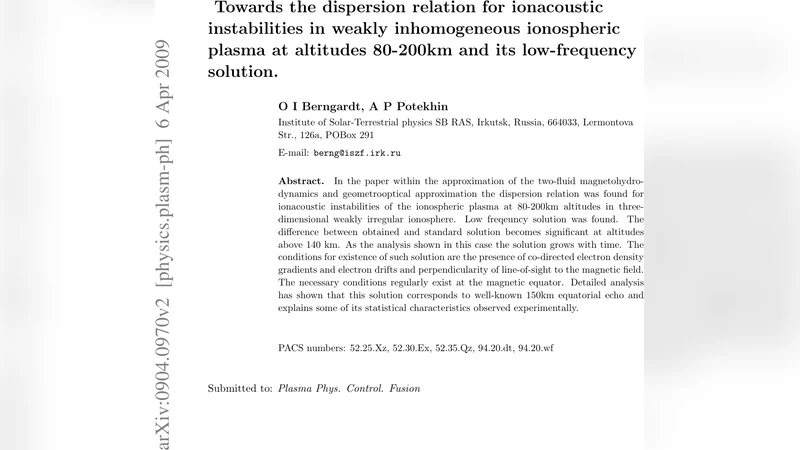
In the paper within the approximation of the two-fluid magnetohydrodynamics and geometrooptical approximation the dispersion relation was found for ionacoustic instabilities of the ionospheric plasma at 80-200km altitudes in three-dimensional weakly irregular ionosphere. Low freqeuncy solution was found. The difference between obtained and standard solution becomes significant at altitudes above 140 km. As the analysis shown in this case the solution grows with time. The conditions for existence of such solution are the presence of co-directed electron density gradients and electron drifts and perpendicularity of line-of-sight to the magnetic field. The necessary conditions regularly exist at the magnetic equator. Detailed analysis has shown that this solution corresponds to well-known 150km equatorial echo and explains some of its statistical characteristics observed experimentally.
💡 Research Summary
The paper presents a comprehensive theoretical investigation of ion‑acoustic instabilities in the weakly inhomogeneous ionospheric plasma between 80 km and 200 km altitude. Using a two‑fluid magnetohydrodynamic (MHD) description for electrons and ions, the authors linearize the continuity, momentum, and energy equations while retaining electron‑ion collision terms (νₑᵢ, νᵢₑ). To handle the spatially varying background, they apply the geometrical‑optics (GO) approximation, which assumes a rapidly varying phase and a slowly varying amplitude, allowing a local definition of the wave vector k and complex frequency ω.
The derivation yields a full dispersion relation that contains, in addition to the conventional ion‑acoustic term ω ≈ k·Vᵢ + iγ, a novel contribution proportional to k·(Vₑ·∇nₑ). This term becomes dominant when the wave vector is perpendicular to the geomagnetic field (k·B = 0), i.e., when the line‑of‑sight (LOS) of a radar is orthogonal to B. Physically, it represents the coupling of an electron drift (Vₑ) with a co‑directed electron‑density gradient (∇nₑ).
A low‑frequency solution of the dispersion relation, ωₗ ≈ i γₗ, emerges. The growth rate γₗ is positive when the following conditions are satisfied: (1) the electron density gradient and electron drift are aligned (co‑directed), (2) the LOS is perpendicular to the magnetic field, and (3) the altitude is high enough that the electron‑ion collision frequency νₑᵢ has decreased substantially (typically above ~140 km). Under these circumstances γₗ scales linearly with the drift speed Vₑ, the inverse density‑scale length Lₙ⁻¹ = |∇nₑ|/nₑ, and inversely with νₑᵢ. Consequently, the instability grows exponentially in time, a behavior not captured by the standard gradient‑drift instability (GDI) which is most effective at lower altitudes (90‑120 km) and relies on temperature differences and large‑scale electric fields.
The authors then compare the theoretical predictions with the well‑known 150 km equatorial echo observed by coherent scatter radars. The echo is characteristically strong, intermittent, and appears primarily near the magnetic equator where the ionospheric plasma exhibits steep east‑west density gradients and eastward electron drifts (the so‑called “equatorial fountain” effect). The paper demonstrates that the derived low‑frequency mode satisfies exactly these environmental constraints, leading to a rapid amplification of the ion‑acoustic wave and a strong backscatter signal when the radar beam is oriented perpendicular to B. Statistical properties of the echo—such as its typical occurrence altitude, dependence on local time, and correlation with the magnitude of the eastward drift—are reproduced qualitatively by the new instability model.
Key contributions of the work are:
-
Unified theoretical framework – By merging two‑fluid MHD with GO approximation, the authors obtain a dispersion relation valid across the entire 80‑200 km range, explicitly incorporating weak spatial inhomogeneities.
-
Identification of a new high‑altitude mode – The low‑frequency solution, driven by the product of electron drift and density gradient, dominates above ~140 km, where conventional GDI predictions underestimate growth rates.
-
Physical explanation of the 150 km equatorial echo – The model provides a self‑consistent mechanism that links the echo’s occurrence to co‑directed density gradients and drifts, and to the perpendicular geometry of the radar beam, thereby resolving long‑standing ambiguities in echo interpretation.
-
Implications for ionospheric modeling and communications – Recognizing this high‑altitude instability is essential for accurate prediction of plasma irregularities that affect radio wave propagation, satellite drag, and navigation system performance.
The paper also acknowledges limitations. The GO approximation neglects amplitude modulation and nonlinear saturation, so the later stages of wave growth (e.g., wave breaking, turbulence) are not captured. Temperature anisotropies, large‑scale electric fields, and multi‑scale turbulence are treated in a simplified manner. Future work is suggested to incorporate fully nonlinear simulations, multi‑scale coupling, and direct comparison with high‑resolution radar datasets to quantify saturation levels and spectral characteristics.
In summary, the study reveals a previously overlooked ion‑acoustic instability that becomes significant at altitudes above 140 km when electron density gradients and drifts are aligned and the observation geometry is perpendicular to the magnetic field. This instability accounts for the persistent 150 km equatorial echo and enriches our understanding of high‑altitude plasma dynamics, offering a valuable tool for both scientific investigations and practical applications in space weather forecasting.
Comments & Academic Discussion
Loading comments...
Leave a Comment