On the Lusternik-Schnirelmann category of symmetric spaces of classical type
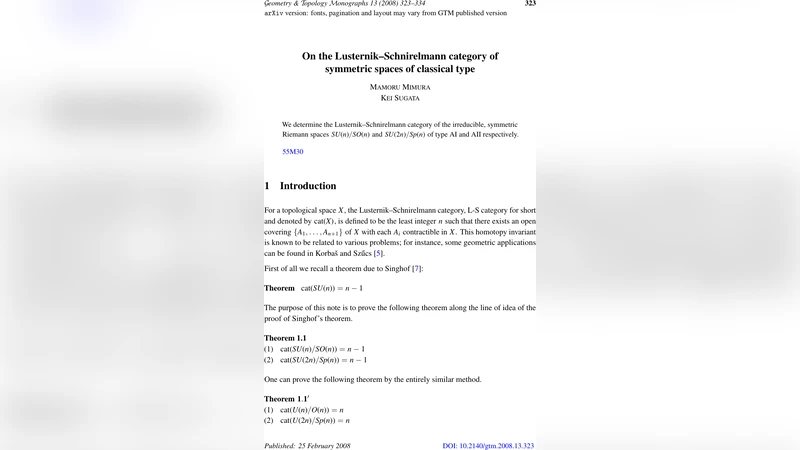
We determine the Lusternik-Schnirelmann category of the irreducible, symmetric Riemann spaces SU(n)/SO(n) and SU(2n)/Sp(n) of type AI and AII respectively.
💡 Research Summary
The paper addresses the problem of determining the Lusternik‑Schnirelmann (LS) category of two classical irreducible symmetric spaces: the AI‑type space (SU(n)/SO(n)) and the AII‑type space (SU(2n)/Sp(n)). The LS category of a topological space (X) is the smallest number of open sets that cover (X) such that each set is contractible within (X). It provides a quantitative measure of the space’s topological complexity.
The authors begin by recalling the standard tools for estimating LS category. A lower bound is obtained from the cup‑length of the cohomology ring (H^{*}(X;R)); the maximal length of a non‑trivial cup product gives a minimal possible category. An upper bound is produced by constructing an explicit open cover of (X) in which each member can be deformed to a point inside (X). When the two bounds coincide, the LS category is determined exactly.
For (SU(n)/SO(n)) the authors exploit the polar (or Cartan) decomposition (A = Q S) with (Q\in SO(n)) and (S) a positive‑definite symmetric matrix. The eigenvalues of (A) are written as (e^{i\theta_{1}},\dots ,e^{i\theta_{n}}). By partitioning the circle into (n) disjoint arcs that avoid the point (1) (i.e., (\theta=0)), they define open subsets \
Comments & Academic Discussion
Loading comments...
Leave a Comment