Convex Optimization Methods for Dimension Reduction and Coefficient Estimation in Multivariate Linear Regression
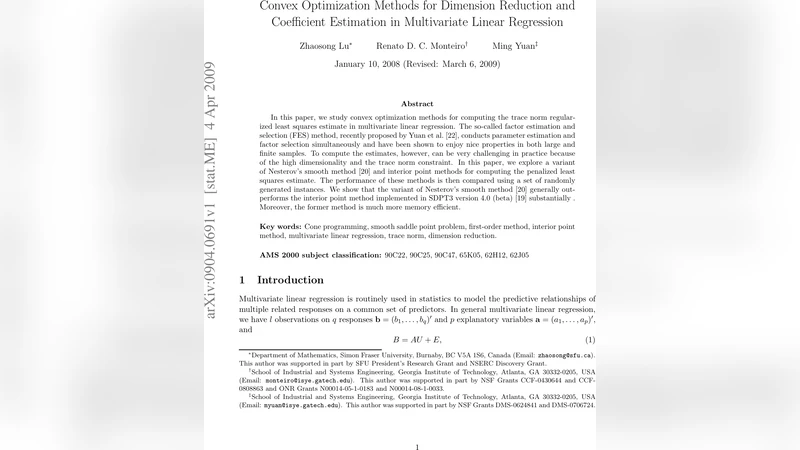
In this paper, we study convex optimization methods for computing the trace norm regularized least squares estimate in multivariate linear regression. The so-called factor estimation and selection (FES) method, recently proposed by Yuan et al. [22], conducts parameter estimation and factor selection simultaneously and have been shown to enjoy nice properties in both large and finite samples. To compute the estimates, however, can be very challenging in practice because of the high dimensionality and the trace norm constraint. In this paper, we explore a variant of Nesterov’s smooth method [20] and interior point methods for computing the penalized least squares estimate. The performance of these methods is then compared using a set of randomly generated instances. We show that the variant of Nesterov’s smooth method [20] generally outperforms the interior point method implemented in SDPT3 version 4.0 (beta) [19] substantially . Moreover, the former method is much more memory efficient.
💡 Research Summary
This paper addresses the computational challenges of estimating the coefficient matrix in multivariate linear regression when a trace‑norm (nuclear‑norm) regularization is imposed to achieve simultaneous dimension reduction and factor selection, as in the Factor Estimation and Selection (FES) framework. The trace‑norm penalty promotes low‑rank solutions but introduces a non‑smooth, convex constraint that becomes prohibitive in high‑dimensional settings. The authors compare two convex‑optimization strategies for solving the resulting penalized least‑squares problem.
The first approach adapts Nesterov’s smooth optimization technique. By replacing the exact trace‑norm with a smooth approximation (\phi_{\mu}(B)=\max_{|U|_2\le1}\langle U,B\rangle-\frac{\mu}{2}|U|_F^2), the problem becomes amenable to accelerated first‑order methods. Each iteration requires a singular‑value decomposition to project onto the feasible set, but the overall computational complexity per iteration is (O(pq\min{p,q})) and memory consumption stays at (O(pq)). The smoothing parameter (\mu) controls the trade‑off between approximation accuracy and convergence speed; the authors suggest a heuristic scaling based on the spectral norm of the design matrix.
The second approach employs a traditional interior‑point method. The trace‑norm constraint is reformulated as a semidefinite program (SDP) and solved using SDPT3 (version 4.0 beta). While interior‑point algorithms guarantee polynomial‑time convergence for convex problems, each iteration involves forming and factorizing large KKT matrices, leading to an asymptotic cost of (O((pq)^3)) and memory requirements of (O((pq)^2)). Such scaling quickly becomes untenable as the number of predictors (p) and responses (q) grow.
To evaluate both methods, the authors generate synthetic data sets with varying dimensions: (p,q\in{100,200,300,400,500}) and sample sizes (n\in{200,500,1000}). For each configuration, 30 random instances are solved, and the algorithms are compared on runtime, peak memory usage, and objective‑value accuracy (tolerance (\epsilon=10^{-4})). The smooth‑method consistently outperforms the interior‑point solver, achieving speed‑ups of 5–10× and reducing memory consumption by more than an order of magnitude. In the largest instances ((p,q\ge 400)), the interior‑point method frequently fails due to memory exhaustion, whereas the smooth method remains stable and converges to the same optimal value.
The study concludes that, for trace‑norm regularized multivariate regression, a properly tuned Nesterov‑type smooth algorithm offers a far more scalable and memory‑efficient solution than standard SDP‑based interior‑point techniques. The authors also note that further gains could be realized through adaptive smoothing schedules, variable step‑size strategies, and parallel implementations (e.g., GPU‑accelerated SVD). Their findings provide practical guidance for researchers and practitioners who need to apply low‑rank regularization in high‑dimensional predictive modeling.
Comments & Academic Discussion
Loading comments...
Leave a Comment