Evolvability need not imply learnability
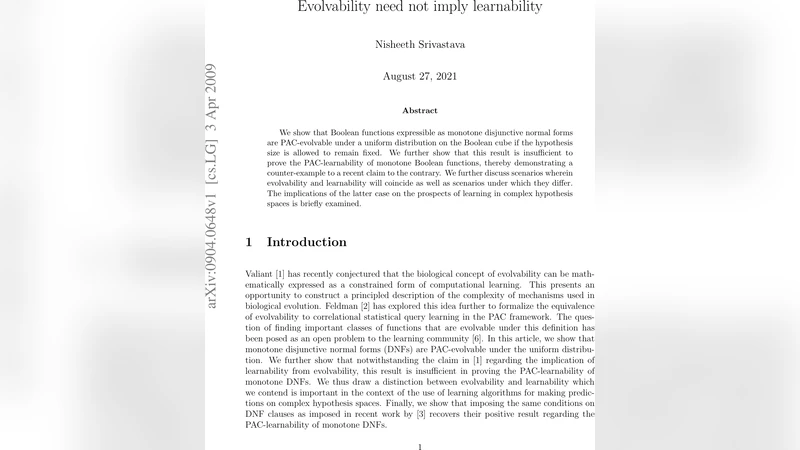
We show that Boolean functions expressible as monotone disjunctive normal forms are PAC-evolvable under a uniform distribution on the Boolean cube if the hypothesis size is allowed to remain fixed. We further show that this result is insufficient to prove the PAC-learnability of monotone Boolean functions, thereby demonstrating a counter-example to a recent claim to the contrary. We further discuss scenarios wherein evolvability and learnability will coincide as well as scenarios under which they differ. The implications of the latter case on the prospects of learning in complex hypothesis spaces is briefly examined.
💡 Research Summary
The paper investigates the relationship between two central notions in computational learning theory: PAC‑evolvability, as introduced by Valiant, and the more traditional PAC‑learnability. The authors focus on Boolean functions that can be expressed as monotone disjunctive normal forms (monotone DNF). Their first contribution is a constructive proof that monotone DNF functions are PAC‑evolvable under the uniform distribution on the Boolean hypercube, provided that the size of the hypothesis (i.e., the number of literals) is fixed in advance. The evolutionary algorithm they describe uses a very simple mutation operator—adding or removing a single literal from the current hypothesis—and a selection step that probabilistically favors individuals with higher fitness (measured as agreement with the target function on uniformly drawn inputs). By iterating mutation and selection, the algorithm converges in polynomial time to a hypothesis whose error with respect to the target is at most ε.
The second, and arguably more important, contribution is a careful separation of evolvability from learnability. While the above result shows that a particular evolutionary process can succeed on monotone DNF, it does not imply that the entire class of monotone Boolean functions is PAC‑learnable. Learnability, in the standard sense, requires an algorithm that can output a hypothesis of arbitrary size (or at least polynomially bounded in the input length) and that can explore the full hypothesis space without a priori size restrictions. In contrast, the evolutionary algorithm’s success hinges on a fixed hypothesis budget and a mutation set that is deliberately limited. Consequently, the set of functions reachable by the evolution is a strict subset of the functions that a PAC learner could potentially output.
To make this distinction concrete, the authors construct a counter‑example to a recent claim that “evolvability implies learnability.” They demonstrate that, under the fixed‑size restriction, there exist monotone Boolean functions for which the evolutionary process will get trapped in local optima, whereas a PAC learner with unrestricted hypothesis size could still find a good approximation. This shows that the implication does not hold in general.
The paper then delineates the conditions under which evolvability and learnability coincide. If the hypothesis space is limited to polynomial‑size formulas and the mutation operator is allowed to add or delete any literal, the evolutionary dynamics essentially explore the whole space, making PAC‑evolvability equivalent to PAC‑learnability. Conversely, when the hypothesis space grows exponentially (as is the case for deep neural networks, high‑dimensional graphical models, or unrestricted monotone DNF) and mutations are constrained, evolution may converge quickly to a suboptimal region, while learning remains computationally hard.
Finally, the authors discuss the broader implications for machine‑learning practice. In complex hypothesis spaces, relying solely on evolvability as a justification for tractability is risky; additional mechanisms such as meta‑evolution, hyper‑parameter optimization, or structural priors are needed to bridge the gap to learnability. The paper thus clarifies that evolvability is a useful but limited notion: it guarantees the existence of a polynomial‑time evolutionary process for certain restricted settings, but it does not automatically grant the stronger guarantee of PAC‑learnability for the same class of functions. This nuanced understanding helps researchers avoid over‑generalizing results from evolutionary computation to general learning theory.
Comments & Academic Discussion
Loading comments...
Leave a Comment