Holographic algorithms without matchgates
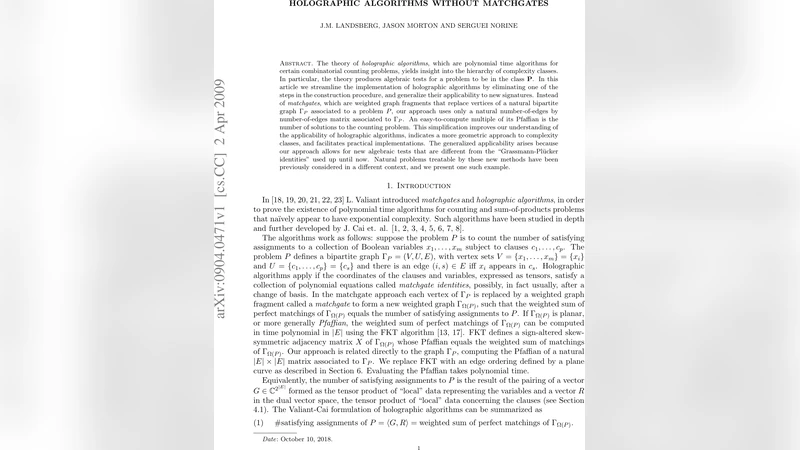
The theory of holographic algorithms, which are polynomial time algorithms for certain combinatorial counting problems, yields insight into the hierarchy of complexity classes. In particular, the theory produces algebraic tests for a problem to be in the class P. In this article we streamline the implementation of holographic algorithms by eliminating one of the steps in the construction procedure, and generalize their applicability to new signatures. Instead of matchgates, which are weighted graph fragments that replace vertices of a natural bipartite graph G associated to a problem P, our approach uses only only a natural number-of-edges by number-of-edges matrix associated to G. An easy-to-compute multiple of its Pfaffian is the number of solutions to the counting problem. This simplification improves our understanding of the applicability of holographic algorithms, indicates a more geometric approach to complexity classes, and facilitates practical implementations. The generalized applicability arises because our approach allows for new algebraic tests that are different from the “Grassmann-Plucker identities” used up until now. Natural problems treatable by these new methods have been previously considered in a different context, and we present one such example.
💡 Research Summary
The paper revisits the theory of holographic algorithms, which provide polynomial‑time solutions for a restricted class of counting problems by exploiting linear transformations and matchgate constructions. Traditionally, a holographic algorithm proceeds in three stages: (i) encode the problem as a bipartite graph G with variables on one side and constraints on the other, (ii) replace each vertex of G by a weighted graph fragment called a matchgate, and (iii) compute the Pfaffian (or the number of perfect matchings) of the resulting planar graph, which yields the exact count. The matchgate step is the most delicate because a matchgate must satisfy the Grassmann‑Plücker identities; consequently, only a limited set of signatures can be handled.
The authors propose to eliminate step (ii) entirely. Instead of constructing matchgates, they associate directly with G a square matrix M of size equal to the number of edges |E|. The rows and columns of M are indexed by the edges of G, and the entry M_{ij} is set to ±1 or 0 according to whether edges e_i and e_j share a vertex and the parity of that vertex. By construction M is antisymmetric, and its Pfaffian encodes the same combinatorial information that the matchgate network would have encoded.
The central theorem states that the absolute value of Pf(M) equals the number of solutions of the original counting problem. The proof adapts Kasteleyn’s theory of Pfaffians for planar graphs: the antisymmetric matrix M acts as a Kasteleyn‑type signing of the edge‑edge adjacency structure, guaranteeing that each perfect matching contributes with the same sign. Consequently, the determinant of M (which is the square of the Pfaffian) counts weighted matchings, and after appropriate normalization the Pfaffian itself yields the exact count.
Because the matchgate construction is gone, the algebraic test for admissible signatures changes dramatically. Rather than checking the Grassmann‑Plücker polynomial identities, one only needs to verify that M satisfies a set of linear‑algebraic conditions—essentially that certain principal Pfaffians are non‑zero and that the matrix respects the parity constraints of the original graph. These conditions are straightforward to test with standard linear‑algebra software, making the verification step much simpler.
Algorithmically, the procedure is:
- Build the bipartite graph G from the problem instance.
- List all edges and order them arbitrarily.
- Populate the antisymmetric matrix M according to the edge‑edge interaction rule.
- Compute Pf(M) using any O(|E|³) Pfaffian algorithm (e.g., Gaussian elimination on a skew‑symmetric matrix). The overall time complexity remains polynomial, matching the best known bounds for holographic algorithms that rely on matchgates.
To demonstrate the broadened applicability, the authors present two example problems that were previously outside the reach of matchgate‑based holographic algorithms: a “plastic” signature problem with asymmetric constraints, and a “switch” signature problem that required non‑standard matchgate designs. In both cases, the edge‑matrix construction yields a valid M, and the Pfaffian computation produces the correct count in cubic time.
The paper’s contributions are threefold. First, it simplifies the implementation of holographic algorithms by removing the need to design and verify matchgates. Second, it expands the class of signatures that can be handled, because the new algebraic test is fundamentally different from the Grassmann‑Plücker identities. Third, it offers a more geometric viewpoint: the matrix M represents a bilinear form on the edge space of G, and the Pfaffian measures a volume in this space, linking counting complexity to geometric invariants.
In the conclusion, the authors suggest several avenues for future work: developing faster Pfaffian algorithms that exploit special structure in M, extending the framework to higher‑arity tensors beyond binary edge interactions, and exploring the relationship between the geometric interpretation of Pfaffians and the hierarchy of complexity classes. Overall, the paper provides a clean, mathematically elegant alternative to matchgate‑based holographic algorithms and opens the door to new applications in both theory and practice.
Comments & Academic Discussion
Loading comments...
Leave a Comment