The paper introduces fuzzy linguistic logic programming, which is a combination of fuzzy logic programming, introduced by P. Vojtas, and hedge algebras in order to facilitate the representation and reasoning on human knowledge expressed in natural languages. In fuzzy linguistic logic programming, truth values are linguistic ones, e.g., VeryTrue, VeryProbablyTrue, and LittleFalse, taken from a hedge algebra of a linguistic truth variable, and linguistic hedges (modifiers) can be used as unary connectives in formulae. This is motivated by the fact that humans reason mostly in terms of linguistic terms rather than in terms of numbers, and linguistic hedges are often used in natural languages to express different levels of emphasis. The paper presents: (i) the language of fuzzy linguistic logic programming; (ii) a declarative semantics in terms of Herbrand interpretations and models; (iii) a procedural semantics which directly manipulates linguistic terms to compute a lower bound to the truth value of a query, and proves its soundness; (iv) a fixpoint semantics of logic programs, and based on it, proves the completeness of the procedural semantics; (v) several applications of fuzzy linguistic logic programming; and (vi) an idea of implementing a system to execute fuzzy linguistic logic programs.
Deep Dive into Fuzzy Linguistic Logic Programming and its Applications.
The paper introduces fuzzy linguistic logic programming, which is a combination of fuzzy logic programming, introduced by P. Vojtas, and hedge algebras in order to facilitate the representation and reasoning on human knowledge expressed in natural languages. In fuzzy linguistic logic programming, truth values are linguistic ones, e.g., VeryTrue, VeryProbablyTrue, and LittleFalse, taken from a hedge algebra of a linguistic truth variable, and linguistic hedges (modifiers) can be used as unary connectives in formulae. This is motivated by the fact that humans reason mostly in terms of linguistic terms rather than in terms of numbers, and linguistic hedges are often used in natural languages to express different levels of emphasis. The paper presents: (i) the language of fuzzy linguistic logic programming; (ii) a declarative semantics in terms of Herbrand interpretations and models; (iii) a procedural semantics which directly manipulates linguistic terms to compute a lower bound to the tr
People usually use words (in natural languages), which are inherently imprecise, vague and qualitative in nature, to describe real world information, to analyse, to reason, and to make decisions. Moreover, in natural languages, linguistic hedges are very often used to state different levels of emphasis. Therefore, it is necessary to investigate logical systems that can directly work with words, and make use of linguistic hedges since such systems will make it easier to represent and reason on knowledge expressed in natural languages.
Fuzzy logic, which is derived from fuzzy set theory, introduced by L. Zadeh, deals with reasoning that is approximate rather than exact, as in classical predicate logic. In fuzzy logic, the truth value domain is not the classical set {False, True} or {0, 1}, but a set of linguistic truth values (Zadeh 1975b) or the whole unit interval [0,1]. Moreover, in fuzzy logic, linguistic hedges play an essential role in the generation of the values of a linguistic variable and in the modification of fuzzy predicates (Zadeh 1989). Fuzzy logic provides us with a very powerful tool for handling imprecision and uncertainty, which are very often encountered in real world information, and a capacity for representing and reasoning on knowledge expressed in linguistic forms.
Fuzzy logic programming, introduced in Vojtáš (2001), is a formal model of an extension of logic programming without negation working with a truth functional fuzzy logic in narrow sense. In fuzzy logic programming, atoms and rules, which are many-valued implications, are graded to a certain degree in the interval [0,1]. Fuzzy logic programming allows a wide variety of many-valued connectives in order to cover a great variety of applications. A sound and complete procedural semantics is provided to compute a lower bound to the truth value of a query. Nevertheless, no proofs of extended versions of Mgu and Lifting lemmas are given. Fuzzy logic programming has applications such as threshold computation, a data model for flexible querying (Pokorný and Vojtáš 2001), and fuzzy control (Gerla 2005).
The theory of hedge algebras, introduced in Nguyen and Wechler (1990;1992), forms an algebraic approach to a natural qualitative semantics of linguistic terms in a term domain. The hedge-algebra-based semantics of linguistic terms is qualitative, relative, and dependent on the order-based structure of the term domain. Hedge algebras have been shown to have a rich algebraic structure to represent linguistic domains (Nguyen et al. 1999), and the theory can be effectively applied to problems such as linguistic reasoning (Nguyen et al. 1999) and fuzzy control (Nguyen et al. 2008). The notion of an inverse mapping of a hedge is defined in Dinh-Khac et al. (2006) for monotonic hedge algebras, a subclass of linear hedge algebras.
In this work, we integrate fuzzy logic programming and hedge algebras to build a logical system that facilitates the representation and reasoning on knowledge expressed in natural languages. In our logical system, the set of truth values is that of linguistic ones taken from a hedge algebra of a linguistic truth variable. Furthermore, we consider only finitely many truth values. On the one hand, this is due to the fact that normally, people use finitely many degrees of quality or quantity to describe real world applications which are granulated (Zadeh 1997). On the other hand, it is reasonable to provide a logical system suitable for computer implementation. In fact, the finiteness of the truth domain allows us to obtain the Least Herbrand model for a finite logic program after a finite number of iterations of an immediate consequences operator. Moreover, we allow the use of linguistic hedges as unary connectives in formulae to express different levels of accentuation on fuzzy predicates. The procedural semantics in Vojtáš (2001) is extended to deduce a lower bound to the truth value of a query by directly computing with linguistic terms.
The paper is organised as follows: the next section gives a motivating example for the development of fuzzy linguistic logic programming; Section 3 presents linguistic truth domains taken from hedge algebras of a truth variable, inverse mappings of hedges, many-valued modus ponens w.r.t. such domains; Section 4 presents the theory of fuzzy linguistic logic programming, defining the language, declarative semantics, procedural semantics, and fixpoint semantics, and proving the soundness and completeness of the procedural semantics; Section 5 and Section 6 respectively discuss several applications and an idea for implementing a system where such logic programs can be executed; the last section summarises the paper.
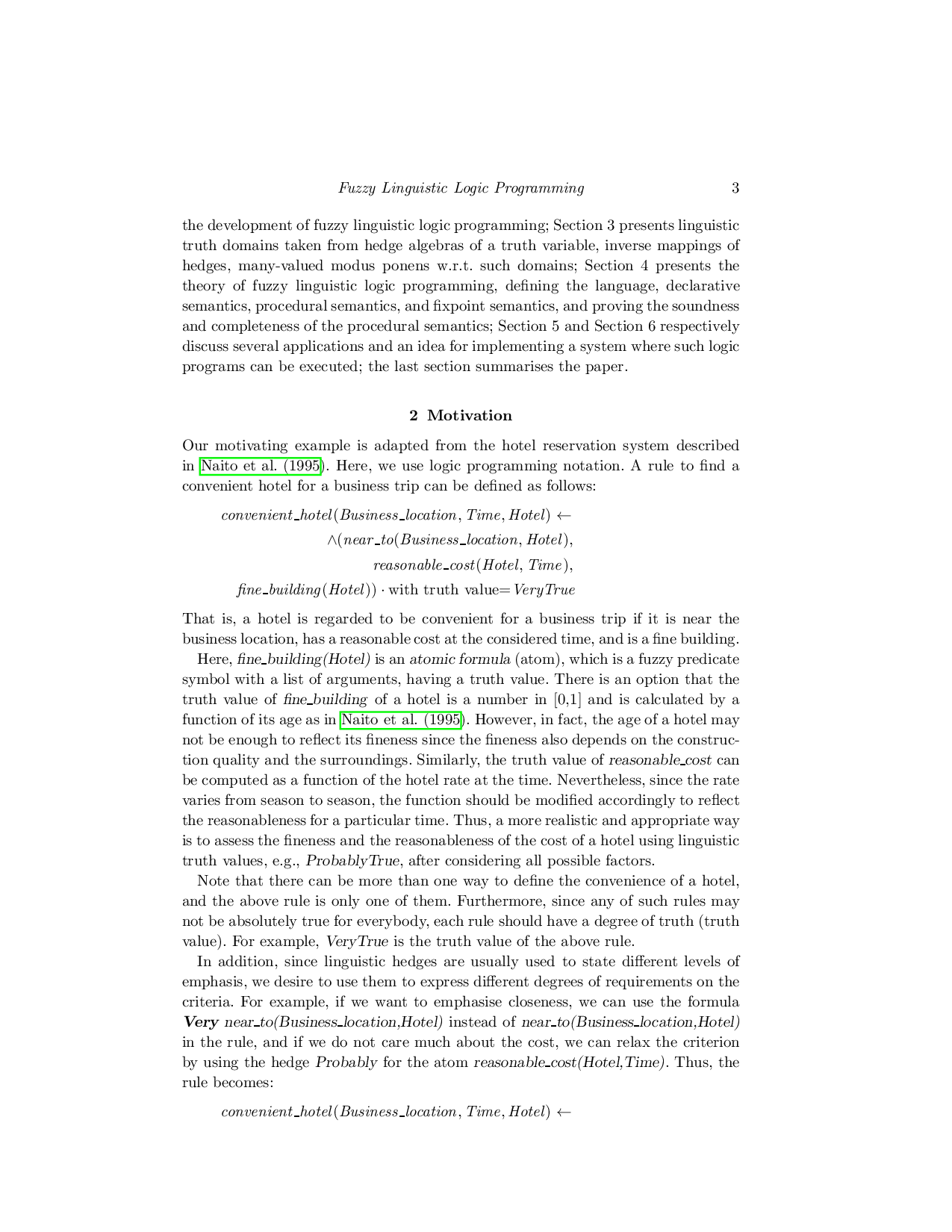
Our motivating example is adapted from the hotel reservation system described in Naito et al. (1995). Here, we use logic programming notation. A rule to find a convenient hotel for a business trip can be defined as follows:
convenient hotel (Business location, Time, Ho
…(Full text truncated)…
This content is AI-processed based on ArXiv data.