Categorical sequences
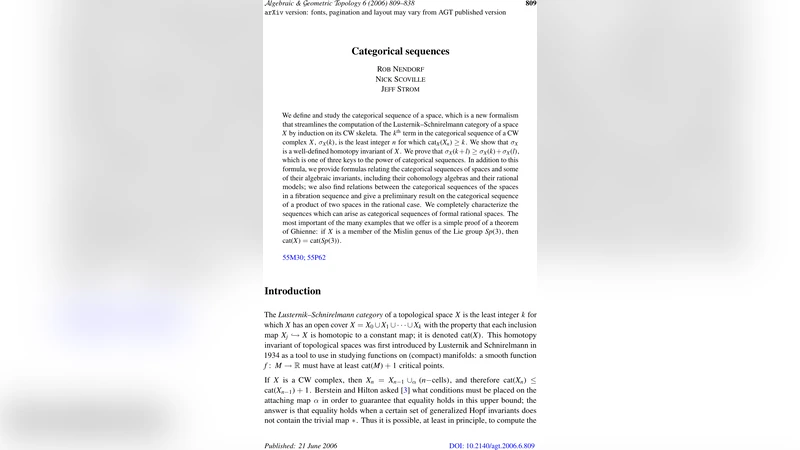
We define and study the categorical sequence of a space, which is a new formalism that streamlines the computation of the Lusternik-Schnirelmann category of a space X by induction on its CW skeleta. The k-th term in the categorical sequence of a CW complex X, \sigma_X(k), is the least integer n for which cat_X(X_n) >= k. We show that \sigma_X is a well-defined homotopy invariant of X. We prove that \sigma_X(k+l) >= \sigma_X(k) + \sigma_X(l), which is one of three keys to the power of categorical sequences. In addition to this formula, we provide formulas relating the categorical sequences of spaces and some of their algebraic invariants, including their cohomology algebras and their rational models; we also find relations between the categorical sequences of the spaces in a fibration sequence and give a preliminary result on the categorical sequence of a product of two spaces in the rational case. We completely characterize the sequences which can arise as categorical sequences of formal rational spaces. The most important of the many examples that we offer is a simple proof of a theorem of Ghienne: if X is a member of the Mislin genus of the Lie group Sp(3), then cat(X) = cat(Sp(3)).
💡 Research Summary
The paper introduces a novel invariant called the categorical sequence σ_X of a CW complex X, designed to streamline the computation of the Lusternik‑Schnirelmann (L‑S) category by working inductively on the skeleta of X. For each integer k≥1, σ_X(k) is defined as the smallest integer n such that the relative category cat_X(X_n) of the n‑skeleton X_n is at least k. The authors first prove that σ_X is well defined, independent of the chosen CW structure, and invariant under homotopy equivalence.
A central structural result is the subadditivity inequality
σ_X(k + l) ≥ σ_X(k) + σ_X(l).
This inequality shows that the sequence behaves like a convex function on the natural numbers and provides a powerful lower bound for the category of larger skeleta in terms of smaller ones. It mirrors the classical product inequality cat(X × Y) ≥ cat X + cat Y, but operates at the level of individual skeleta, thereby yielding finer information.
The authors then relate σ_X to algebraic invariants. They show that σ_X(1) coincides with the minimal dimension in which X has non‑trivial rational cohomology, and that the cup‑product structure imposes constraints on the growth of σ_X. In the rational setting, using Sullivan’s minimal models, they prove that for formal spaces the entire categorical sequence is determined by the degrees of a minimal set of generators of the cohomology algebra. Consequently, they give a complete classification of the sequences that can arise from formal rational spaces: they must be non‑decreasing, satisfy the subadditivity inequality, and be realizable as cumulative sums of generator degrees.
The paper also investigates how σ behaves under fibrations. For a fibration F → E → B, they establish the inequality σ_E(k) ≤ σ_F(k) + σ_B(k) and identify conditions (e.g., trivial action of π₁(B) on the homotopy of the fiber) under which equality holds. This provides a new perspective on classical results such as the Ganea–Sullivan inequality for L‑S category in fibrations.
In the product case, a rational version of the subadditivity inequality is proved: for rational spaces X and Y, σ_{X×Y}(k) ≥ σ_X(k) + σ_Y(k). This result, together with the previous fibration formula, yields a unified framework for estimating the category of both fiber bundles and Cartesian products.
The theoretical developments are illustrated with concrete calculations. The authors give a streamlined proof of a theorem of Ghienne: any space X belonging to the Mislin genus of the Lie group Sp(3) has the same L‑S category as Sp(3) itself, namely cat X = 5. By computing σ_X for Sp(3) and showing that σ_X is invariant within its genus, the result follows without recourse to intricate homotopy‑theoretic arguments.
Overall, the paper presents categorical sequences as a versatile tool that connects geometric, algebraic, and rational homotopy data. By encoding the growth of relative categories across skeleta, σ_X provides sharper estimates for cat X, clarifies the interaction with cohomology algebras, and yields new, concise proofs of existing theorems. The work opens avenues for further research on product formulas, higher‑order fibrations, and the classification of possible categorical sequences beyond the formal rational case.
Comments & Academic Discussion
Loading comments...
Leave a Comment