Synchronization and clustering of synthetic genetic networks: A role for cis-regulatory modules
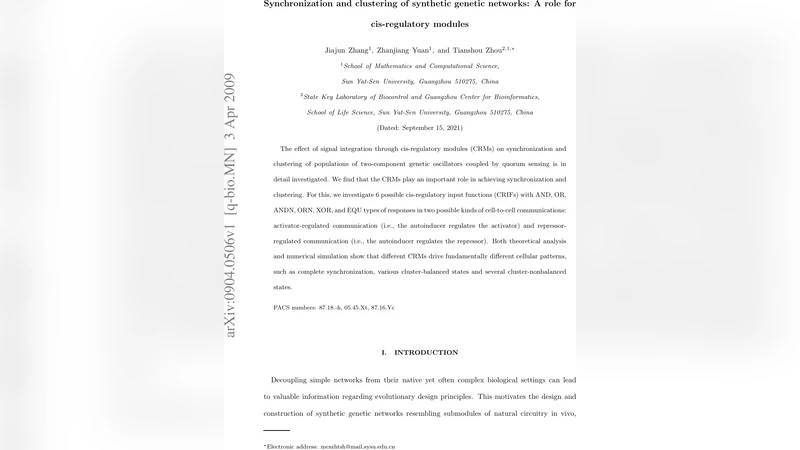
The effect of signal integration through cis-regulatory modules (CRMs) on synchronization and clustering of populations of two-component genetic oscillators coupled by quorum sensing is in detail investigated. We find that the CRMs play an important role in achieving synchronization and clustering. For this, we investigate 6 possible cis-regulatory input functions (CRIFs) with AND, OR, ANDN, ORN, XOR, and EQU types of responses in two possible kinds of cell-to-cell communications: activator-regulated communication (i.e., the autoinducer regulates the activator) and repressor-regulated communication (i.e., the autoinducer regulates the repressor). Both theoretical analysis and numerical simulation show that different CRMs drive fundamentally different cellular patterns, such as complete synchronization, various cluster-balanced states and several cluster-nonbalanced states.
💡 Research Summary
This paper investigates how the logical architecture of cis‑regulatory modules (CRMs) shapes the collective dynamics of populations of synthetic two‑component genetic oscillators that communicate through quorum sensing. The authors construct a minimal oscillator consisting of an activator (A) and a repressor (R) that form a negative feedback loop and generate autonomous oscillations. Cells release an autoinducer (AI) that diffuses in the medium and feeds back onto the intracellular circuit. Two modes of coupling are considered: (i) activator‑regulated communication, where AI modulates the activity of the activator transcription factor, and (ii) repressor‑regulated communication, where AI modulates the repressor transcription factor.
Six canonical input‑output functions for CRMs—AND, OR, ANDN, ORN, XOR, and EQU—are defined. Each function specifies how the two inputs (the transcription factor and AI) are combined to produce either activation or repression of the downstream promoter. The authors embed these logical functions into the oscillator model, yielding twelve distinct configurations (six CRIFs × two coupling modes).
To assess the impact of each configuration on population‑level behavior, the study employs two complementary analytical tools. First, a phase‑reduction framework is used to derive an interaction function H(φ) that captures how the phase difference φ between two cells evolves under coupling. The sign of the derivative H′(0) predicts whether small phase differences shrink (synchronization) or grow (desynchronization). Second, master stability function (MSF) analysis quantifies the stability of the fully synchronized state across the entire network.
The theoretical analysis reveals systematic trends. AND and OR CRMs generate positive H′(0) over a broad parameter range, favoring complete synchronization. XOR and EQU produce non‑monotonic H′(0) that can become negative for certain coupling strengths, enabling the emergence of multiple phase‑locked clusters. ANDN and ORN, which incorporate a negated input, often yield mixed signs, predisposing the system to asymmetric, non‑balanced clustering.
Numerical simulations of 100–200 cells with random initial phases confirm these predictions. Four qualitatively distinct regimes are observed:
- Complete synchronization – Predominantly seen with AND/OR CRMs in the activator‑regulated scheme; all cells converge to a single phase.
- Balanced multi‑cluster states – Typical for XOR and EQU CRMs in the repressor‑regulated scheme; the population splits into two or more equally sized clusters, each internally synchronized but separated by a fixed phase offset.
- Non‑balanced clustering – Characteristic of ANDN/ORN CRMs in the activator‑regulated scheme; clusters differ markedly in size and phase, producing a heterogeneous distribution.
- Parameter‑driven transitions – By varying binding affinities (Kd), transcriptional strengths (α), or repression coefficients (β), the same network can switch between the above regimes, illustrating that CRM parameters act as tunable knobs for collective behavior.
The authors discuss practical implementation using synthetic biology tools. CRISPR‑dCas9 fused to activation or repression domains, together with guide RNAs responsive to AI or the native transcription factor, can realize the six logical functions on engineered promoters. For example, an AND gate can be built by requiring simultaneous binding of two dCas9‑VP64 complexes, whereas an XOR gate can be achieved by arranging mutually exclusive binding sites that recruit either an activator or a repressor depending on which input is present.
In conclusion, the study demonstrates that the logical design of cis‑regulatory modules is a decisive factor in determining whether a population of quorum‑sensing coupled oscillators will synchronize, form balanced clusters, or develop asymmetric cluster patterns. By providing both analytical criteria (sign of H′(0), MSF spectra) and extensive simulation evidence, the work offers a design framework for engineering desired collective dynamics in synthetic gene networks. The findings open avenues for constructing programmable microbial consortia that can perform coordinated tasks, exhibit robust pattern formation, or switch between functional states on demand. Future work will likely focus on experimental validation of the proposed CRMs and on extending the analysis to more complex network topologies and heterogeneous cell populations.
Comments & Academic Discussion
Loading comments...
Leave a Comment