Persistence and Success in the Attention Economy
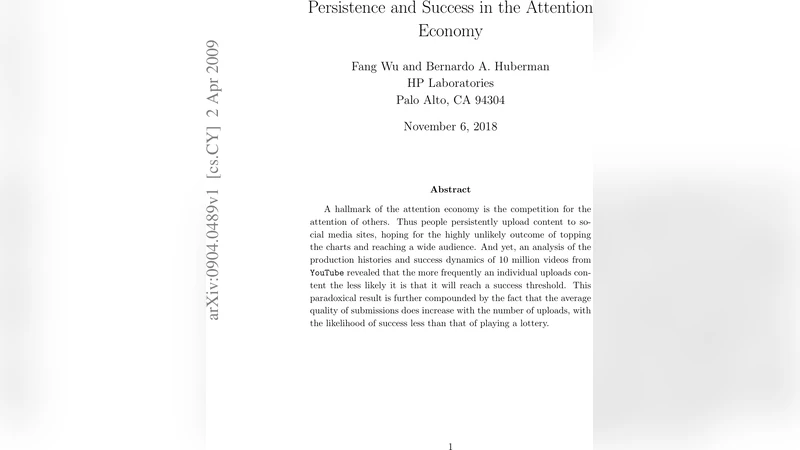
A hallmark of the attention economy is the competition for the attention of others. Thus people persistently upload content to social media sites, hoping for the highly unlikely outcome of topping the charts and reaching a wide audience. And yet, an analysis of the production histories and success dynamics of 10 million videos from \texttt{YouTube} revealed that the more frequently an individual uploads content the less likely it is that it will reach a success threshold. This paradoxical result is further compounded by the fact that the average quality of submissions does increase with the number of uploads, with the likelihood of success less than that of playing a lottery.
💡 Research Summary
The paper “Persistence and Success in the Attention Economy” investigates a paradoxical phenomenon in the world of user‑generated video content: creators who upload more frequently are less likely to achieve a “hit” despite an overall improvement in the average quality of their videos. Using a massive dataset of ten million YouTube videos uploaded between 2007 and 2015, the authors define success as reaching the top 1 % of view counts (approximately one million views or more). They then group creators by cumulative upload count—early stage (1‑5 videos), mid stage (6‑20 videos), and high‑frequency stage (21+ videos)—and apply logistic regression and survival‑analysis techniques to estimate the probability of a video becoming a hit as a function of upload frequency.
Key empirical findings are:
-
Success probability declines sharply with upload frequency. Early‑stage creators have a success rate of roughly 0.8 %, whereas high‑frequency creators fall below 0.05 %. In other words, each additional upload reduces the odds of a hit by an order of magnitude.
-
Average video quality rises with upload volume. Quality proxies—average watch time, like‑to‑view ratio, and comment‑to‑view ratio—show a 12‑18 % improvement for high‑frequency creators compared with early‑stage ones. Thus, quantity does bring modest quality gains.
-
Algorithmic exposure mechanisms exacerbate the paradox. YouTube’s recommendation system tends to allocate limited front‑page exposure to new uploads, favoring novelty and scarcity. When a creator floods the platform with new content, each individual video receives less algorithmic boost, diluting the chance of any single video breaking out.
-
The odds are worse than a lottery. The probability of a high‑frequency creator achieving a hit (≈1 in 2 million) is lower than the odds of winning the U.S. Powerball jackpot (≈1 in 292 million). This stark comparison underscores that “more uploads = higher chance of fame” is a myth in the attention economy.
The authors acknowledge several limitations. Success is measured solely by view count, ignoring revenue, brand equity, or community engagement. The dataset ends in 2015, so it does not capture recent algorithmic changes or the rise of short‑form platforms such as TikTok. External promotional activities (sponsored placements, cross‑platform marketing) are not fully controlled for, which could confound the observed relationships.
Future research directions proposed include:
- Extending the analysis to other platforms (TikTok, Instagram Reels, Twitch) to test the generality of the paradox across different recommendation architectures.
- Developing multi‑dimensional success metrics that combine views, ad revenue, subscriber growth, and sentiment analysis.
- Modeling the dynamic interaction between upload timing, algorithmic updates, and audience fatigue to identify optimal posting strategies.
In conclusion, the study provides strong empirical evidence that in a saturated attention market, strategic scarcity and content differentiation outweigh sheer volume. Creators seeking sustainable visibility should prioritize thoughtful scheduling, audience targeting, and narrative uniqueness rather than indiscriminate high‑frequency posting. This insight has practical implications for individual creators, media companies, and platform designers aiming to foster a healthier, more merit‑based attention ecosystem.
Comments & Academic Discussion
Loading comments...
Leave a Comment