Two-way source coding with a helper
Consider the two-way rate-distortion problem in which a helper sends a common limited-rate message to both users based on side information at its disposal. We characterize the region of achievable rates and distortions where a Markov form (Helper)-(User 1)-(User 2) holds. The main insight of the result is that in order to achieve the optimal rate, the helper may use a binning scheme, as in Wyner-Ziv, where the side information at the decoder is the “further” user, namely, User 2. We derive these regions explicitly for the Gaussian sources with square error distortion, analyze a trade-off between the rate from the helper and the rate from the source, and examine a special case where the helper has the freedom to send different messages, at different rates, to the encoder and the decoder.
💡 Research Summary
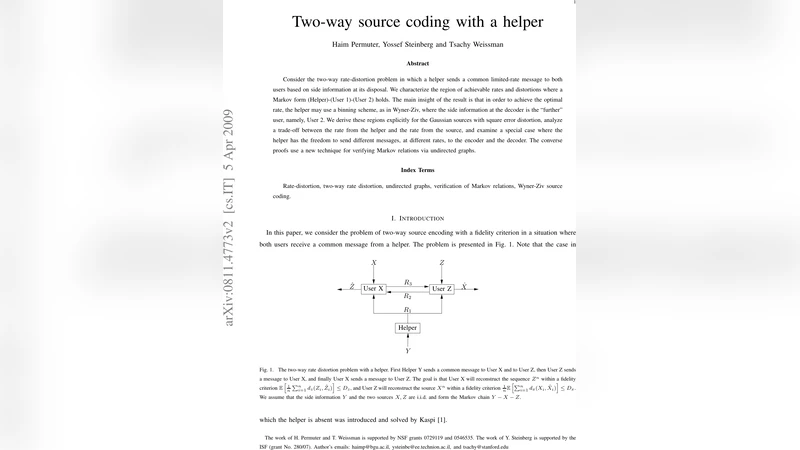
The paper studies a two‑way rate‑distortion problem in which a helper, observing side information Y, sends a common limited‑rate message to both terminals (User X and User Z). The sources X and Z as well as the helper’s observation Y are i.i.d. and satisfy the Markov chain Y – X – Z. Communication proceeds in three stages: (i) the helper broadcasts a message at rate R₁, (ii) User Z sends a message to User X at rate R₂, and (iii) User X replies to User Z at rate R₃. Each terminal must reconstruct the other’s source within prescribed average distortion constraints Dₓ and D_z.
The main contribution is a single‑letter characterization of the achievable rate‑distortion region R(Dₓ,D_z). By introducing auxiliary random variables U, V, W the joint distribution factorizes as
p(x,y) p(z|x) p(u|y) p(v|u,z) p(w|u,v,x).
The region consists of all triples (R₁,R₂,R₃) satisfying
R₁ ≥ I(Y;U | Z),
R₂ ≥ I(Z;V | U,X),
R₃ ≥ I(X;W | U,V,Z),
for some choice of (U,V,W) with bounded cardinalities. The reconstructions are deterministic functions: \hat Z = f₁(U,V,X) and \hat X = f₂(U,W,Z), and they must meet the distortion constraints.
A key insight is that the helper should employ a Wyner‑Ziv binning scheme designed for the “farther” user Z, even though both users receive the same message. Because of the Markov chain, I(U;Z) ≤ I(U;X), the binning can be decoded by both terminals, providing a common side‑information variable U that is useful for the subsequent two‑way exchange. This observation leads to the above rate bounds, where the first bound reflects the cost of sending U to a decoder that already knows Z, while the second and third bounds capture the cost of the two directional messages given the shared side information U.
To verify the required Markov relations, the authors develop a novel undirected‑graph technique: variables are nodes, and each factor in the joint distribution induces edges among the variables it involves. If every path from a set G₁ to a set G₃ must pass through G₂, then the Markov chain G₁‑G₂‑G₃ holds. This graphical method simplifies the otherwise cumbersome algebraic verification and is used throughout the converse proofs.
The paper also treats two special cases that illuminate the general result. When R₂ = 0 and D_z = ∞ (i.e., only X needs to be reconstructed), the problem reduces to a single Wyner‑Ziv coding step: the helper sends U to both terminals, and X uses a second Wyner‑Ziv code with side information Z and auxiliary W. The region collapses to
R₁ ≥ I(Y;U | Z), R ≥ I(X;W | U,Z).
The symmetric case with R₃ = 0 and Dₓ = ∞ is handled analogously, swapping the roles of X and Z.
For Gaussian sources with squared‑error distortion, the authors substitute the Gaussian joint distribution into the single‑letter formulas. The optimal auxiliaries become linear Gaussian functions, and the mutual informations reduce to logarithmic expressions in signal‑to‑noise ratios. This yields explicit rate‑distortion curves and clearly shows the trade‑off between the helper’s rate R₁ and the two directional rates R₂, R₃. In particular, increasing R₁ allows a reduction in R₂ and R₃, confirming the helper’s value in reducing overall communication load.
Finally, the paper sketches an extension where the helper may send different messages to the two users at possibly different rates. This “asymmetric helper” scenario leads to a more intricate region that remains an open problem; the authors provide partial results and discuss the challenges.
Overall, the work delivers the first complete single‑letter description of a two‑way source‑coding problem with a common helper, demonstrates that Wyner‑Ziv binning aimed at the farther decoder is optimal, introduces a useful graphical tool for Markov verification, and supplies explicit Gaussian results and trade‑off analyses that are valuable for both theory and the design of distributed compression systems.
Comments & Academic Discussion
Loading comments...
Leave a Comment