We consider limits over categories of extensions and show how certain well-known functors on the category of groups turn out as such limits. We also discuss higher (or derived) limits over categories of extensions.
Deep Dive into Limits over categories of extensions.
We consider limits over categories of extensions and show how certain well-known functors on the category of groups turn out as such limits. We also discuss higher (or derived) limits over categories of extensions.
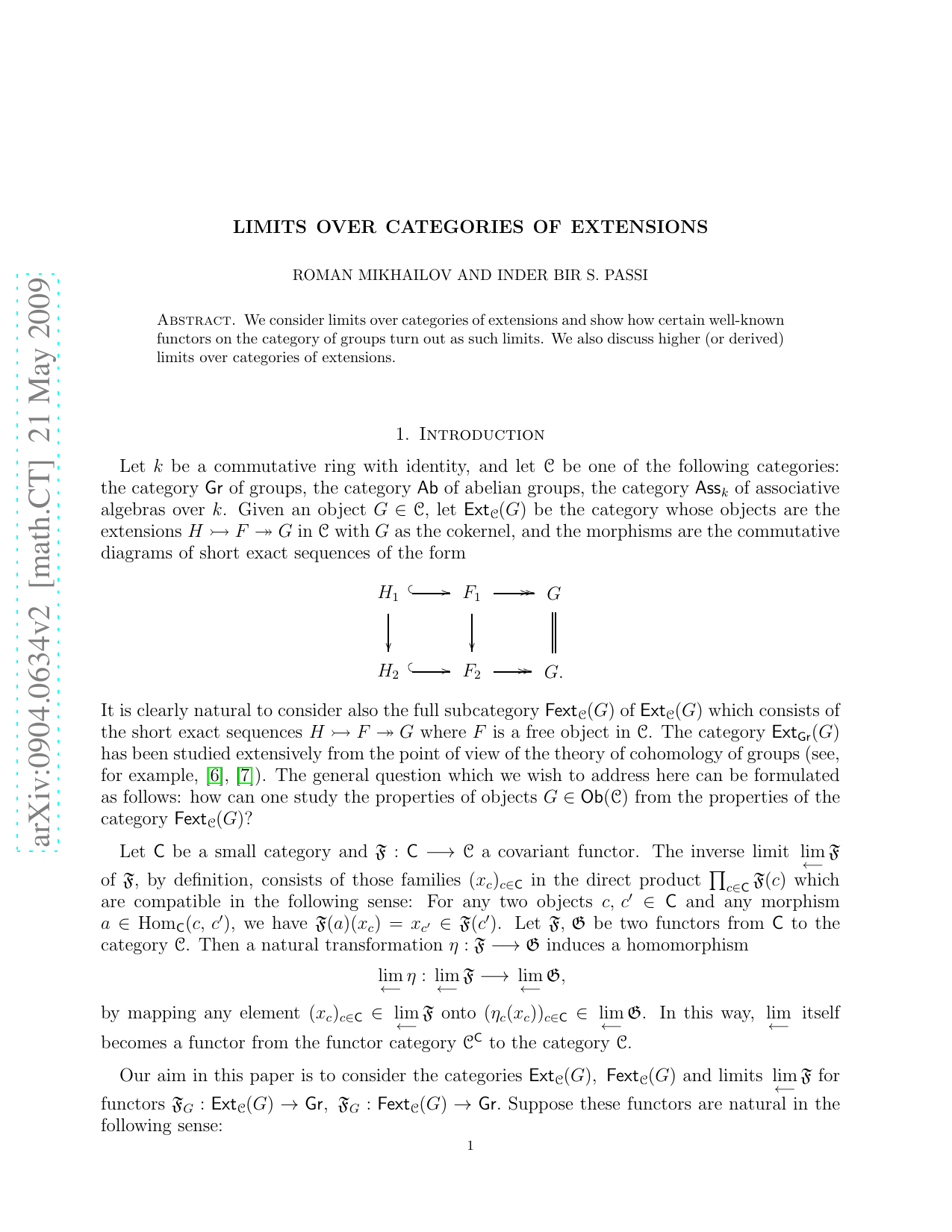
Let k be a commutative ring with identity, and let C be one of the following categories: the category Gr of groups, the category Ab of abelian groups, the category Ass k of associative algebras over k. Given an object G ∈ C, let Ext C (G) be the category whose objects are the extensions H F ։ G in C with G as the cokernel, and the morphisms are the commutative diagrams of short exact sequences of the form
It is clearly natural to consider also the full subcategory Fext C (G) of Ext C (G) which consists of the short exact sequences H F ։ G where F is a free object in C. The category Ext Gr (G) has been studied extensively from the point of view of the theory of cohomology of groups (see, for example, [6], [7]). The general question which we wish to address here can be formulated as follows: how can one study the properties of objects G ∈ Ob(C) from the properties of the category Fext C (G)?
Let C be a small category and F : C -→ C a covariant functor. The inverse limit lim
In that case the limit of the functors over categories of extensions defines a functor C → Gr by setting
To clarify our point of view further, let us recall some known examples which have motivated our present investigation. Let C = Gr, G a group, Z[G] its integral group ring and M a Z[G]module. For n ≥ 1, define the functor
M, where R ab denotes the abelianization of R, the action of G on R ⊗n ab is diagonal and is defined via conjugation in F . It is shown by I. Emmanouil and R. Mikhailov in [4] that lim
For any group G and field k of characteristic 0 viewed as a trivial G-module, the homology groups H n (G, k), n ≥ 2, appear as inverse limits for suitable natural functors defined on the category Ext Gr (G) (see [5] for details).
Consider the category C = Ass Q of associative algebras over Q, the field of rationals. For integers n ≥ 1, and an associative algebra A over Q, consider the functors
given by setting ( 5)
where [R, R] is the Q-submodule of R, generated by the elements rs -sr with r, s ∈ R. It has been shown by D. Quillen in [11] that the inverse limit lim
F n is isomorphic to the even cyclic homology group HC 2n (A, Q):
Furthermore, the Connes suspension map S : HC 2n (A, Q) → HC 2n-2 (A, Q) can be obtained as follows:
where the right hand side map is induced by the natural projection
The motivation for our investigation should now be clear from the above examples: one takes quite simple functors, like (3) and ( 5), on the appropriate categories of extensions and asks for the corresponding inverse limits. It is then also natural to consider the derived functors lim ←-i : Ab Fext(G) → Ab of the limit functor. Every functor F : Fext C (G) → Ab which is natural in the above-mentioned sense (see diagrams (1) and ( 2)) determines a series of functors C → Ab by setting G → lim
We now briefly describe the contents of the present paper. We begin by recalling in Section 2 two properties of the limits given in [4] and [5]. The first (Lemma 2.1) provides a set of vanishing conditions for lim ←-F while, the second states that lim ←-F embeds in F(c 0 ) for every quasi-initial object c 0 . In Section 3 (Theorems 3.1 and 3.4) we show how the derived functors in the sense of A. Dold and D. Puppe [3] of certain standard non-additive functors on Ab, like tensor power, symmetric power, exterior power, are realized as limits of suitable functors over extension categories. In Section 4 we discuss higher limits and prove (Theorem 4.4) that for the functor
not a perfect group. We conclude with some remarks and possibilities for further work in Section 5.
Recall that the coproduct of two objects a and b in a category C is an object a ⋆ b which is endowed with two morphisms ι a : a -→ a ⋆ b and ι b : b -→ a ⋆ b having the following universal property:
For any object c of C and any pair of morphisms f : a -→ c and g : b -→ c, there is a unique morphism h :
The morphism h is usually denoted by (f, g).
We recall from [4] the following Lemma which provides certain conditions which imply the triviality of the inverse limit. Lemma 2.1. [4] Let C be a small category and F : C -→ Ab a functor to the category of abelian groups, and suppose that the following conditions are satisfied:
(i) Any two objects a, b of C have a coproduct (a ⋆ b, ι a , ι b ) as above.
(ii) For any two objects a, b of C the morphisms ι a : a -→ a ⋆ b and
of abelian groups. Then, the inverse limit lim
F be a compatible family and fix an object a of C. We consider the coproduct a ⋆ a of two copies of a and the morphisms ι 1 : a -→ a ⋆ a and ι 2 : a -→ a ⋆ a. Then, we have
) and hence the element (x a , -x a ) is contained in the kernel of the additive map
In view of our assumption, this latter map is injective and hence x a = 0. Since this is the case for any object a of C, we conclude that the compatible family (x c ) c∈Ob(C) vanishes, as asserted.
We next mention another property of the limit functor. Recall that an object c 0 of a category C is called quasi-ini
…(Full text truncated)…
This content is AI-processed based on ArXiv data.