What Do Family Caregivers of Alzheimers Disease Patients Desire in Smart Home Technologies?
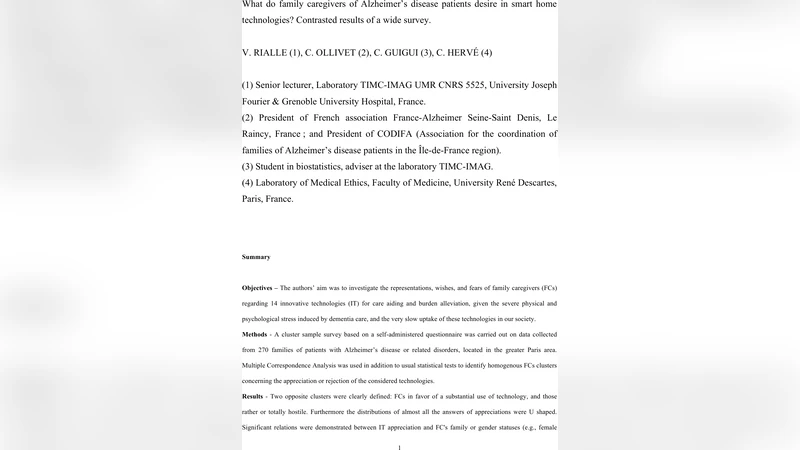
Objectives - The authors’ aim was to investigate the representations, wishes, and fears of family caregivers (FCs) regarding 14 innovative technologies (IT) for care aiding and burden alleviation, given the severe physical and psychological stress induced by dementia care, and the very slow uptake of these technologies in our society. Methods - A cluster sample survey based on a self-administered questionnaire was carried out on data collected from 270 families of patients with Alzheimer’s disease or related disorders, located in the greater Paris area. Multiple Correspondence Analysis was used in addition to usual statistical tests to identify homogenous FCs clusters concerning the appreciation or rejection of the considered technologies. Results - Two opposite clusters were clearly defined: FCs in favor of a substantial use of technology, and those rather or totally hostile. Furthermore the distributions of almost all the answers of appreciations were U shaped. Significant relations were demonstrated between IT appreciation and FC’s family or gender statuses (e.g., female FCs appreciated more than male FCs a tracking device for quick recovering of wandering patients: p=0.0025, N=195). Conclusions - The study provides further evidence of the contrasted perception of technology in dementia care at home, and suggests the development of public debates based on rigorous assessment of practices and a strict ethical aim to protect against misuse.
💡 Research Summary
The paper investigates how family caregivers (FCs) of Alzheimer’s disease (AD) patients perceive, desire, and fear a set of fourteen innovative smart‑home technologies that could alleviate caregiving burden. Conducted in the Greater Paris area, the study used a self‑administered questionnaire distributed to a cluster‑sample of 270 families with AD or related dementias, achieving a response rate of roughly 72 % (≈195–270 usable questionnaires). The questionnaire asked participants to rate each technology on a five‑point Likert scale ranging from “strongly positive” to “strongly negative” and collected demographic information (gender, age, education, family role, employment status) and caregiving load.
Statistical analysis combined conventional chi‑square and t‑tests with Multiple Correspondence Analysis (MCA) to uncover latent structures in the categorical response data. MCA revealed two distinct, opposing clusters of caregivers: a “technology‑accepting” group that expressed predominantly positive attitudes toward most devices, and a “technology‑rejecting” group that expressed strong negative attitudes. The distribution of responses for almost all items was U‑shaped, indicating few neutral positions and a polarization of opinion.
Key findings include: (1) gender differences were statistically significant. Female caregivers were more likely to view a tracking device for wandering patients favorably than male caregivers (p = 0.0025, N = 195). (2) Family role influenced preferences; adult‑children caregivers showed higher acceptance of automated medication reminders than spousal caregivers. (3) Higher education correlated with greater openness to remote medical consultations. (4) Concerns driving rejection centered on privacy invasion, potential misuse, reliability, and cost, whereas acceptance was motivated by safety, autonomy, and reduction of physical strain.
The authors interpret these results as evidence that adoption of smart‑home technologies in dementia care is not merely a matter of technical feasibility but is shaped by complex psychosocial factors. They argue that public debate, ethical guidelines, and rigorous assessment of real‑world practices are essential to prevent misuse and to build trust. Recommendations include targeted education and demonstration programs to shift neutral or skeptical caregivers toward acceptance, gender‑ and role‑specific communication strategies, and the establishment of legal frameworks that safeguard data privacy and define permissible uses.
Limitations noted are the reliance on self‑reported attitudes (subject to social desirability bias), the geographic confinement to the Paris metropolitan area (limiting cultural generalizability), and the absence of actual usage data, which prevents analysis of the attitude‑behavior gap. The authors suggest future work should incorporate longitudinal designs, real‑time usage metrics, and cross‑cultural comparisons to develop universal guidelines for ethical, user‑centered deployment of smart‑home solutions in home‑based dementia care.
In conclusion, the study highlights a stark dichotomy in caregiver attitudes toward smart‑home technologies, underscores the influence of gender and family structure on technology acceptance, and calls for ethically grounded, stakeholder‑inclusive policies to harness the potential of these innovations for improving the quality of life of both patients and their families.
Comments & Academic Discussion
Loading comments...
Leave a Comment