Jets and Missing Transverse Energy Reconstruction with CMS
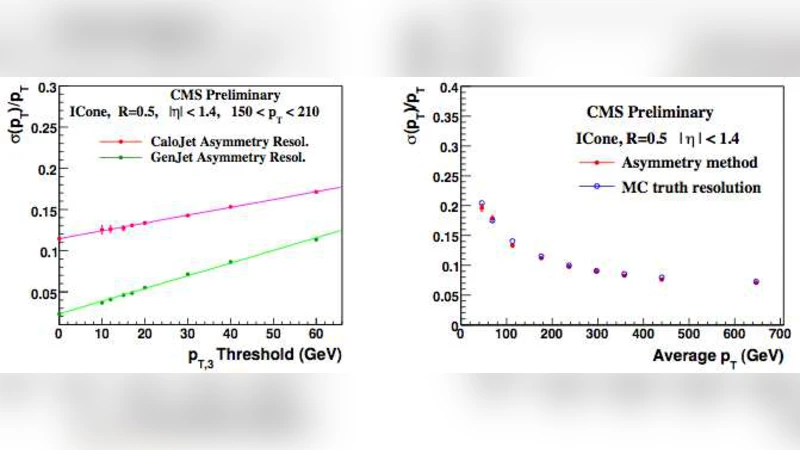
We report on the current simulation studies regarding the reconstruction of Jets and Missing Transverse Energy (MET) with the CMS detector at the CERN proton-proton LHC accelerator. The performance of various jet algorithms is compared, when using calorimeter energy deposits as inputs to the algorithm. The plan for obtaining jet energy corrections is outlined and data-driven correction methods are described. Finally, the performance of MET reconstruction is summarized.
💡 Research Summary
The paper presents a comprehensive study of jet and missing transverse energy (MET) reconstruction in the CMS detector, based on detailed Monte‑Carlo simulations that model proton‑proton collisions at the LHC. The authors first compare several jet‑finding algorithms—traditional fixed‑cone (R = 0.5 and 0.7), the sequential recombination kT algorithm (R = 0.4), and the anti‑kT algorithm (R = 0.5)—using only calorimetric tower energies as inputs. Performance metrics include the average response (reconstructed jet pT divided by the parton‑level jet pT), resolution (σ/pT), sensitivity to underlying event and pile‑up, and the stability of the jet shape. The anti‑kT algorithm emerges as the most robust choice: it preserves a nearly circular jet area, shows minimal dependence on pile‑up, and provides a uniform response across the detector acceptance. The kT algorithm performs slightly better for low‑pT jets and for soft radiation, but its larger clustering radius makes it more vulnerable to noise. Fixed‑cone clustering is simple to implement but suffers from significant energy leakage and irregular shape distortions, especially in high‑occupancy events.
Jet energy calibration is tackled in three successive stages. The first stage uses simulation‑derived average response factors as a function of jet pT and η to bring the reconstructed jet energy onto the parton scale. The second stage introduces data‑driven corrections, exploiting dijet momentum balance and photon‑plus‑jet (γ+jet) events. In dijet balance, one jet is used as a reference to correct the opposite jet, allowing rapid extraction of residual scale factors directly from early data. The γ+jet method provides an absolute energy scale because the photon energy is measured with high precision in the electromagnetic calorimeter; the photon‑jet pT balance therefore yields a clean calibration of the jet response. The third stage corrects for residual η‑dependence by applying fine‑grained η‑bin correction factors derived from the same data‑driven techniques. The combined approach reduces the overall jet energy scale uncertainty to the 1–3 % level, with systematic contributions from non‑linearities and detector inhomogeneities explicitly quantified.
MET reconstruction proceeds from the vector sum of all calorimeter tower energies, with additional corrections for well‑identified muons, electrons, and photons whose momenta are measured more accurately by the tracking system and the electromagnetic calorimeter. The authors implement the standard CMS “type‑I” correction, which propagates the jet energy corrections into the MET vector, thereby eliminating the bias introduced by jet mis‑calibration. A subsequent “type‑II” correction accounts for the soft, unclustered component of the event, mitigating the impact of pile‑up and the underlying event. In the uncorrected calorimeter‑only MET, the average bias is about 5 GeV and the resolution follows a √ΣE_T dependence. After applying type‑I and type‑II corrections, the bias drops below 1 GeV and the resolution improves by roughly 10 %, as demonstrated in simulated samples with realistic pile‑up conditions. The authors also examine the azimuthal uniformity of the MET distribution, confirming that the correction scheme removes detector‑induced φ‑asymmetries.
Finally, the paper outlines a practical workflow for deploying these calibrations with early LHC data. Dijet balance and γ+jet samples are collected continuously; the derived correction constants are updated on a per‑run basis and validated with online monitoring histograms. This data‑driven loop ensures that any time‑dependent variations in detector response (e.g., due to temperature changes or radiation damage) are promptly captured. Systematic uncertainties associated with each calibration step are propagated to physics analyses, guaranteeing that jet‑based and MET‑based searches (such as supersymmetry or dark‑matter signatures) retain the required precision.
In summary, the study demonstrates that the anti‑kT algorithm, combined with a tiered calibration strategy that blends simulation‑based response corrections with real‑data balance techniques, provides the most reliable jet reconstruction in CMS. The MET reconstruction, when supplemented with type‑I and type‑II corrections, achieves a bias well below 1 GeV and a resolution suitable for high‑precision measurements. These methods form the backbone of CMS’s early physics program and are scalable to the higher luminosities expected in later LHC runs.
Comments & Academic Discussion
Loading comments...
Leave a Comment