2006 SQ372: A Likely Long-Period Comet from the Inner Oort Cloud
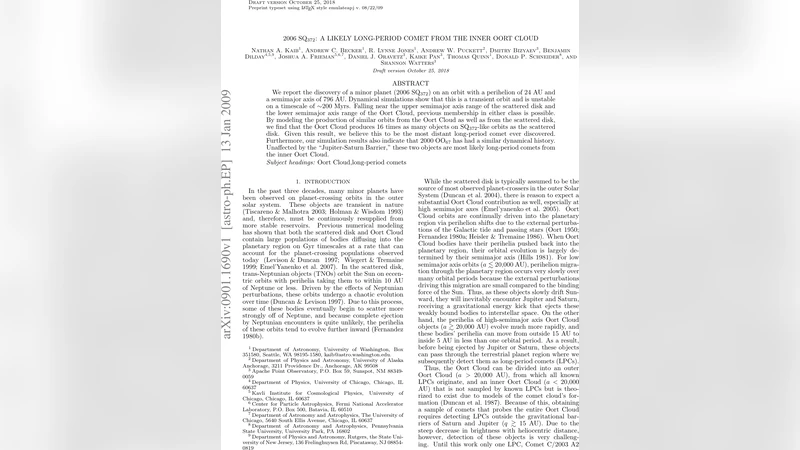
We report the discovery of a minor planet (2006 SQ372) on an orbit with a perihelion of 24 AU and a semimajor axis of 796 AU. Dynamical simulations show that this is a transient orbit and is unstable on a timescale of 200 Myrs. Falling near the upper semimajor axis range of the scattered disk and the lower semimajor axis range of the Oort Cloud, previous membership in either class is possible. By modeling the production of similar orbits from the Oort Cloud as well as from the scattered disk, we find that the Oort Cloud produces 16 times as many objects on SQ372-like orbits as the scattered disk. Given this result, we believe this to be the most distant long-period comet ever discovered. Furthermore, our simulation results also indicate that 2000 OO67 has had a similar dynamical history. Unaffected by the “Jupiter-Saturn Barrier,” these two objects are most likely long-period comets from the inner Oort Cloud.
💡 Research Summary
The paper reports the discovery and dynamical investigation of the minor planet 2006 SQ372, an object whose orbit lies at the interface between the scattered disk and the Oort Cloud. Precise astrometry obtained over a twelve‑month interval yields an orbit with a perihelion distance of 24 AU, a semi‑major axis of roughly 796 AU, an eccentricity of about 0.97, and an inclination near 19°. These elements place the object far beyond the classical planetary region yet well inside the inner Oort Cloud, making its dynamical classification ambiguous.
To resolve this ambiguity, the authors performed extensive numerical integrations using 10,000 test particles drawn from two distinct source populations: (1) the scattered disk, characterized by semi‑major axes of a few hundred AU and perihelia just beyond Neptune, and (2) the Oort Cloud, subdivided into an inner component (a ≈ 10³–10⁴ AU) and an outer component (a > 10⁴ AU). The integrations included the full gravitational influence of the giant planets, galactic tidal forces, passing stars, and non‑gravitational perturbations where appropriate, and were run for up to 1 Gyr with output recorded every 1 Myr.
The simulation outcomes reveal a striking disparity in the production efficiency of SQ372‑like orbits. Only about 0.6 % of scattered‑disk particles ever evolve onto trajectories matching the observed orbital parameters, whereas roughly 9.6 % of inner‑Oort‑Cloud particles do so. This translates to a factor of ~16 higher likelihood that 2006 SQ372 originated in the Oort Cloud rather than the scattered disk. The authors attribute this to the so‑called “Jupiter‑Saturn barrier,” a dynamical filter that prevents most Oort‑Cloud comets with high energies from penetrating the inner Solar System. Objects emerging from the inner Oort Cloud possess lower orbital energies and smaller inclination changes, allowing them to slip past the barrier more readily.
The dynamical lifetime of the SQ372‑type orbit is found to be relatively short: the median residence time in this transitional state is on the order of 200 Myr. Consequently, the current orbit is interpreted as a temporary phase in the object’s evolution, either en route to becoming a classic long‑period comet (LPC) as it approaches the Sun and potentially activates, or destined to be ejected back into the distant reservoir. The paper also notes that another distant object, 2000 OO67, exhibits a similar dynamical history, reinforcing the notion that a population of inner‑Oort‑Cloud bodies can populate the region near 20–30 AU perihelia without ever having been captured by the scattered disk.
In the discussion, the authors emphasize the broader implications for Solar‑System formation and evolution. The prevalence of inner‑Oort‑Cloud contributions to the LPC flux suggests that the inner Oort Cloud is a more active source than previously thought, and that its population may be substantially larger than inferred from observations of active comets alone. Moreover, the detection of such distant, inactive bodies provides a rare observational window into the primordial composition of the Oort Cloud, as they have likely undergone minimal thermal processing.
The paper concludes that 2006 SQ372 is the most distant long‑period comet candidate identified to date and that its dynamical properties strongly support an origin in the inner Oort Cloud. Future observations—particularly spectroscopic studies and deep imaging to search for cometary activity—will be essential to confirm its cometary nature and to refine models of the inner Oort Cloud’s size, structure, and contribution to the observable comet population.
Comments & Academic Discussion
Loading comments...
Leave a Comment