Middle Convolution and Heuns Equation
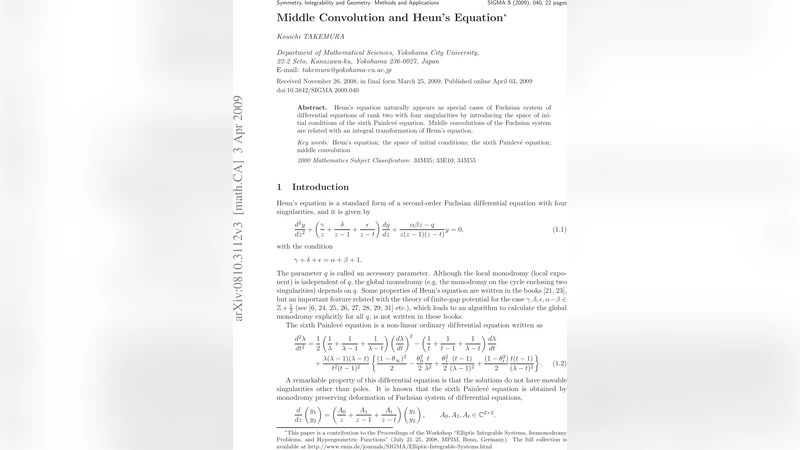
Heun’s equation naturally appears as special cases of Fuchsian system of differential equations of rank two with four singularities by introducing the space of initial conditions of the sixth Painlev'e equation. Middle convolutions of the Fuchsian system are related with an integral transformation of Heun’s equation.
💡 Research Summary
The paper “Middle Convolution and Heun’s Equation” establishes a deep and explicit connection between rank‑two Fuchsian systems with four regular singular points and the classical Heun differential equation, using the framework of the sixth Painlevé equation (PVI). The authors begin by recalling that a rank‑two Fuchsian system with singularities at (z=0,1,t,\infty) can be encoded by a Riemann‑Hilbert data set ({\theta_0,\theta_1,\theta_t,\theta_\infty}) together with a monodromy representation in (SL_2(\mathbb{C})). By interpreting the space of initial conditions of PVI as a moduli space of such Fuchsian systems, they show that the isomonodromic deformation equations of the system are precisely the Painlevé VI equation.
The central technical tool is Katz’s middle convolution (MC), an operation that shifts the local exponents of a Fuchsian system by a complex parameter (\lambda) while preserving its rank. The authors give a concrete matrix‑realisation of MC for the four‑point case, distinguishing the additive and multiplicative versions. They prove that applying MC with (\lambda=\frac12) transforms the original system (\mathcal{F}) into a new system (\mathcal{F}^{\frac12}) whose Riemann scheme differs from that of (\mathcal{F}) by exactly half‑unit shifts in each exponent.
Next, the paper turns to the Heun equation, written in its standard form with parameters (\alpha,\beta,\gamma,\delta,\epsilon,q) satisfying the Fuchsian condition (\gamma+\delta+\epsilon=\alpha+\beta+1). By comparing the Riemann scheme of (\mathcal{F}^{\frac12}) with that of Heun’s equation, the authors derive explicit linear relations between the Fuchsian exponents and the Heun parameters. Crucially, they construct an integral transform
\
Comments & Academic Discussion
Loading comments...
Leave a Comment