Integrals and Valuations
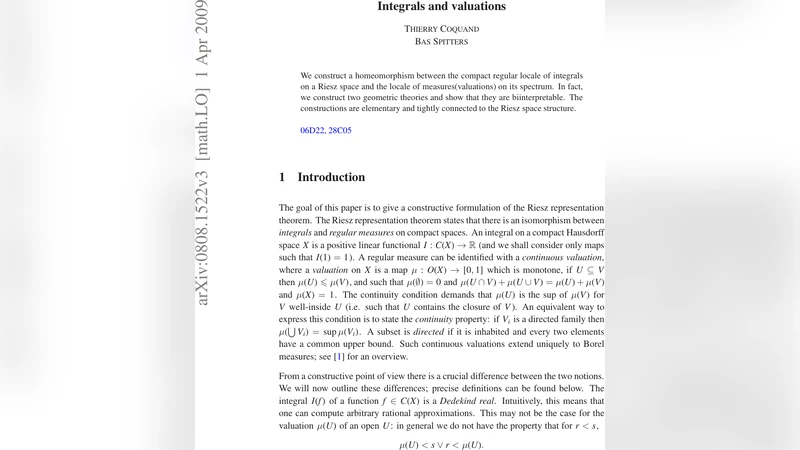
We construct a homeomorphism between the compact regular locale of integrals on a Riesz space and the locale of (valuations) on its spectrum. In fact, we construct two geometric theories and show that they are biinterpretable. The constructions are elementary and tightly connected to the Riesz space structure.
💡 Research Summary
The paper establishes a precise correspondence between two point‑free structures that arise from a Riesz space: the locale of integrals (positive linear functionals) on the space and the locale of valuations (measure‑like maps) on its spectrum. After recalling the classical theory of Riesz spaces, positive linear functionals, and the role of valuations in measure theory, the authors introduce the language of locales, emphasizing that a locale is defined by its lattice of open sets rather than by points.
In the first technical section the authors construct the “integral locale”. Starting from the set of all positive linear functionals on the given Riesz space, they generate a frame whose basic opens are statements of the form “the functional takes a value in a given rational interval”. This frame is shown to be compact, regular, and completely determined by the algebraic operations of the underlying Riesz space (addition, scalar multiplication, and lattice operations). The resulting locale captures exactly the constructive content of integration without referring to any underlying point‑set space.
The second section deals with the spectrum of the Riesz space, defined as the locale of its prime ideals. By interpreting each prime ideal as a “point” of the space, the authors obtain a point‑free spectrum equipped with a natural frame of opens. On this spectrum they define the “valuation locale”: a valuation assigns a non‑negative real number to each open, satisfying finite additivity and monotonicity in the sense of locale theory. The basic opens of this frame are statements of the form “the valuation of a given open lies in a rational interval”.
The core contribution appears in the third section, where the authors formulate two geometric theories—one describing integrals and the other describing valuations. Using the machinery of geometric logic, they construct interpretations of each theory inside the other, thereby proving that the two theories are bi‑interpretable. Consequently, the two frames they generate are isomorphic as locales. The proof avoids classical order‑theoretic arguments; instead it relies on the existence‑preserving nature of geometric logic, making the result compatible with constructive mathematics.
Finally, the authors discuss the significance of the homeomorphism between the integral locale and the valuation locale. It provides a bridge between constructive integration theory and point‑free measure theory, showing that the algebraic structure of a Riesz space fully determines both notions. The paper also outlines potential extensions to non‑Archimedean Riesz spaces, to locales arising from non‑σ‑additive valuations, and to applications in computer science (domain theory) and quantum logic, where point‑free representations are particularly valuable.
Comments & Academic Discussion
Loading comments...
Leave a Comment