The transfer in mod-p group cohomology between Sigma_p int Sigma_{p^{n-1}}, Sigma_{p^{n-1}} int Sigma_p and Sigma_{p^n}
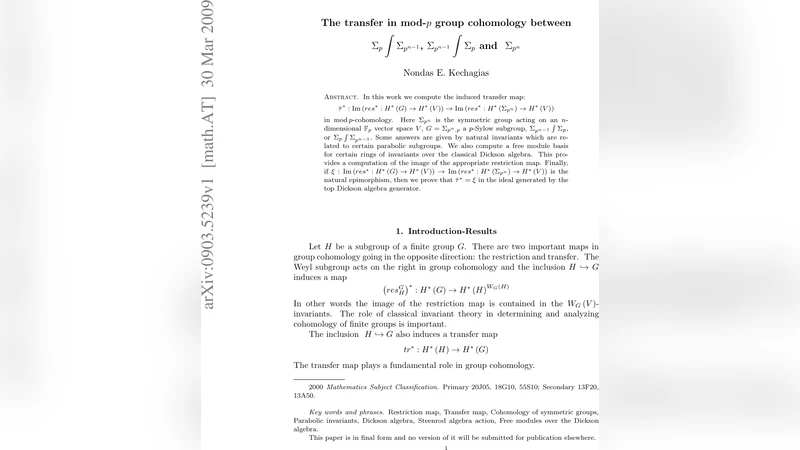
In this work we compute the induced transfer map: $$\bar\tau^\ast: \func{Im}(res^\ast:H^\ast(G) \to H^\ast(V)) \to \func{Im}(res^\ast: H^\ast (\Sigma_{p^n}) \to H^\ast(V))$$ in $\func{mod}p$-cohomology. Here $\Sigma_{p^{n}}$ is the symmetric group acting on an $n$-dimensional $\mathbb F_p$ vector space $V$, $G=\Sigma_{p^{n},p}$ a $p$-Sylow subgroup, $\Sigma_{p^{n-1}}\int \Sigma_{p}$, or $\Sigma_{p}\int \Sigma_{p^{n-1}}$. Some answers are given by natural invariants which are related to certain parabolic subgroups. We also compute a free module basis for certain rings of invariants over the classical Dickson algebra. This provides a computation of the image of the appropriate restriction map. Finally, if $ \xi :\func{Im}(res^\ast:H^\ast(G) \to H^\ast(V)) \to \func{Im}(res^\ast}: H^\ast(\Sigma_{p^n}) \to H^\ast(V)) $ is the natural epimorphism, then we prove that $\bar\tau^\ast=\xi$ in the ideal generated by the top Dickson algebra generator.
💡 Research Summary
The paper investigates the transfer map in mod‑p cohomology between the images of restriction maps for the symmetric group Σₚⁿ acting on an n‑dimensional 𝔽ₚ‑vector space V and three specific p‑Sylow subgroups G: the standard p‑Sylow Σₚⁿ,ₚ, the “upper” parabolic subgroup Σₚⁿ⁻¹ ⨝ Σₚ, and the “lower” parabolic subgroup Σₚ ⨝ Σₚⁿ⁻¹. The central object is the induced transfer
\
Comments & Academic Discussion
Loading comments...
Leave a Comment