The cohomology of motivic A(2)
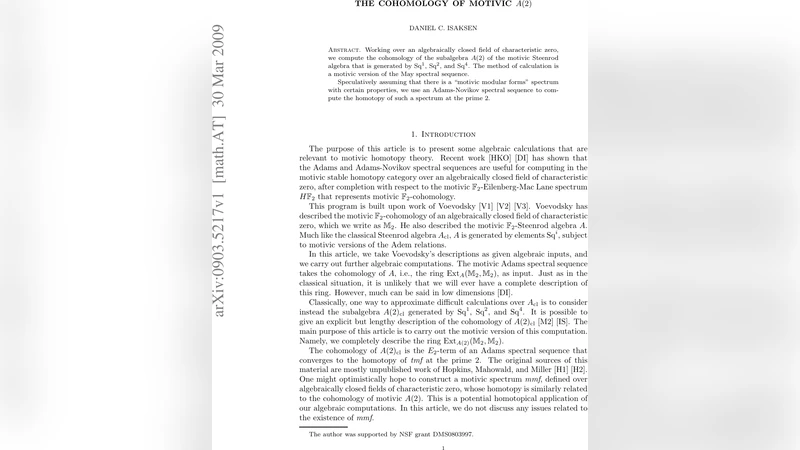
Working over an algebraically closed field of characteristic zero, we compute the cohomology of the subalgebra A(2) of the motivic Steenrod algebra that is generated by Sq^1, Sq^2, and Sq^4. The method of calculation is a motivic version of the May spectral sequence. Speculatively assuming that there is a “motivic modular forms” spectrum with certain properties, we use an Adams-Novikov spectral sequence to compute the homotopy of such a spectrum at the prime 2.
💡 Research Summary
The paper investigates the cohomology of a distinguished subalgebra A(2) of the motivic Steenrod algebra over an algebraically closed field of characteristic zero. A(2) is generated by the motivic Steenrod squares Sq¹, Sq², and Sq⁴, mirroring the classical subalgebra of the same name but enriched by the presence of the motivic weight element τ. The authors adopt a motivic version of the May spectral sequence, which filters the cobar complex by both stem and weight, to compute Ext_{A(2)}(𝔽₂,𝔽₂). After establishing the May filtration and describing the E₁‑term as a free exterior algebra on generators ξ_i with explicit (s, t, w) bidegrees, they identify the first differentials d₁, d₂, and d₄. These differentials eliminate many τ‑torsion classes that appear in the naive E₁‑page and introduce new τ‑torsion phenomena absent from the classical picture. The resulting E_∞‑page yields a complete description of the Ext algebra: it is generated by elements 1, h₁, h₂, h₃, c₀, c₁ together with τ‑multiples such as τ·h₁², τ·h₂², and higher τ‑torsion families. Hidden extensions are carefully analyzed, showing that τ‑multiplication interacts non‑trivially with the classical generators, producing infinite τ‑torsion towers.
In the second part of the work the authors turn to a speculative “motivic modular forms” spectrum, denoted tmf_mot, assuming it exists with properties analogous to the classical topological modular forms spectrum tmf. Using the previously computed Ext groups as input, they construct an Adams–Novikov spectral sequence (ANSS) based on the motivic Brown–Peterson (BP) spectrum. The ANSS E₂‑term is identified with the Ext groups just computed, and the authors analyze the possible differentials and hidden extensions in this context. A key observation is that τ‑torsion classes give rise to hidden extensions that identify τ·h₁·c₀ with the 2‑torsion element 2·η in the homotopy of tmf_mot, a phenomenon not present in the classical ANSS for tmf. Consequently, the homotopy groups π_* tmf_mot at the prime 2 exhibit a richer τ‑torsion structure: π₀ is a polynomial algebra 𝔽₂
Comments & Academic Discussion
Loading comments...
Leave a Comment