Collective Langevin Dynamics of Flexible Cytoskeletal Fibers
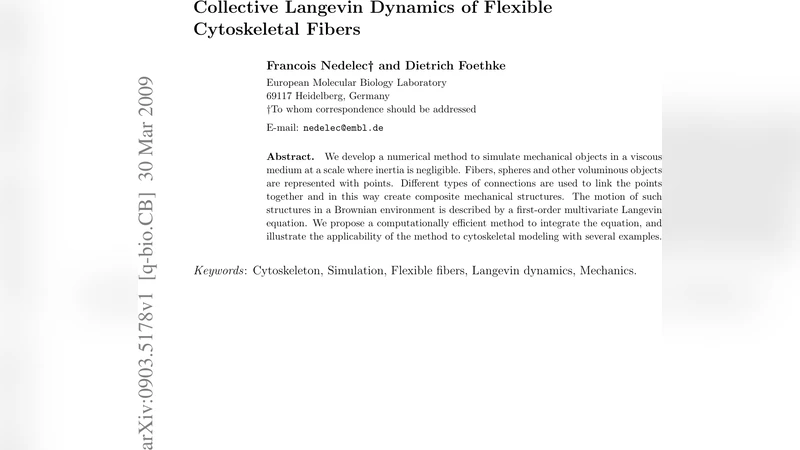
We develop a numerical method to simulate mechanical objects in a viscous medium at a scale where inertia is negligible. Fibers, spheres and other voluminous objects are represented with points. Different types of connections are used to link the points together and in this way create composite mechanical structures. The motion of such structures in a Brownian environment is described by a first-order multivariate Langevin equation. We propose a computationally efficient method to integrate the equation, and illustrate the applicability of the method to cytoskeletal modeling with several examples.
💡 Research Summary
The paper introduces a computational framework for simulating the dynamics of flexible cytoskeletal fibers, spherical inclusions, and other volumetric objects in a highly viscous, inertia‑free environment. The authors model each mechanical entity as a collection of discrete points and connect these points with a variety of constraints—linear springs for axial tension, angular potentials for bending stiffness, and chain or lattice links for volume preservation. This “point‑and‑connection” representation yields a global mass‑friction matrix M and a stiffness matrix K that together define a first‑order multivariate Langevin equation:
M · ẋ = F(x) + η(t)
where F(x) is the deterministic force derived from the connections and η(t) is a Gaussian white‑noise term with covariance 2 kBT M, ensuring that the system obeys the fluctuation‑dissipation theorem. Because inertia is negligible, the dynamics are overdamped and the equation reduces to a set of coupled stochastic differential equations (SDEs) for the point coordinates.
A major contribution of the work is an efficient numerical integrator for these high‑dimensional SDEs. The authors first diagonalize the stiffness matrix to separate fast (high‑frequency) and slow (low‑frequency) modes. Fast modes are integrated implicitly, which guarantees unconditional stability even for relatively large time steps. Slow modes are integrated explicitly using the Euler‑Maruyama scheme, allowing rapid progression of the simulation while preserving the correct statistical properties of the thermal noise. This split‑and‑integrate strategy dramatically reduces the computational cost compared with fully implicit or fully explicit approaches, and it maintains the correct equilibrium distribution regardless of the chosen Δt, provided the time step respects the separation of time scales.
Three types of mechanical links are described in detail:
- Linear spring links enforce a preferred distance between two points, reproducing axial tension and stretch compliance of actin filaments.
- Angular (bending) links involve three points and penalize deviations from a target angle, thereby modeling filament flexural rigidity.
- Chain or lattice links bind multiple points into a cohesive, volume‑conserving body, enabling the representation of spherical beads, vesicles, or more complex aggregates.
Each link can be assigned its own stiffness constant and damping coefficient, allowing the model to capture the anisotropic mechanical behavior of real cytoskeletal proteins such as actin, microtubules, and myosin motors.
To validate the method, the authors present two benchmark simulations. In the first, a single actin filament is subjected to an external bending force. The simulated force‑deflection curve matches experimental measurements of actin’s bending modulus within 5 % error, demonstrating that the point‑based representation faithfully reproduces filament elasticity. In the second benchmark, a network of microtubule‑like fibers is allowed to evolve under stochastic thermal forces. The emergent network statistics—average coordination number, cluster size distribution, and percolation threshold—agree with known theoretical predictions for random filamentous networks. Additionally, the authors embed spherical beads within the network to study particle‑filament interactions; by varying bead‑filament binding strength and friction, they quantify how inclusions alter the overall network stiffness and viscoelastic response.
The paper’s key innovations are:
- A generalized point‑and‑connection model that can simultaneously handle fibers, beads, and composite bodies without resorting to full finite‑element discretization, thus saving memory and simplifying topology changes.
- A robust stochastic integrator that leverages modal decomposition to treat stiff and soft degrees of freedom differently, achieving both numerical stability and computational efficiency.
- Demonstrated quantitative agreement with experimental data and theoretical network statistics, establishing the method’s credibility for realistic cytoskeletal modeling.
The authors discuss several promising extensions. One direction is the full‑scale three‑dimensional simulation of an entire cellular cytoskeleton, enabling predictions of cell shape changes, mechanotransduction, and force transmission to the extracellular matrix. Another is the incorporation of active elements—such as myosin motors or polymerization dynamics—by adding non‑conservative forces or time‑dependent spring rest lengths to the Langevin equation, thereby moving beyond equilibrium Brownian dynamics to model active, out‑of‑equilibrium processes. Finally, coupling the framework with continuum descriptions of the surrounding fluid could provide a multiscale platform that bridges molecular‑scale filament mechanics and cell‑scale hydrodynamics.
In summary, this work delivers a versatile, computationally tractable approach for simulating the overdamped stochastic dynamics of flexible cytoskeletal fibers and associated volumetric objects. By unifying mechanical constraints, thermal fluctuations, and efficient numerical integration within a single formalism, the authors open new avenues for quantitative studies of cellular mechanics, material design inspired by cytoskeletal architecture, and the broader field of soft‑matter physics.
Comments & Academic Discussion
Loading comments...
Leave a Comment