Support varieties for modules over stacked monomial algebras
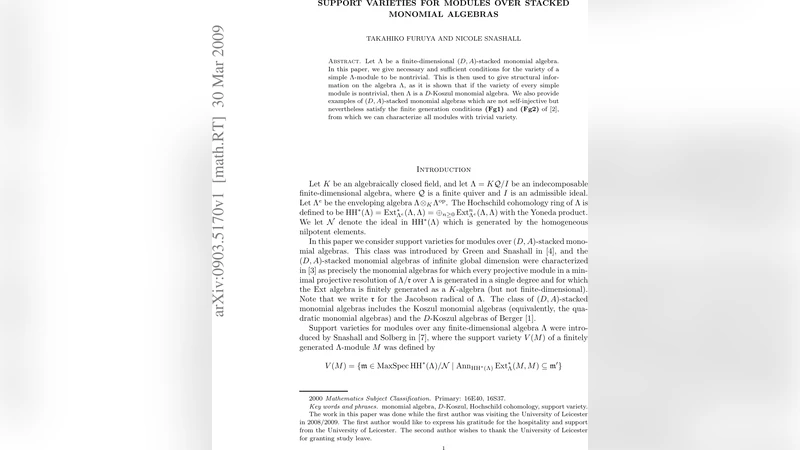
In this paper we give necessary and sufficient conditions for the variety of a simple module over a (D,A)-stacked monomial algebra to be nontrivial. This class of algebras was introduced in [Green and Snashall, The Hochschild cohomology ring modulo nilpotence of a stacked monomial algebra, Colloq. Math. 105 (2006), 233-258] and generalizes Koszul and D-Koszul monomial algebras. As a consequence we show that if the variety of every simple module over such an algebra is nontrivial then the algebra is D-Koszul. We give examples of (D,A)-stacked monomial algebras which are not selfinjective but nevertheless satisfy the finiteness conditions of [Erdmann, Holloway, Snashall, Solberg and Taillefer, Support varieties for selfinjective algebras, K-Theory 33 (2004), 67-87] and so some of the group-theoretic properties of support varieties have analogues in this more general setting and we can characterize all modules with trivial variety.
💡 Research Summary
The paper investigates support varieties for modules over a broad class of finite‑dimensional algebras called (D, A)‑stacked monomial algebras, a family introduced by Green and Snashall that simultaneously generalises Koszul monomial algebras (the case D = 2, A = 1) and D‑Koszul monomial algebras (A = 0). An algebra Λ in this class is defined as a quotient KQ/I of a path algebra by an ideal generated by monomial relations whose lengths are either D or D + A, arranged in a “stacked” pattern: each relation overlaps with the previous one by exactly A arrows. This combinatorial structure controls the homological behaviour of Λ.
The authors work with the Hochschild cohomology ring HH⁎(Λ) and its quotient by the ideal of nilpotent elements, denoted HH⁎(Λ)/𝒩. They prove that for any (D, A)‑stacked monomial algebra, HH⁎(Λ)/𝒩 is Noetherian, which is the key finiteness condition required to define support varieties in the sense of Snashall–Solberg. For a Λ‑module M, the support variety V(M) is defined as the maximal ideal spectrum of the annihilator of Ext⁎_Λ(M,M) regarded as a module over HH⁎(Λ)/𝒩. The variety is called trivial when V(M) = {0}.
The central result (Theorem 3.1) gives a necessary and sufficient condition for a simple module S_i (corresponding to a vertex i of the quiver) to have a non‑trivial support variety. Let C_i be a directed cycle in the quiver that passes through i, and let ℓ_i be its length. Then V(S_i) ≠ {0} iff ℓ_i is a multiple of D. The proof proceeds by constructing a specific homogeneous element z_D ∈ HH⁎(Λ)/𝒩 of degree D (coming from the D‑length relations) and showing that z_D acts non‑nilpotently on Ext⁎_Λ(S_i,S_i) exactly when ℓ_i ≡ 0 (mod D). If ℓ_i is not divisible by D, the action is nilpotent, forcing the annihilator to be the whole ring and the variety to collapse to the origin.
An immediate corollary (Corollary 3.3) is that if every simple Λ‑module has a non‑trivial support variety, then every cycle length in the quiver is a multiple of D; consequently Λ must be D‑Koszul. Thus the paper provides a homological characterisation of D‑Koszul monomial algebras within the larger (D, A)‑stacked family.
In Section 4 the authors address the finiteness conditions (Fg1) and (Fg2) introduced by Erdmann, Holloway, Snashall, Solberg and Taillefer for self‑injective algebras. They construct explicit examples of (D, A)‑stacked monomial algebras that are not self‑injective yet satisfy (Fg1) and (Fg2): HH⁎(Λ)/𝒩 remains Noetherian and Ext⁎_Λ(M,M) is a finitely generated HH⁎(Λ)/𝒩‑module for every finite‑dimensional Λ‑module M. Consequently, many group‑theoretic properties of support varieties—such as the dimension formula dim V(M⊕N) = max{dim V(M), dim V(N)} and the detection of projectivity via trivial varieties—hold in this non‑self‑injective setting.
Section 5 gives a complete description of modules with trivial support variety. The authors prove that a simple module S_i has V(S_i) = {0} precisely when the vertex i does not lie on any cycle whose length is divisible by D. Moreover, any module built from such simples by extensions, direct sums, or kernels of morphisms also has trivial variety. Conversely, any module with trivial variety must be constructed from these “non‑cycle” simples. This yields a clean homological classification: the support variety detects whether a module “sees” the D‑length cycles in the quiver.
The paper concludes with remarks on possible extensions. The authors suggest studying the geometry of support varieties for higher‑dimensional modules, exploring change‑of‑rings phenomena (e.g., passing to derived equivalences), and investigating whether the D‑divisibility condition can be relaxed while retaining a meaningful variety theory.
Overall, the work significantly broadens the applicability of support variety theory beyond self‑injective algebras, showing that the combinatorial data encoded in (D, A)‑stacked monomial algebras governs the homological behaviour of modules in a precise and computable way.
Comments & Academic Discussion
Loading comments...
Leave a Comment