Generalised Proof-Nets for Compact Categories with Biproducts
Just as conventional functional programs may be understood as proofs in an intuitionistic logic, so quantum processes can also be viewed as proofs in a suitable logic. We describe such a logic, the logic of compact closed categories and biproducts, p…
Authors: ** 논문에 명시된 저자는 **Duncan**(주 저자)와 **Abramsky**(공동 저자) 등이며, 구체적인 소속은 논문 본문에 따로 기재되지 않았다. (※ 실제 논문에서는 저자명과 소속이 명시되어 있을 것으로 예상된다.) --- **
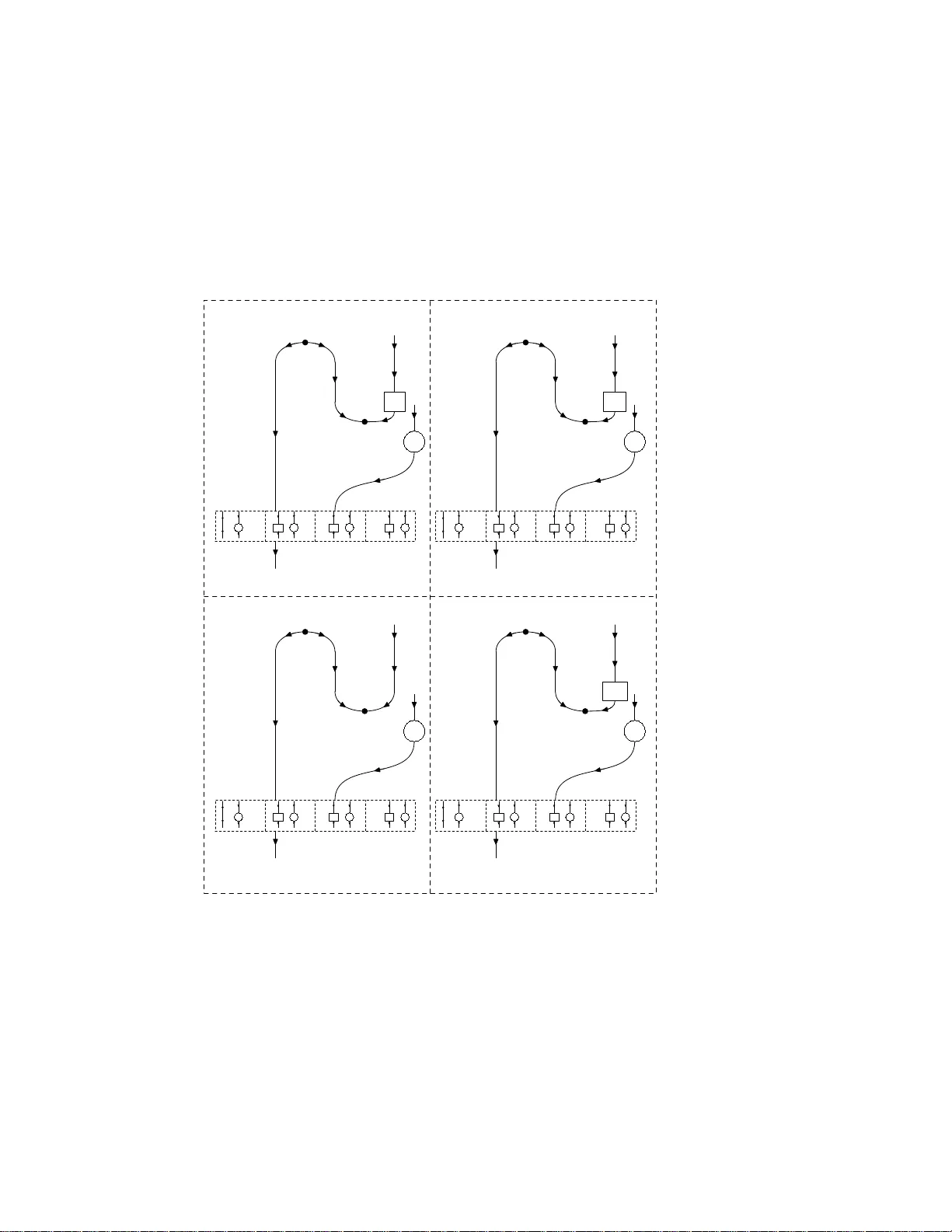
1 Generalised Pro of-Nets for Compact Categories with Bipro ducts Abstract Just as conven tional functional progr ams ma y b e unders to o d as pro ofs in an intuitionistic lo g ic, so quan tum pro cesses can also b e viewed as pro ofs in a suitable log ic. W e descr ibe such a logic, the log ic of compact closed categorie s and bipr o ducts, pr esented b o th as a sequent calculus and as a system of pro of-nets. This logic captures muc h of the necessa ry structure needed to r epresent quantum pro cesses under classical control, while re- maining agnostic to the fine de ta ils. W e demonstrate how to r epresent quantum pro cess es a s pro of-nets , and show that the dynamic b ehaviour of a quantum pr o cess is captured by the cut-elimination proce dure for the logic. W e sho w that the cut elimination proce dur e is strongly nor- malising: tha t is, that every legal way of simplifying a pro o f-net leads to the same, unique, no rmal for m. Fina lly , taking some initial set of op era- tions as non-log ical axioms, we show that that the re s ulting categ ory of pro of-nets is a repre s entation of the free compact clo sed ca tegory with bipro ducts generated by thos e o p er ations. 1.1 In tro duction 1.1.1 L o gic, Pr o c esses, and Cate gories Birkhoff and von Neumann initiated the logical study of quantum me- chanics in their 19 36 pap er [BvN36]. They cons tructed a lo gic by as- signing a pro p o sition letter to each observ able pro p erty of a given quan- tum sys tem, and studied nega tions, conjunctions, a nd disjunctions of these pro p er ties. The resulting lattice is non-distr ibutive, and so the heart of what is ca lled “quantum lo gic”is the study of v ario us k inds of non-distributive lattices. These traditional quantum log ics suffer from 1 2 a num b er of defects. Firstly , they are monolithic: there is no way to derive the prop erties of a comp osite system from the prop erties of its parts. E ach sys tem has its own a sso ciated lattice which can only r arely be r elated to those of other systems. F urther , these systems are seen statically: a sy s tem that under go es some dynamical c hang e is a new system. Finally , the failure of comp o s itionality is connected with the fact that quantum log ic has no decent notion o f implication [Sme01 ]; hence we have a logic which has a notion of v alidity , but no concept of infer enc e or pr o of . These limitations form a serio us obstacle to the use of Birkhoff-von Neumann-style quan tum log ic to study inter acting quantum systems. If by “sy stem” we unders tand the ubiq uitous qubit, then it is precise ly such interactions which form the basis of quantum informatics. Indeed, the principal concern of the computer scientist † —ho w to soundly con- struct lar ge systems from smaller ones—is exactly where quantum log ic is w ea kest. In this a r ticle I will describ e a v ery different kind of logic which can address these q uestions. This logic is ca lled ten s or-sum lo gic and it shares many fea tures with linear logic [Gir 87a], which has been widely studied in computer science and struc tur al pro of theory . W e pro ceed in ac cordance with an old traditio n in c o mputer science, that of linking co mputational systems and logics, of cla iming that a certain logic “is the same a s” some formal computing machine. The archet yp e of this a pproach is the Curry-Howard corresp ondence b etw een int uitionistic na tural deduction [Gen35, Pra65] and the simply-typed λ - calculus [CF58, How80 ]. The basic insig ht is that the inference r ule s of the logic a re es sentially the sa me as the constructor s used to form a λ -ter m. The v alid types o f the λ -calculus are no thing more than the theorems of the lo gic, and more imp ortantly every pro o f r epresents a λ -term. W e can thus view the lo gic itse lf as a co mputational system, with the impor tant proviso that the o b jects o f interest ar e the pr o ofs and not the theorems. This corres po ndence is not just skin deep. Re- call that the β -r eduction rela tion b etw een λ -terms expres ses the exe cu- tion b ehaviour of the calculus; we co nsider terms to be computationally equiv alen t when they reduce to the sa me β -nor mal form. This dynam- ical asp ect o f the λ -calculus co rresp onds exactly to the norma lisation pro cedure for natur al deductio n pro ofs or, in the sequent calculus set- ting, to the cut-elimination pro cedure [Gen35]. In our presen tatio n of † At l east: the principal concern of many computer scien tists. Gener alise d Pr o of-Nets for Comp act Cate gories with Bipr o ducts 3 tensor-sum logic we will take this co rresp ondence as given, and trea t the pro of theoretic presentation a s a computational sy s tem in its own right. The normalisation pro cedure gives the computational dynamics. There is a further c o rresp ondenc e that we eng a ge with r ather more seriously: that b etw een the pro o fs in a given logic and the arrows in a particular class of catego ries [La m68, La m6 9]. W e can equa te the prop o - sitions of a log ic L with the ob jects of a categor y C ; for each pro of of, say , a prop osition B from a premise A , we define a corresp o nding arrow f : A → B in the ca tegory . Stated so blandly , we have little structure to work with, so we g o further , and demand that the logical connectives are represented by functors on C . The na tural transfor mations b etw een these functors then give rise to the inference rules of the logic. In this wa y a n arrow in C may b e constr ucted for each pro of in L ; we say that C is a denotational m o del o f L if, whenever tw o pro o fs sha re the same normal form, they have equal denotatio ns in C . The categ orical mo del gives a n extensional acc ount o f the co mputational dynamics r e presented in the term language. The general schema o f this tr ipartite relation is shown in T able 1 .1. Computation Logic Category types form ulae ob jects terms proofs arro ws type formers connectives functors term constructors inference rules natural transformations T able 1.1 . Curry-Howar d-L amb ek c orr esp ondenc es T o return to our earlier example, the simply-typed λ -calculus forms such a triple with in tuitionistic natura l deductio n and the cla ss of Carte- sian clos e d categ ories [LS86]. Another example is pr ovided by int uition- istic m ultiplicative linear logic [Gir8 7a]; this logical system co rresp onds to the line ar λ -calculus and to the cla ss o f *-a utonomous categ ories [Bar79, Bar 91]. The pattern is quite gener al, a nd more examples ca n easily be found. This rela tionship b etw een a logic and its catego rical mo dels can be made exact. In the ab ov e description we embedded the co nnectives and inference r ules o f L in to C us ing o nly functors a nd natural transfor- mations: the lo g ical structure is agnostic with r esp ect to the conc r ete elements of the ca tegory . Hence an y categ ory with the requisite functors can provide a mo de l, up to some ass ignment of the ba sic prop osition let- 4 ters. O f cour se such a c a tegory may w ell contain o ther ob jects o r arrows which do not cor resp ond to anythin g in the logic we ar e tr ying to mo del. T o mak e the corr esp ondence exa ct w e must b e able to transla te fro m the fr e e c ate gory (with appropr iate structure) faithfully back to our logic. That is, we must find an injective transla tion from the arrows of C on to the cut-free proo fs of L . In the case of our gener alised pro of-nets , that is indeed p oss ible, but for a simpler example, consider the simply-typed λ -calculus with just one g round type; then the category of its terms is the free Cartesian closed categor y generated by the category 1 , which has only one ob ject, and o ne identit y a rrow. The choice of genera tor can b e rather impo rtant. B y cho osing a dis- crete catego r y (i.e. a set) the res ulting lo gic will have that set as its prop ositiona l v ariables. By choo sing a category with non-triv ia l a rrows, we int ro duce non-log ical a xioms: if cut-elimination for the res ulting logic is to b e re ta ined we must lift the co mpo sition op era tion of C into the cut-elimination pro cedur e of L itself. If other equa tions b etw een arr ows are req uir ed these to o must b e hois ted into the logic. In the case we consider here, the situation is even w or se: we will take as a generator a c omp act symmetric p olyc ate gory [Dun06]. This esoteric creature will b e describ ed in a later section, but for now we note that the int ric acy of the required comp osition forces the adoption of the pro of-net for malism, an illustration of the p ow er of graphica l metho ds ov er conv entional syntax. The dev elopment in the following s ections will be the reverse of the exp osition ab ov e. W e first describ e the ma thematical basis o f quantum computation in its co ncrete setting—finite dimensional Hilber t spac e s— then we ident ify cer tain structures of the category fdHilb w hich are the essential features for ca rrying out quan tum computation. Next w e present the s yntax of tens o r-sum lo gic, and finally prov e that the cate- gory of g e ne r alised pro of-nets is the free compa ct closed category with bipro ducts generated by a co mpact symmetric po lycatego r y . Prior W ork The orig inal formulation of quantum mechanics in terms of compact close d categorie s with bipro ducts was due to Abramsky and Co eck e [AC04]. An early attempt to formalise quan tum computations in terms of pro of-nets for MLL was [Dun04]. The first description of a logic based on compact closed categories and biproducts was g iven by Abramsky and the author in [AD06], howev er this log ic is ess ent ia lly restricted to quantum sys tems with only bipartite entanglement. This restriction was lifted in [Dun06] via the use o f p olyca tegories , although only the multiplicativ e fragment of the logic was tr eated. The pres e nt Gener alise d Pr o of-Nets for Comp act Cate gories with Bipr o ducts 5 article is ess ent ia lly a fusion of the previo us tw o: giving a complete pr e- sentation of t wo-sided pro o f-ne ts with genera lised axioms, a nd b oth the tensor and sum connectives. A notable distinctio n b etw een the trea t- men t o f the bipro duct he r e as compar ed to that of [A C04] is that here the bipro duct is freely generated, hence the our treatment is c lo ser to that of [Sel04]; w e will discuss the vexed p osition of this connective a t the end of Section 1.1.2. 1.1.2 Qu antum Me chanics C oncr etely, and Abstr actly The main work of this ar ticle is to characterise the structure of cer ta in kinds of category in terms of pro of-nets. The par ticular categorie s we are interested in are c omp act close d c ate gories with bipr o ducts , and in the next s ection we’ll go into co nsiderable detail defining, ch a r acterising , a nd giving so me o f the basic prop er ties o f such categ ories. In this s ection w e describ e, at a mor e intuitiv e level, how the structur e relates to quantum mechanics and quantum computation in particular. W e star t with a schematic descr iption of quantum mechanics. Since we ar e int er ested in qua nt um computation, we will restrict o urselves to qua ntu m systems with finite dimensiona l sta te spa c es. Cons ider the following axioms. (i) T o ea ch quantum s ystem we asso ciate a finite dimensional Hilb er t space, its state sp ac e ; the p ossible states of the system are unit vectors in the state spa ce, mo dulo a global phase factor . (ii) If t wo sy s tems are com bined, then their joint s tate space is the tensor pr o duct o f the t wo state spaces. (iii) Measuring a quantum sy stem is non- deterministic ; p ossible out- comes are the eigenv ector s o f some se lf-adjoint o per ator on the state space, a nd the pr obability of obs e r ving a particular out- come depends on the inner pro duct of the current state and the eigenv ector for that outcome. After the measure ment the state is updated to match the o bserved vector † , assuming it is not de- stroy ed b y the ac t o f measuring. (iv) F o r any discrete time s tep, the next state of the sys tem is deter- mined by a unitary map on its s tate space. Of cours e, we ha ve omitted s ome imp ortant details, but the ab ov e ax io ms approximate the level o f a bstraction of our categ orical fo r malisation. † W e ha ve impl icitly assumed that the measurement is non-degenerate. 6 The first thing we should note that the fdHilb , the ca tegory of finite dimensional Hilb ert s paces and linear ma ps, is the “natura l” categor y in which to formalise the ab ove ax ioms ‡ . The second po int is that fdHilb is compact closed and has bipr o ducts. Thirdly , the a b ove axio ms can b e rephrased in terms of the categ o rical structure alone. Before showing how the ingredients of the a xioms translate into cat- egorica l terms, let’s disp o s e of so me unnecessary bagg age. Consider a linear map ψ : C → H . Since it is linear, a nd its do main is one- dimensional, its v alue is fixed by its v alue on 1, he nce maps of this type are in 1-1 corr esp ondence with vectors of H . Hence w e ca n forget ab out vectors and talk only o f linea r maps. Now consider measurements. There ar e three pa rts to a q uantum measurement: the non-deterministic p os sibilities, the calcula tion of the probabilities, and the up dated state. W e will deal with these in r everse order. The new state of a measured system dep ends only on which outcome i of the mea s urement happ ened, hence it is just a new state | φ i i , with no particular rela tion to the old one. Of cours e, the measurement pro cess may destroy the system, in which case there is no new state. T o calculate the pr o bability o f seeing o utcome i when we are in state | ψ i we must calcula te the inner pro duct h φ i | ψ i . This pr o cess to o ca n be seen as a linear map, namely the pr o jection map h φ i | : H → C ; when comp osed with | ψ i this yie lds the inner pro duct. Hence the state transformatio n as so ciated to the i th outcome o f some measure ment is describ ed by the map: H h φ i | ✲ C | φ i i ✲ H . Note that this is desir ed transforma tion even in the case when o nly part of a comp osite system is measur ed. F or the purp oses of this work, calculating the proba bilities is not so impo rtant, but the transformatio n of the state is essential. Finally let’s consider the non-deterministic asp ect of measur ement. The ma in p o in t is that ther e several p ossible outco mes and we know which one happ ene d . Suppo se we per form a meas urement with tw o o ut- comes; we can view this pro c ess as map of type H → H ⊕ H ‡ As the first and last axioms suggest fdHilb is actu all y too big: i t con tains ve ctors and maps which do not correspond to an ything in quantum mechanics. The general program of describing quant um mechanics in categorical terms aim s to find the minimal structure required. Gener alise d Pr o of-Nets for Comp act Cate gories with Bipr o ducts 7 where the tw o sides o f the direct sum corresp o nd to the t wo “p ossible worlds” induced by the tw o outcomes o f the measurement. One can then represent conditional op eratio ns by acting on only one subspace or the other; for exa mple f ⊕ g b ehav es as the linear map f : H → H if the first outcome was obse r ved, and g : H → H if the seco nd was obse rved. How then can we wr ite the axioms of qua ntum mech a nic s in the lan- guage of co mpa ct closed ca tegories and bipro ducts? Firstly , compact closed c a tegories ar e equipp ed with a tensor pro duct, and this tensor pro duct ha s a neutral element I . In fdHil b the tenso r pr o duct is sim- ply the usual Kro neck er pr o duct, and its neutral element is the base field, na mely C . This gives us the firs t tw o ax ioms: • T o each q ua ntu m sys tem we ass o ciate a n o b ject A , its state space; the p ossible states of the system are given by arr ows ψ : I → A . • If tw o systems with state spa ces A and B resp ectively a re combined, then their joint state space is A ⊗ B . In fdHil b the bipr o duct is the direct sum of Hilb ert spa ces, and this will allow the forma lis ation o f mea surements. • An n -o utcome measurement of a quantu m sy stem whose sta te space is A is represented by a n a rrow m : A ✲ M i B i where each of the the pro jections π i ◦ m : A → B i factors as A ✲ I ✲ B i . This is very gener al notion o f measure ment. The common cas e s are when B i = I and the orig inal system is destroy ed; and, when B i = A when the original system is pres erved. Since we are int er ested in formalis ing as m uch of qua ntu m mechanics as poss ible within o ne ca tegory w e will not restrict state transforma tions to unitary evolutions; note that a measurement is a v alid transfor mation of a quantum state w hich is not unitary . Hence the last axiom is simply the fo llowing. • A quantum system A may tra ns form to a nother system B by means of any arrow f : A → B . W e hav e not yet mentioned the role of the compa ct structure of the category . While not required to paraphras e the a xioms, the compact structure plays an imp or tant role in ca pturing quantum phenomena. 8 Recall that the tensor pro duct o f tw o vector spa ces co ntains p oints, Ψ : I → A ⊗ B which cannot be factored into a pair of vectors ψ 1 : I → A and ψ 2 : I → B . The such qua ntum states are called en tangle d a nd they a central role in qua nt um computation. The compact str ucture guarantees the existence o f cer ta in entangled states, namely Bel l states for every finite dimensional Hilb ert s pace: η A : I → A ∗ ⊗ A . If A is tw o-dimensiona l, i.e. a qubit, then the cor r esp onding vector is η A (1) = | 0 0 i + | 11 i . F urther more, the compa ct str ucture also provides a pro jection o nt o this state ǫ A : A ⊗ A ∗ → I hence we can define measurements on Bell states. These tw o o p e r ations will allow many mor e entangled sta tes to b e defined. This completes o ur impressio nistic description of how quan tum me- chanics may b e fo rmalised in the categor ical setting. Before moving on, it w o r th po inting o ut what has b een excluded from our formalisa tion. Perhaps the mo st striking o mission in moving b etw een the concr ete ax - ioms and the abstract is the co ncept of unitarity . The abstract for mulation of quantum mechanics describ ed here is de- rived fro m that introduced in [A C04] which uses str ongly compact closed categorie s. Also ca lle d † -compact, these ca tegories are equipp ed with a contra v ariant inv olutive functor which sends each map f to its adjoint f † , and has no effect on ob jects. This functor can then b e used to define uni- tarity and the inner pro duct. In this a rticle, w e fo cus on fr e ely constr uc t- ing the compact closed and bipr o duct structure from some underly ing category o f genera tors. One could consider the case when these str uc- tures coher e with the ( · ) † op eration, giving a † -compac t category with † -bipro ducts; how ever the only difference here b etw een the † -structure and the original is that the structural iso morphisms are req uired to b e unitary . That is to say that the only new maps whic h ar e in tro duced are the adjoints of the generato rs. Hence we can simply enlarge the clas s of generator s be forehand, and there a fter ig nore the † -structure. O f course, when working on concr ete exa mples it is impo rtant to b e aw are of the adjoints, and the equational theory of the gener ators mor e g enerally , but that is not the fo cus o f the present ar ticle. The o ther imp or ta nt deviation fro m usua l qua nt um mechanics is that Gener alise d Pr o of-Nets for Comp act Cate gories with Bipr o ducts 9 we hav e b een extremely libera l ab out measurements. In particular we do not make any r e s triction on the num b er of outcomes a measurement may hav e. Of course, in quantum mechanics the outcomes are the sp ectrum of some o p erator, and hence ar e bo unded by the dimens io n o f the space. Considering these issues would take us to o far afield but [AC04] has o ne approach; a mo re recen t ca tegorica l trea tmen t of quantum observ ables is found in [CD08]. In any cas e , it see ms unlikely that the structure of quantum measur ements—being fundamentally connected to the bases of the under lying space—will yield to a descr iption in terms of natur al transformatio ns of some functors . Some R emarks on t he Bipr o duct In their origina l pa p er [AC04] Abramsky and Co eck e used the bipro duct of fdHilb in t wo r oles: firstly , to enco de cla ssical branching, a s describ ed ab ov e; and secondly , to construct b ases for the under lying space. In particular, they define sta te prepara tions and destructive measurements as is o morphisms of the forms base : M i I → A and meas : A → I M i . This seco nd us e of the bipr o duct has b een criticised by later works [Co e05a, Sel05] on tw o main accounts. In the orig ina l approa ch the comp osite A meas ✲ M i I meas ✲ A yields the iden tity map, co ntradicting physical reality—a real exp eri- men t would transform a pure s ta te to a mixed state, so mething not handled within this simple fr amework. More imp or tantly , when moving from a “vector space” s etting like fdHilb to a “pr o jective” setting, s uch as Selinger’s CPM co nstruction or Co eck e’s WPro j, the direct sum of the underlying space no longer yields a bipro duct. The only o ption is to co nstruct the bipro duct as formal vectors and matrices. The w ork s cited a b ove show that, in the pro jective setting, if there is a bipro d- uct then the sca lars ar e essentially restricted to pr ob abili ties ra ther than amplitudes . The immedia te co nsequence is that we m ust give up any hop e of using the additive s tr ucture to enco de in terfere nce effects: we are essentially restr icted to a c lassical probabilistic setting. The a pproach to bipro ducts tak en in this work is a bsolutely co nsonant with these restrictions. W e co ns truct b oth the multiplicativ e a nd addi- tive structures freely , and hence the scala rs ar e s imply a (free) semiring. 10 The theor y of proce s ses thus pro duced is muc h like that in tro duced in [Sel04], based on classic a lly co nt r o lled qua ntum op erations. 1.1.3 An Example Pr o of-net Sections 1.3 and 1 .4 will introduce tenso r-sum logic, and its pro of-net notation. Since those s ections will fo cus on the tec hnical details of the formalism we present now an illustra tive example o f how pro o f-nets c a n be used to to mo del qua nt um pro ces s es. W e will describ e an old fav ourite: the quantum telepo rtation pr o to col [BBC + 93]. The sketc h o f the proto col go es like this: Two parties, Alice and Bob, initially shar e an ent a ng led pair o f particles in a Bell sta te, | Bell i = | 00 i + | 11 i √ 2 The parties then separ ate, and at some la ter p oint Alice wan ts to send a qubit to Bob, but unfortunately she has only a clas sical channel. How- ever, it is still p ossible to tra nsmit the qubit b y using the shared entan- glement b etw een the t wo parties. T o pro ceed, Alice p erforms a joint mea surement on the qubit s he wishes to transmit together with her ha lf of the entangled pa ir. She measures in the Bell basis, so her sta te will b e pro jected onto one o f the following vectors: | Bell 1 i = | 00 i + | 11 i √ 2 | Bell Z i = | 00 i − | 11 i √ 2 | Bell X i = | 01 i + | 10 i √ 2 | Bell Y i = | 01 i − | 10 i √ 2 These states a re all entangled, a nd further , ea ch of them can b e pr o duced by starting with | B el l 1 i (ak a η ) and applying one of the Pauli o per ators; hence we can a sso ciate a Pauli o per ator to each outcome of the mea- surement. In or der to complete the proto col, Alice transmits a c lassical message to Bo b, saying which o f the four o utcomes she observed. Bob then applies the corr esp onding Pauli o pe r ation to his qubit and—as if by magic—it is now in the sta te that Alice wished to transmit. W e now show how this pr oto col can b e repr esented in term o f pro o f- nets using the compact close d str uctur e and bipro ducts. By norma lising the pr o of-net we will effectively simulate the exec utio n o f the proto c o l. W e start with a pr emise r epresenting Alice’s input, and a unit link, Gener alise d Pr o of-Nets for Comp act Cate gories with Bipr o ducts 11 representing the initial shar ed Bell state — η Note that in these diagr ams time flows fro m the top to the b ottom: input at the top of the page, o utputs at the b o ttom. The right tw o qubits ar e taken to b e long to Alice, the leftmost belo nging to Bob. The next element is the Bell bas is measurement. W e will as s ume this is a destructive measurement, so the four p os sible tra ns formations ar e simply pro jections. T o indicate that these form an exclusive choice, we put them in a b ox, as shown below. ⋆ ⊕ 1 — ⋆ X ⊕ 2 — ⋆ Y ⊕ 3 — ⋆ Z ⊕ 3 ǫ ǫ ǫ ǫ I I I I ⊕ 4 i =1 I ⊕ 4 i =1 I ⊕ 4 i =1 I ⊕ 4 i =1 I Notice the output of type ⊕ i I ser ves simply to indicate which outcome o ccurred Finally we co nsider Bob’s co rrection. Since his behaviour is condi- tional on a cla ssical input, he has a b ox with an input of type ⊕ i I a s shown below. ⊕ 1 — ⋆ X ⊕ 2 — ⋆ Y ⊕ 3 — ⋆ Z ⊕ 4 — ⋆ I I I I 12 Putting it all together we have the following picture: — — η ⊕ i I Q Q Q ⋆ ⊕ 1 — ⋆ X ⊕ 2 — ⋆ Y ⊕ 3 — ⋆ Z ⊕ 3 ǫ ǫ ǫ ǫ I I I I ⊕ 4 i =1 I ⊕ 4 i =1 I ⊕ 4 i =1 I ⊕ 4 i =1 I ⊕ 1 — ⋆ X ⊕ 2 — ⋆ Y ⊕ 3 — ⋆ Z ⊕ 4 — ⋆ I I I I Now we can b egin to simulate the pro to col. The firs t step is to resolve the non-determinism of Alice’s mea surement. W e do this by “op ening the b ox”, essentially ma king four copies o f the whole sys tem, o ne fo r Gener alise d Pr o of-Nets for Comp act Cate gories with Bipr o ducts 13 each po ssible outcome of the meas urement. — ⋆ — ⊕ 1 η ǫ ⊕ i I Q Q Q ⊕ 1 — ⋆ X ⊕ 2 — ⋆ Y ⊕ 3 — ⋆ Z ⊕ 4 — ⋆ I I I I — X ⋆ — ⊕ 2 η ǫ ⊕ i I Q Q Q ⊕ 1 — ⋆ X ⊕ 2 — ⋆ Y ⊕ 3 — ⋆ Z ⊕ 4 — ⋆ I I I I — Y ⋆ — ⊕ 3 η ǫ ⊕ i I Q Q Q ⊕ 1 — ⋆ X ⊕ 2 — ⋆ Y ⊕ 3 — ⋆ Z ⊕ 4 — ⋆ I I I I — Z ⋆ — ⊕ 4 η ǫ ⊕ i I Q Q Q ⊕ 1 — ⋆ X ⊕ 2 — ⋆ Y ⊕ 3 — ⋆ Z ⊕ 4 — ⋆ I I I I Next, in every copy the interaction of the ent a ng led state and the mea- 14 surement can b e rewr itten a s shown. — ⋆ — ⊕ 1 ⊕ i I Q Q Q ⊕ 1 — ⋆ X ⊕ 2 — ⋆ Y ⊕ 3 — ⋆ Z ⊕ 4 — ⋆ I I I I — X ⋆ — ⊕ 2 ⊕ i I Q Q Q ⊕ 1 — ⋆ X ⊕ 2 — ⋆ Y ⊕ 3 — ⋆ Z ⊕ 4 — ⋆ I I I I — Y ⋆ — ⊕ 3 ⊕ i I Q Q Q ⊕ 1 — ⋆ X ⊕ 2 — ⋆ Y ⊕ 3 — ⋆ Z ⊕ 4 — ⋆ I I I I — Z ⋆ — ⊕ 4 ⊕ i I Q Q Q ⊕ 1 — ⋆ X ⊕ 2 — ⋆ Y ⊕ 3 — ⋆ Z ⊕ 4 — ⋆ I I I I Now we can op en the b ox cor r esp onding to Bob’s non- determinism; this will leave us with sixteen copies of the system. W e won’t draw all o f these copies , s ince tw elve of them can b e erase d: these s are the case s the input tha t Bob is exp ecting do es not ma tch what Alice sends. W e Gener alise d Pr o of-Nets for Comp act Cate gories with Bipr o ducts 15 are left with: — — Q Q Q — X X — Q Q Q — Y Y — Q Q Q — Z Z — Q Q Q Now w e simply note (and this is not a lo gic al axio m) that X 2 = Y 2 = Z 2 = 1 so we can simply remov e these maps. Hence we hav e the normal 16 form: — — Q Q Q — — Q Q Q — — Q Q Q — — Q Q Q which show that in ev ery p ossible world, Alice has succ e ssfully formed a channel to Bob along which her state can b e trans mitted. Although we pr esented the r e w r ites in the or der that the steps of the pr oto col would b e carrie d out, in fact our pr o of-nets are strongly normalising, so any order would pro duce the same results. Having sketc hed the system, we move to the details. Fir st the category theory , then in Sections 1 .3 and 1.4 the logic. 1.2 Categorical Preliminarie s In this s e c tion, we introduce the neces sary categoric al structures, co m- pact closed ca teg ories and biproducts , and present their ba sic pro p er ties. Much of this mater ial is well known so pro ofs are omitted. Standar d ref- erences ar e Mac Lane [ML97] and Kelly-Laplaz a [KL 80]; o ther ma ter ial is derived from the author’s thesis [Dun06]. Other sources are cited as needed. Compact clo sed categor ies [KL80] ar e abundant thro ughout mathe- matics and computer science. E xamples include Rel , the categor y of sets and relatio ns, finitely-generated pro jective modules ov er a commu- Gener alise d Pr o of-Nets for Comp act Cate gories with Bipr o ducts 17 tative r ing and Conw ay ga mes (as c a tegorified in [Joy77]). In Hilb , the category of all Hilb ert spaces , the s ub-categor y of determined by the Hilber t-Schmit t maps is compact closed, and more genera lly , the nu- clear maps of a ny tensor e d *-categ ory [ABP99] for a compact closed sub- category . Of co urse, fdHi lb , the categor y of finite dimensional Hilb ert spaces is compact closed. In computer science compact clos ed categories hav e been studied in the context of typed concur rency as interaction categor ies [AGN96]; in logic, compact closed catego ries are deg enerate mo dels of m ultiplica- tive linear logic [AJ 94, Loa9 4, HS03 ]; in physics the categor y of n - dimensional cob or disms, used in top olog ical quantum field, theory is compact closed [BD95]. More examples are easy to find. W e define bipr o ducts and inv estiga te their basic pr o p erties in r elation to compact closed categ o ries. Categ ories with bipro ducts hav e b een studied since the ear liest days of category theory as part of the theory of Abelia n c ategorie s [Mit65, ML97]. Compa ct c lo sed ca tegories with bipro ducts hav e b een studied by Soloviev [Sol87]. A sp ecial cas e of compact clo sed categ ories with bipro ducts is T annakien c ate gory [Del91]. A recent contribution is by Hous ton [Hou08], who proved that every compact closed catego ry with pro ducts has bipro ducts. 1.2.1 Monoi dal Cate gories Definition 1 A c ate gory C is monoidal if e quipp e d with a functor ⊗ : C × C → C , a distinguishe d neutra l obje ct I , and natur al isomorphisms α A,B ,C : A ⊗ ( B ⊗ C ) ∼ = ✲ ( A ⊗ B ) ⊗ C, λ A : I ⊗ A ∼ = ✲ A, ρ A : A ⊗ I ∼ = ✲ A. F or the asso ciativi ty morphism α we r e quir e that t he p entagon A ⊗ ( B ⊗ ( C ⊗ D )) α ✲ ( A ⊗ B ) ⊗ ( C ⊗ D ) α ✲ (( A ⊗ B ) ⊗ C ) ⊗ D A ⊗ (( B ⊗ C ) ⊗ D ) 1 ⊗ α ❄ α ✲ ( A ⊗ ( B ⊗ C )) ⊗ D α ⊗ 1 ✻ c ommutes. The isomorphi sms λ and ρ expr ess t he neutr ality of I ; we 18 r e quir e that the fol lowing diagr am c ommutes: A ⊗ ( I ⊗ B ) α ✲ ( A ⊗ I ) ⊗ B A ⊗ B . ✛ ρ ⊗ 1 1 ⊗ λ ✲ Prop ositi o n 2 In a monoidal c ate gory the e quality λ I = ρ I holds and t he fol lowing dia gr ams c ommu te: ( A ⊗ B ) ⊗ I α ✲ A ⊗ ( B ⊗ I ) ( I ⊗ A ) ⊗ B α ✲ I ⊗ ( A ⊗ B ) A ⊗ B ✛ 1 ⊗ ρ ρ ✲ A ⊗ B . ✛ λ λ ⊗ 1 ✲ Pr o of Se e [JS93]. Definition 3 A monoidal c ate gory is symmetric if it has a natu r al iso- morphism σ A,B : A ⊗ B → B ⊗ A such that ( A ⊗ B ) ⊗ C σ ✲ C ⊗ ( A ⊗ B ) A ⊗ ( B ⊗ C ) ✛ α − 1 ( C ⊗ A ) ⊗ B α ✲ A ⊗ ( C ⊗ B ) α ✲ 1 ⊗ σ ✲ ( A ⊗ C ) ⊗ B , ✛ σ ⊗ 1 Gener alise d Pr o of-Nets for Comp act Cate gories with Bipr o ducts 19 and A ⊗ I σ ✲ I ⊗ A A ⊗ B 1 ✲ A ⊗ B A ✛ λ ρ ✲ B ⊗ A σ ✲ σ ✲ c ommute. Mac Lane’s celebra ted cohere nc e theorem states that any formal diagra m constructed fro m the α, ρ, λ and σ will comm ute. A monoidal categ ory is called str ict if the isomo rphisms α, λ ,and ρ are all identities. T o minimise syntactic ov er head we will make use o f the following theorem through this s ection: Theorem 4 (Mac Lane) Every monoidal c ate gory C is e quivalent to some strict m onoidal c ate gory A . Note, how ever, that the ca teg ory of pro of-nets co nstructed in Sectio n 1.4 is not strict: we will pro duce non-triv ial asso ciativity and unit mor- phisms. 1.2.2 Comp act Close d Cate gories Let C b e a symmetric mono idal category . W e say that C is c omp act close d if every ob ject A has a chosen dual † A ∗ and maps η A : I → A ∗ ⊗ A ǫ A : A ⊗ A ∗ → I such that the comp os ites A 1 A ⊗ η ✲ A ⊗ A ∗ ⊗ A ǫ ⊗ 1 A ✲ A and A ∗ η ⊗ 1 A ∗ ✲ A ∗ ⊗ A ⊗ A ∗ 1 A ∗ ⊗ ǫ ✲ A ∗ are equa l to 1 A and 1 A ∗ resp ectively . W e call η A and ǫ A the unit and c ounit ma ps. † Some writers call this the “adjoint” in light of the relation b etw een A and A ∗ ; we use “dual” here to av oid confusion with the linear algebraic use of the word adjoint . 20 Prop ositi o n 5 In a c omp act close d c ate gory we have natur al isomor- phisms: u : ( A ⊗ B ) ∗ ∼ = B ∗ ⊗ A ∗ v : I ∗ ∼ = I w : A ∗∗ ∼ = A, A compa ct clo s ed ca tegory which, in a dditio n to b eing strictly monoidal, has all of the isomorphisms u, v , w equal to the identit y is ca lled a strict c omp act close d c ate gory . Kelly and Lapla za [KL80] show that any com- pact closed category is equiv alent to a strict one, hence we will take the isomorphisms ab ov e to be equalities whenever co nv enient. Prop ositi o n 6 In a c omp act close d c ate gory the units and c ounits define dinatur al t r ansformations (se e [GSS91]) η : I ⇒ (( − ) ∗ ⊗ − ) ǫ : ( − ⊗ ( − ) ∗ ) ⇒ I . W e have a bijection b etw een C ( A, B ) a nd C ( B ∗ , A ∗ ): given f : A → B , define f ∗ : B ∗ → A ∗ by B ∗ η A ⊗ 1 B ∗ ✲ A ∗ ⊗ A ⊗ B ∗ A ∗ f ∗ ❄ ✛ 1 A ∗ ⊗ ǫ B A ∗ ⊗ B ⊗ B ∗ . 1 A ∗ ⊗ f ⊗ 1 B ∗ ❄ W e call f ∗ the dual o f f . Prop ositi o n 7 The op er ation ( − ) ∗ defines a functor C op → C , which is an e quivalenc e of c ate gories. Pr o of We have 1 ∗ A = 1 A ∗ imme diately fr om the definition of dual, and ( f ◦ g ) ∗ = g ∗ ◦ f ∗ fol lows fr om a r outine c alculation. T aki ng C t o b e strict, we we have A ∗∗ = A , it fol low fr om t he defining pr op erty of c omp act closur e that f ∗∗ = f , which gives the e quivalenc e. Since w e hav e the equiv alence b etw een C and C op , a ny statement ab out some arrow applies equally w ell to its dua l. In pa rticular, results con- cerning units translate directly into results a bo ut counits and vice- versa. Gener alise d Pr o of-Nets for Comp act Cate gories with Bipr o ducts 21 The duality of a compact close d ca teg ory gives a particularly s trong form of mono idal closure. Every arrow in the category has a p oint whic h rep- resents it, and dually a c op oint . These repr esentativ es, the names and conames, will b e crucial to our tr eatment of entangled qua ntu m states. Definition 8 L et f : A → B in a c omp act close d c ate gory C . Define the name and coname of f to b e the maps p f q : I → A ∗ ⊗ B and x f y : A ⊗ B ∗ → I which ar e define d by the diagr ams b elow. I η A ✲ A ∗ ⊗ A A ⊗ B ∗ A ∗ ⊗ B 1 A ∗ ⊗ f ❄ p f q ✲ B ∗ ⊗ B f ⊗ 1 B ∗ ❄ ǫ B ✲ I x f y ✲ An immediate consequence of this definition is the iso morphism of hom- sets C ( I , A ∗ ⊗ B ) ∼ = C ( A, B ) ∼ = C ( A ⊗ B ∗ , I ) . Lemma 9 L et C b e c omp act close d and s upp ose we have arr ows D h ✲ A f ✲ B g ✲ C ; then t he fol lowing e quations hold: (1 A ∗ ⊗ g ) ◦ p f q = p g ◦ f q , ( h ∗ ⊗ 1 B ) ◦ p f q = p f ◦ h q , and ( x f y ⊗ 1 C ) ◦ (1 A ⊗ p g q ) = g ◦ f . W e can also define partial versions of the name and co name; essentially currying and uncurrying. Lemma 10 (Par tial Names and Co nam e s) In any c omp act close d c ate gory we have the fol lowing isomorphi sms: C ( A ⊗ C, B ) ∼ = C ( A, C ∗ ⊗ B ) (1.1) C ( A, C ⊗ B ) ∼ = C ( A ⊗ C ∗ , B ) (1.2) 22 Pr o of Sinc e t he two isomorphisms ar e dual, we pr ove only t he firs t. Define F : C ( A ⊗ C, B ) → C ( A, C ∗ ⊗ B ) and G : C ( A, C ∗ ⊗ B ) → C ( A ⊗ C, B ) by F : f 7→ (1 ⊗ f ) ◦ ( η A ⊗ 1 ) G : g 7→ ( ǫ A ⊗ 1 ) ◦ (1 ⊗ g ) Their c omp osition gives GF f = ( ǫ A ⊗ 1 ) ◦ (1 ⊗ f ) ◦ (1 ⊗ η A 1 ) fr om which A ⊗ C 1 ⊗ η A ⊗ 1 ✲ A ⊗ A ∗ ⊗ A ⊗ C 1 ⊗ f ✲ A ⊗ A ∗ ⊗ B A ⊗ C ǫ A ⊗ 1 ❄ f ✲ 1 ✲ B ǫ A ⊗ 1 ❄ and henc e GF = Id . Similarly Id = F G , whic h establishes the isomor- phism. Equation (1.1) ess entially states that co mpact closed c a tegories are in- deed closed with B A = A ∗ ⊗ B . Since A ∗ ⊗ I ∼ = A ∗ this gives immediately the fo llowing. Corollary 11 Comp act close d c ate gories ar e ∗ -au t onomous [Bar79]. Hence compact closed categor ies a re mo dels of MLL , a nd in pa rticular the linear λ -calculus; a lbe it, these ar e rather strang e mo dels equipped with only one, self-dual, tensor. Definition 12 L et C b e c omp act close d and define a map T r : C ( A ⊗ C , B ⊗ C ) → C ( A, B ) by s etting T r C A,B ( f ) = (1 B ⊗ ǫ C ) ◦ ( f ⊗ 1 C ∗ ) ◦ (1 A ⊗ η C ∗ ) The map T r( f ) is c al le d the trace of f . The tr ace so defined makes C int o a tr ac e d monoidal c ate gory in the sense of J oy al, Street, and V erity [J SV96]. F ew of the prop erties of the trace a r e requir ed here s o we will not r ecapitulate the definition—in any case the relev ant facts can be deduced from the prope r ties of η and ǫ . W e will, how ever, need the following lemma : Gener alise d Pr o of-Nets for Comp act Cate gories with Bipr o ducts 23 Lemma 13 ([AHS0 2]) Supp ose we have arr ows A f ✲ B g ✲ C in a symmetric tr ac e d monoidal c ate gory; then: g ◦ f = T r B A,C ( σ B ,C ◦ ( f ⊗ g )) . The p artial trace defined ab ove may b e extended to a full trace ov er any endomorphism f : A → A by s etting T r( f ) = T r A I ,I ( ρ ◦ f ◦ ρ − 1 ) . In fdHi lb , the categ o ry of finite dimensional Hilbert spa ces, this co- incides with the usual trace, explicitly g iven by summing the diagonal elements of a matrix re pr esentation of f . 1.2.3 Sc alars and L o ops Definition 14 In any monoidal c ate gory C t he endomorphisms of t he neutr al element C ( I , I ) ar e c al le d t he scalar s . Lemma 15 The sc alars form a c ommutative monoid with r esp e ct to c omp ositio n. Pr o of L et s, t ∈ C ( I , I ) ; then I ρ − 1 ✲ I ⊗ I ρ ✲ I I s ✻ ρ − 1 ✲ I ⊗ I s ⊗ t ✲ s ⊗ 1 ✲ I ⊗ I ρ ✲ 1 ⊗ t ✲ I t ❄ I t ❄ ρ − 1 ✲ I ⊗ I ρ ✲ 1 ⊗ s ✲ t ⊗ 1 ✲ I . s ✻ Corollary 16 F or sc alars s, t the c omp osite I ∼ = I ⊗ I s ⊗ t ✲ I ⊗ I ∼ = I is e qual t o s ◦ t = t ◦ s . 24 Definition 17 Le t C b e a monoidal c ate gory. Given a sc alar s and some arr ow f : A → B define a sc alar multiplic ation s • f by t he c omp ositio n: A ρ − 1 ✲ A ⊗ I f ⊗ s ✲ B ⊗ I ρ ✲ B . W e could have defined s • f equiv alently b y multiplication on the le ft rather than on the right as ab ove. Note that u := λ − 1 ◦ ρ is a natural isomorphism ( − ⊗ I ) ⇒ ( I ⊗ − ), so the following diagra m commutes A ⊗ I f ⊗ s ✲ B ⊗ I A ρ − 1 ✲ B ρ ✲ I ⊗ A u ❄ s ⊗ f ✲ λ − 1 ✲ I ⊗ B u ❄ λ ✲ and hence the tw o definitions coincide. Lemma 1 8 Each s c alar s determines a n atur al t r ansformation Id ⇒ Id such that s • f = f ◦ s A = s B ◦ f . Pr o of The top and b ottom e dges define s A and s B r esp e ctively : A ρ − 1 ✲ A ⊗ I 1 A ⊗ s ✲ A ⊗ I ρ ✲ A B f ❄ ρ − 1 ✲ B ⊗ I f ⊗ 1 I ❄ 1 B ⊗ s ✲ B ⊗ I f ⊗ 1 I ❄ ρ ✲ f ⊗ s ✲ B . f ❄ The outer squar es c ommute due to natur ality of ρ , and t he midd le due to the functoriality of the tensor. H enc e s defines a n atur al tr ansformation. Note t hat t he midd le p ath fr om A to B is the definition of s • f . Corollary 19 The fol lowing ar e imme diate. (i) s • ( t • f ) = ( s ◦ t ) • f (ii) ( s • f ) ◦ ( t • g ) = ( s ◦ t ) • ( f ◦ g ) (iii) ( s • f ) ⊗ ( t • g ) = ( s ◦ t ) • ( f ⊗ g ) Gener alise d Pr o of-Nets for Comp act Cate gories with Bipr o ducts 25 Definition 20 In a c omp act close d c ate gory C define the dimension of an obje ct A , to b e the fol lowing c omp osite: dim A = I η A ✲ A ∗ ⊗ A σ ✲ A ⊗ A ∗ ǫ A ✲ I . Of course, this is nothing mo re than the tr ace of 1 A . The presence of these non-tr ivial scalar s gives a q ualitative asp ect even to freely con- structed compact closed catego ries. 1.2.4 F r e ely Constru cte d Comp act Cl ose d Cate gories Define the set of endomorphisms E ( A ) by the dis joint union E ( A ) = X A ∈|A| A ( A, A ) , and let the set of lo ops [ A ] b e the quo tient of E ( A ) ge ne r ated b y the relation f ◦ g ∼ g ◦ f w he ne ver A f ✲ B g ✲ A . Let τ : E ( A ) → [ A ] b e the cano nical map onto the lo ops, a nd for eac h endo morphism f write [ f ] for its image under τ . The k ey theor em is the following of [K L80]. Theorem 2 1 L et T : A op × A × A op × A × · · · × A op × A ✲ B b e a funct or of 2 n variables, let K and L b e obje cts of B and let α : K ⇒ T and β : T ⇒ L b e natur al tr ansformations with typic al c omp onents α : K ✲ T ( A 1 , A 1 , A 2 , A 2 , A 3 , . . . , A n − 1 , A n , A n ) , (1.3) β : T ( B 1 , B 2 , B 2 , B 3 , . . . , B n − 1 , B n , B n , B 1 ) ✲ L ; (1.4) given maps B 1 B 2 B 3 · · · B n B 1 · · · A 1 f 2 ✲ f 1 ✲ A 2 f 4 ✲ f 3 ✲ · · · A n f 2 n ✲ f 2 n − 1 ✲ the c omp osite of (1.3), T ( f 1 , f 2 , f 3 , . . . , f 2 n − 1 , f n ) and (1.4), dep ends only on [ f 2 n f 2 n − 1 · · · f 2 f 1 ] s o t hat α and β give rise to a function [ A ] → B ( K , L ) . 26 T aking A = B , K = L = I , α = η and β = ǫ gives a ready sour ce of scalars in a ny compact closed categor y A ; indeed this is the dimensio n map given in Definition 20. If the category is freely constructed these ar e the only non-triv ia l s c alars. This is a conse q uence o f the more g e ne r al coherence theor em of K elly a nd Laplaza. Before stating the theo rem we must in tro duce s o me additional terminology , which will b e also b e required later in this sectio n. Definition 22 A signed set S is a function fr om a c arrier set | S | to the set { + , −} . Given signe d sets R and S , let R ∗ denote the signe d set with the opp osite signing to R ; let R ⊗ S b e the disjoint union of R and S , su ch that | R ⊗ S | = | R | + | S | . Definition 23 An in volution is a c ate gory which is a c opr o duct of c opies of the c ate gory 2 . Gi ven an involution σ , its obje ct set | σ | c an form a signe d set by assigning − to t he sour c e and + to t he tar get of e ach arr ow of 2 . Cal l σ an inv olution on the signed set S when this signing agr e es with t hat of S . Given some ca tegory A , w e can construct the free compact close d cat- egory generated by A , which we c a ll F A . The ob jects o f the F A are constructed from those of A by r e p ea ted application of the functors − ⊗ − , ( − ) ∗ and the consta nt I . This characterisa tion may b e us e d to inductively construct a sig ned set S ( X ) corres p o nding to each ob ject X of F A . Let S ( I ) = ∅ , S ( X ⊗ Y ) = S ( X ) ⊗ S ( Y ) , S ( X ∗ ) = S ( X ) ∗ , S ( A ) = { A 7→ + } if A is an ob ject of A . The basic structure of arrows in F A dep ends up on inv olutions on the signed sets generated by its ob jects. Theorem 24 (Kelly-Laplaza) L et A b e a c ate gory; e ach arr ow f : A → B of the fr e e c omp act close d c ate gory gener ate d by A is c ompletely describ e d by the fol lowing data: (i) An involution σ on S ( A ∗ ⊗ B ) ; (ii) A functor θ : σ → A agr e eing with σ on obje cts (i.e. a lab el ling of σ with arr ows of A ); Gener alise d Pr o of-Nets for Comp act Cate gories with Bipr o ducts 27 (iii) A multiset L of lo ops fr om A . The baro que statement of this theorem concea ls its g raphical conten t. One can view the ob jects of F A as lists of p os itively and negatively o ccurring ob jects of A , and an arrow b e tw een tw o such lists is simply a collection of ar cs, ea ch connecting a negative o ccurrence to a p ositive one, and lab elled by an a r row of A . T o comp ose arrows in F A we simply connect up the arcs , using the under ly ing comp osition in A . F rom this p oint of view w e can see an immedia te limitation in the use of such freely g enerated compact closed ca tegories to mo del quant um states. Reca ll that when we interpret pro cesses in ca tegorical terms, we view the ob jects as state spaces; henc e the o b jects of the generating cat- egory A ar e the state spaces of the elementary subsys tems from which our co mp o s ite sy stems will b e built. A state of a co mp o und system, that is, an a rrow ψ : I → X in F A , is thus comp osed of p airs o f elementary systems r elated by some ar row fro m A , a nd each pair is unconnected to the others. Quant um informatics attaches grea t imp or tance to en - tangle d states ; that is , s tates which cannot b e bro ken down in to their constituent parts. How ever the ab ov e result s tates that free co mpact closed categor ies can o nly result in bipartite entanglemen t, whic h do es not suffice to descr ib e all entangled sta tes. T o extend o ur rea ch we now int ro duce p olyc ate gories . 1.2.5 Comp act S ymmetric Polyc ate gories The r eason that the free construction describ ed ab ov e yields o nly bipa r- tite states is simple. The states are bas ed on the ar rows of the underlying category A , and a n arrow has exactly t wo ends. In order to re present m ultipar tite states we will need gener ators with more than one and input and output, suggesting the need to construct the co mpact closed cate- gory from a categor y which a lready has a monoida l structure . Howev er the direct route leav es op en the problem o f ensur ing that the downstairs tensor (fro m the mono idal catego ry A ) and the upstair s tensors (fre e ly generated in F A ) co here corre ctly . W or se, there is no reas on to be lieve that a n ar row in a mono idal categ ory is in any sense indeco mpo sable among its subsystems. F ortunately there is a na tural g eneralisatio n of categor y , a p olyc at- e gory , whose a rrows may hav e more than one ob ject in their do ma in and co do main. The o r iginal notio n of p olyca tegory [La m68, Sza75] w as int ro duced to study classical logic, where a seq uent may have m ultiple 28 premises and co nclusions; compo sition is defined by the cut-rule, so one output is connected to one input. Here we c onsider c omp act symmet ric po lycategor ies [Dun06], where co mp o sition is defined by the m u lti-cut rule, allowing arbitra ry v ecto r s o f inputs and outputs to b e co mpo sed. Definition 25 A co mpact symmetr ic p o lycatego r y , P , c onsists of a class of obje cts Ob j P and, t o e ach p air (Γ , ∆) of finite se quenc es over Ob j P , a set of p olyarr ows P (Γ , ∆) . Given a non-empty se quenc e of obje ct s Θ and p oly-arr ows Γ f ✲ ∆ 1 , Θ , ∆ 2 and Γ 1 , Θ , Γ 2 g ✲ ∆ we may form t he c omp osition Γ 1 , Γ , Γ 2 g i k ◦ j f ✲ ∆ 1 , ∆ , ∆ 2 wher e | ∆ 1 | = i , | Γ 1 | = j and | Θ | = k > 0 . F or e ach obje ct A ther e is an identity arr ow 1 A : h A i → h A i for the singleton se quenc e h A i . In genera l there ar e many w ays to comp os e the polyarrows, and many equations which must be sa tisfied. W e will spar e the reader the full definition † , a nd instead we will offer a theore m in the spirit o f the K elly- Laplaza r esult cited a bove, characterising the free compact closed ca t- egory gener ated b y suc h a p o lycategor y . Before pr o ceding we no te the most imp orta n t point a b o ut these po lycatego r ies: there is no nu lla r y comp osition and no tenso r pr o duct. Each input of a p olyarrow has a path (not necessarily dir ected) to each o utput, and hence despite ha v- ing many inputs and o utputs, p olyarrows cannot b e decomp osed into non-interacting parts. Before we can s tate the represe ntation theo rem we must make s ome definitions. Definition 26 A gr a ph c onsists of a 5-tuple ( V , E , C , s, t ) wher e V , E , and C ar e sets, r esp e ctively of vertices , edges , and cir cles , and s and t ar e maps E s ✲ t ✲ V which we c al l sour ce and target . L et in ( v ) and out ( v ) b e V -indexe d † F or the full glory of its coherence equations, and also the pro of of the theorem cited, see [ Dun06]. Gener alise d Pr o of-Nets for Comp act Cate gories with Bipr o ducts 29 subsets of E define d by in ( v ) = t − 1 ( v ) out ( v ) = s − 1 ( v ) . The in-deg ree of a vertex v is the c ar dina lity of in ( v ) and the out-degree is the c ar dinali ty of out ( v ) . The degree of a vertex is t he s u m of its in- and ou t -de gr e es. Definition 27 A op en gra ph is a p air ( G, ∂ G ) of an underlying gr aph G = ( V , E , C, s, t ) and a distinguishe d su bset of the de gr e e one vertic es ∂ G c al le d the bounda ry of G ; V − ∂ G is c al le d the in terior of G , written I G . If a vertex x ∈ ∂ G it is an outer or b oundar y no de ; otherwise it is an inner or interior no de . Definition 28 A circuit Γ = ( G, dom Γ , co d Γ , < in ( · ) , < out ( · ) ) wher e: • G = (( V , E , C, s, t ) , ∂ G ) is an op en gr aph; • dom Γ and co d Γ ar e total ly or der e d sets such that ∂ G = dom Γ + co d Γ ; • < in ( · ) is a family of maps, indexe d by V su ch t hat < in ( v ) : in ( v ) ∼ = ✲ N k wher e k = | in ( v ) | . • < out ( · ) is a family of maps, indexe d by V su ch t hat < out ( v ) : out ( v ) ∼ = ✲ N k ′ wher e k ′ = | out ( v ) | . As sugg e s ted by their name, the purp ose o f the t wo maps < in( · ) and < out( · ) is to imp ose a linear order on in( v ) and out( v ). Since the maps give a bijective corres po ndence b etw een in( v ) , out( v ) a nd a n initial s eg- men t o f the naturals, the or der in N lifts, and hence we will often simply treat these sets a re o rdered, and write < fo r this order ing whenever unambiguous to do so. F or s implicit y , in the following we will consider a p olyca tegory P which is freely generated from some set of basic arrows † called Arr P . † This is not essent ial , but will greatly simplify the subsequent dis cussi on of gener- alised pro of-nets; see the discussi on of homotopy in [Dun06] for the details. 30 dom Γ co d Γ ◦ ◦ ◦ ◦ ◦ ◦ ◦ ◦ ◦ ◦ ◦ • • • • • ∂ Γ I Γ Fig. 1.1. A natomy of a circuit Definition 29 Given a p olyc ate gory P , an P -lab elling for a cir cuit Γ is a p air of maps θ = ( θ O , θ A ) wher e θ O : E + C ✲ Ob j P θ A : V ✲ Arr P such that for e ach no de f , in ( f ) = h a 1 , . . . , a n i and out ( f ) = h b 1 , . . . , b m i imply dom( θf ) = θ a 1 , . . . , θa n co d( θ f ) = θ b 1 , . . . , θb m , and subje ct to the further r estriction t hat θ A ( v ) = 1 A if and only if v ∈ ∂ Γ . Cal l a cir cuit Γ P -lab ella ble if ther e exist s an P -lab el ling for it; if θ is a lab el ling for Γ , then the p air (Γ , θ ) is an P -lab elled circuit . The b o unda ry no des p erform a different role to the interior no de s . The incidence o f the unique edge at a b oundary vertex b defines a signing on the boundar y: we say tha t b is p ositive if it ha s in- degree 1; and negative if its o ut-degree is 1. W e will take the b oundary vertices as lab elled by ob jects of P rather than the corre s po nding iden tity ma ps , and treat the bo undary as an Ob j P -lab elled signed set. W e deno te the class of P -la b e lle d circuits Circ ( P ); it forms a monoidal category in a rather natura l way . The ob jects of Circ ( P ) are signed sequences of ob jects from Ob j P . An arrow from f : A → B is defined by a P -la belle d circuit whose codo main is B a nd whose domain is A ∗ (i.e A with the opp osite sig ning). Comp osition is defined by joining tw o Gener alise d Pr o of-Nets for Comp act Cate gories with Bipr o ducts 31 circuits at their resp ective domain and co domain v er tice s , and er asing the vertices. The tensor pro duct can be defined by taking the disjoin t union of the circuits, a nd concatenating the domain a nd co domains. W e leav e the reader to fill in the details. W e can now state the pro mised representation theorem: Theorem 3 0 Ci r c ( P ) is the fr e e c omp act close d c ate gory gener ate d by the c omp act symmetric p olyc ate gory P . Since categ ories a re a sp ecial case of p olycateg ory (where all the ar r ows are b etw een s ingleton sequence s) we ca n ask: wha t is Circ ( P ) when P is just a norma l categor y? In this cas e, Circ ( P ) is exa ctly the sa me as F P as p er Kelly- Laplaza. One way to understand the generalis ation in g oing from a ca tegory of genera tors to a p olycatego ry of gener ators is by consider ing the ca se with only one gr ound t yp e. If we have a ca tegory with just o ne ob ject, we ca n view its arrows a s ev o lutio ns of this state spa ce. On the other hand, if we hav e a po lycategor y with a single ob ject, the arr ows ar e in some sense inter actions b etw een systems of that type, pos sibly fusing or splitting, pro ducing a different num b er of systems than b egan the int er a ction. By moving to the co mpa ct closed catego ry gener ated by a po lycategor y of interactions we avoid the restriction to bipartite sta tes men tioned ea r lier. This concludes the multiplicativ e structures, now we mov e onto the additives. 1.2.6 Zer o Obje cts Definition 31 In any c ate gory C a zero ob ject is an obje ct, denote d 0 , which is b oth initial and t erminal. By its initiality , there is a unique map from 0 to every ob ject, and dually there is a unique map from each ob ject to 0 . Hence there is unique map A ✲ 0 ✲ B betw een every pair of ob jects A and B . This map is called the z ero m ap and denoted 0 A,B . Since 0 is initial a nd terminal a ny map co mp o s ed with a zero map is again a zero map; the zeros form a t wo-sided ideal with respect to comp osition among the a r rows C . Hence the following 32 diagram commutes: A ✲ 0 ✲ B C f ❄ ✲ 0 1 0 ❄ ✲ D , g ❄ which makes the family 0 A,B natural in b oth A a nd B . A use ful family of arrows in a categ ory with 0 is the Kronecker delta δ ij : A i ✲ A j , de fined for all pair s o f ob jects A i , A j as δ ii = 1 A i δ ij = 0 A i ,A j Lemma 32 If 1 A = 0 A,A then A ∼ = 0 . Pr o of Note that the comp osite 0 ! A ✲ A ! A ✲ 0 is equal to 0 0 , 0 , which b y uniqueness is equal to 1 0 . Thus ! A ◦ ! A = 1 A and ! A ◦ ! A = 1 0 , w hich gives the isomo rphism. Prop ositi o n 33 L et C b e a monoidal close d c ate gory with a zer o obje ct. Then A ⊗ 0 ∼ = 0 . Pr o of Since C is closed, C ( A ⊗ 0 , B ) ∼ = C ( 0 , A ⊸ B ) ∼ = {∗} . T aking B = A ⊗ 0 implies 1 A ⊗ 0 = 0, and hence the r esult follows. Monoidal closure is required; if we take the tensor to b e a copro duct, e.g direct sum of vector spaces , it is clear that the is omorphism do es not hold. Corollary 34 Given f : A → B an arr ow of C , f ⊗ 0 C,D = 0 A ⊗ C,B ⊗ D . If the zer o ob ject is also the neutral ob ject for the tensor, then the ent ir e ca tegory collapses to a single ob ject via A ∼ = A ⊗ 0 ∼ = 0 . So a ny Cartesian c losed category with zero is trivial. Note that in a compact closed category C with a terminal ob ject 1 , by duality 1 ∗ is initial. If the terminal ob ject is the monoidal unit then the isomorphism I ∼ = I ∗ makes I the z e ro ob ject, and hence the ca tegory c ollapses. Gener alise d Pr o of-Nets for Comp act Cate gories with Bipr o ducts 33 Prop ositi o n 35 If C is c omp act close d with r esp e ct to a pr o duct then it is trivial. 1.2.7 Bi pr o du cts In a ny catego r y C with finite pr o ducts and copro ducts every ma p a A i f ✲ Y A j has a “ matrix” representation ( f ij ) wher e each f ij is given by the com- po site A i in i ✲ a A i f ✲ Y A j π j ✲ A j with in i and π j the appropriate injections a nd pro jections. Supposing that C also has a zer o ob ject there is cano nical map 1 : ` A i ✲ Q A i whose ma trix is the identit y 1 = ( δ ij ). Definition 36 A c ate gory C has finite bipr o ducts if it has finite pr o ducts and c opr o ducts, such that • the u n ique map 0 ✲ 1 is invertible; and • the c anonic al map 1 : A ` B ✲ A Q B is an isomorphism for al l obje cts A, B . If C has bipro ducts, for all ob jects A and B , there is a unique (upto isomorphism) ob ject A ⊕ B and maps A in 1 ✲ ✛ π 1 A ⊕ B ✛ in 2 π 2 ✲ B (1.5) such that ( A ⊕ B , π 1 , π 2 ) is a pro duct and ( A ⊕ B , in 1 , in 2 ) is a copro duct. A choice of A ⊕ B for every pair of ob jects makes − ⊕ − int o a functor C × C ✲ C whose action on arrows f 1 ⊕ f 2 is given by π i ◦ ( f 1 ⊕ f 2 ) = f i ◦ π i for i = 1 , 2 or alternatively ( f 1 ⊕ f 2 ) ◦ in i = in i ◦ f i for i = 1 , 2 . Lemma 37 In a c ate gory with bipr o ducts we have the fol lowing natur al isomorphi sms: • ( A ⊕ B ) ⊕ C ∼ = A ⊕ ( B ⊕ C ) ; • A ⊕ B ∼ = B ⊕ A ; 34 • A ⊕ 0 ∼ = A ∼ = 0 ⊕ A . Pr o of All these isomo rphisms hold fo r pro ducts (and also co pro ducts) hence they hold for the bipro duct. W e hav e natural diagona l and co diag onal maps, ∆ A : A ✲ A ⊕ A ∇ A : A ⊕ A ✲ A defined a s ∆ A = h 1 A , 1 A i ∇ A = [1 A , 1 A ] . It is useful to note the e quations ( f ⊕ g ) ◦ ∆ A = h f , g i , ∇ A ◦ ( f ⊕ g ) = [ f , g ] . Definition 38 L et f , g : A ✲ B ; t hen define f + g as the c omp osite A ∆ A ✲ A ⊕ A f ⊕ g ✲ B ⊕ B ∇ B ✲ B . Prop ositi o n 39 In a c ate gory with bipr o ducts C , the additio n of Defi- nition 38: • makes e ach hom-set C ( A, B ) is a c ommutative monoid; and • distributes over c omp osition. Pr o of The addition is asso cia tive due to the following diagr am A ⊕ A ∆ A ⊕ 1 A ✲ ( A ⊕ A ) ⊕ A ( f ⊕ g ) ⊕ h ✲ ( B ⊕ B ) ⊕ B ∇ B ⊕ 1 B ✲ B ⊕ B A ∆ A ✲ B ∇ B ✲ A ⊕ A 1 A ⊕ ∆ A ✲ ∆ A ✲ A ⊕ ( A ⊕ A ) ∼ = ❄ f ⊕ ( g ⊕ h ) ✲ B ⊕ ( B ⊕ B ) ∼ = ❄ 1 B ⊕ ∇ B ✲ B ⊕ B ∇ B ✲ and commut a tive since A ⊕ A f ⊕ g ✲ B ⊕ B A ∆ A ✲ B ∇ B ✲ A ⊕ A σ ❄ g ⊕ f ✲ ∆ A ✲ B ⊕ B σ ❄ ∇ B ✲ Gener alise d Pr o of-Nets for Comp act Cate gories with Bipr o ducts 35 commutes. The neutral elemen t of C ( A, B ) is 0 A,B since the following commutes: A f ✲ B A ⊕ A 1 A ⊕ 0 ✲ ✛ ∆ A A ⊕ 0 f ⊕ 0 ✲ ∼ = ✲ B ⊕ 0 1 B ⊕ 0 ✲ ∼ = ✲ B ⊕ B ✛ ∇ B hence C is enriched o ver commutativ e monoids. T o see that the addition distributes ov er comp osition recall the identities h f , g i ◦ h = h f ◦ h, g ◦ h i h ◦ [ f , g ] = [ h ◦ f , h ◦ g ] hence g ◦ ( f + f ′ ) ◦ h = g ◦ ∇ ◦ ( f ⊕ f ′ )∆ ◦ h = [ g , g ] ◦ ( f ⊕ f ′ ) ◦ h h, h i = ∇ ◦ (( g ◦ f ◦ h ) ⊕ ( g ◦ f ′ ◦ h )) ◦ ∆ = ( g ◦ f ◦ h ) + ( g ◦ f ′ ◦ h ) . Prop ositi o n 40 In a c ate gory with bipr o duct s t he inje ctions and pr o- je ctions shown in Eq (1.5 ) satisfy π i ◦ in j = δ ij for i, j = 1 , 2 in 1 ◦ π 1 + in 2 ◦ π 2 = 1 A 1 ⊕ A 2 . Pr o of F or any pro duct A × B we hav e π 1 × π 2 ◦ ∆ = h π 1 , π 2 i = 1 A × B and dually for any copro duct ∇ ◦ in 1 + in 2 = 1 A + B . Hence in 1 ◦ π 1 + in 2 ◦ π 2 = ∇ ◦ (in 1 ⊕ in 2 ) ◦ ( π 1 ⊕ π 2 ) ◦ ∆ = 1 A ⊕ B . Due to the universal pr o p erty of the bipro duct, the canonical map fr o m A ⊕ B to itself is equal to 1 A ⊕ B . Ther efore π i ◦ in j = π i ◦ 1 ◦ in j = δ ij . 36 The binar y bipr o duct may b e generalise d to arbitra ry finite families of ob jects A 1 , . . . , A n by iteration. Upto a n asso cia tivity isomorphism, the n -fold bipro duct is characteris e d by the diag ram A i in i ✲ M k A k π j ✲ A j sub ject to the equatio ns π i ◦ in j = δ ij , X k π k ◦ in k = 1 ⊕ k A k . Arrows b etw een bipr o ducts have matrix representations as desc r ib ed at the start o f this section, and comp osition o f of arr ows gives the usual matrix multip lica tion. Prop ositi o n 41 Supp ose we have arr ows M i A i f ✲ f ′ ✲ M j B j g ✲ M k C k then ( g ◦ f ) ik = P j ( g j k ◦ f ij ) and ( f + f ′ ) ij = f ij + f ′ ij . Pr o of Let h = g ◦ f ; then h ik = π k ◦ g ◦ f ◦ in i = π k ◦ g ◦ 1 ⊕ B j ◦ f ◦ in i = π k ◦ g ◦ ( X j π j ◦ in j ) ◦ f ◦ in i = X j π k ◦ g ◦ in j ◦ π j ◦ f ◦ in i = X j g j k ◦ f ij . The sec ond eq uation follows directly from the naturality of the diago nal and co diagona l maps. Prop ositio n 39 implies that any categ ory with bipro ducts is enriched ov er CM on , the category of commutative monoids; co nv ersely , we have the fo llowing. Gener alise d Pr o of-Nets for Comp act Cate gories with Bipr o ducts 37 Prop ositi o n 42 Le t C b e a CMon -c ate gory with a 0 obje ct and, for every p air of obje cts A and B , a diagr am (1.5) such t hat pr op osi t ion 40 holds; t hen C has bipr o ducts. Theorem 43 A CMon -c ate gory has pr o ducts (or c opr o ducts ) if and only if it has bipr o ducts. Pr o of This is a fairly trivial mo dificatio n of Mac Lane [ML97] VII I.2, Theorem 2. Definition 44 Cal l a CMon -c ate gory semi- additive if it has 0 and a bipr o duct for e ach p air of its obje cts. L et A and B b e CMon -c ate gories with zer o obje cts; a functor F : A ✲ B is semi-a dditive if F 0 = 0 and F f + F g = F ( f + g ) for al l p ar al lel arr ows f , g in A . Prop ositi o n 45 Le t A have bipr o ducts and let B b e CMo n -enriche d with 0 ; then a functor F A → B is semi-additive if and only if it c arries every bipr o duct diagr am in A to a bipr o duct diagr am in B . Pr o of See Mac Lane [ML97] VI I I.2, Pr op osition 4. Given a categ ory C w e ca n construct the free bipro duct struc tur e on C , first by fre ely enriching C over CM on and then taking matrices ov er the resulting catego r y . Prop ositi o n 46 L et C N b e the c ate gory whose obje cts ar e those of C and wher e C N ( A, B ) = N ( C ( A, B )) , the fr e e c ommutative monoid on C ( A, B ) . Then C N is CMon enriche d and the inclusion of C into C N is a universal arr ow fr om C to a CMon -c ate gory. Prop ositi o n 47 L et C b e a CMon -c ate gory and let Matr ( C ) b e t he c at- e gory whose obje cts ar e n -tu ples of obje cts of C , for n ≥ 1 , and whose ar- r ows ar e matric es of arr ows C . Then Matr ( C ) is semi-additive, and the evident semi-additive emb e ddi ng of C into Matr ( C ) is universal among semi-additive functors fr om C t o semi-additive c ate gories. 38 1.2.8 Comp act Close d Cate gories with Bipr o ducts Prop ositi o n 4 8 L et C b e a monoidal close d c ate gory with bipr o ducts; then t her e ar e natur al distribution isomorphisms A ⊗ ( B ⊕ C ) ∼ = ( A ⊗ B ) ⊕ ( A ⊗ C ) ( A ⊕ B ) ⊗ C ∼ = ( A ⊗ C ) ⊕ ( B ⊗ C ) Pr o of Since A ⊗ − is a left a djoint it preserves c o limits and hence the diagram A ⊗ B 1 A ⊗ in 1 ✲ A ⊗ ( B ⊕ C ) ✛ 1 A ⊗ in 2 A ⊗ C is a copr o duct and hence A ⊗ ( B ⊕ C ) ∼ = ( A ⊗ B ) ⊕ ( A ⊗ C ). The rig ht hand distribution is similar. Corollary 4 9 In a monoidal close d c ate gory C with bipr o ducts, the func- tor A ⊗ − : C → C is additive. In fact we can easily construct the distribution isomo rphisms e xplicitly . Let d A,B ,C = h 1 A ⊗ π 1 , 1 A ⊗ π 2 i and d − 1 A,B ,C = [1 A ⊗ in 1 , 1 A ⊗ in 2 ] . Then [1 A ⊗ in 1 , 1 A ⊗ in 2 ] ◦ h 1 A ⊗ π 1 , 1 A ⊗ π 2 i = ∇ ◦ ((1 A ⊗ in 1 ) ⊕ (1 A ⊗ in 2 )) ◦ ((1 A ⊗ π 1 ) ⊕ (1 A ⊗ π C )) ◦ ∆ = ∇ ◦ (1 A ⊗ (in 1 ◦ π 1 )) ⊕ (1 A ⊗ (in 2 ◦ π 2 )) ◦ ∆ = (1 A ⊗ (in 1 ◦ π 1 )) + (1 A ⊗ (in 2 ◦ π 2 )) = 1 A ⊗ (in 1 ◦ π 1 + in 2 ◦ π 2 ) = 1 A ⊗ 1 B ⊕ C = 1 A ⊗ ( B ⊕ C ) Gener alise d Pr o of-Nets for Comp act Cate gories with Bipr o ducts 39 If a compac t clo sed ca teg ory C ha s a bina r y pro duct − × − then the duality ( · ) ∗ sends every pro duct diagra m A ✛ π A A × B π B ✲ B C h f , g i ✻ g ✲ ✛ f to a copro duct diagra m A ∗ π ∗ A ✲ ( A × B ) ∗ ✛ π ∗ B B ∗ C h f , g i ∗ ❄ ✛ g ∗ f ∗ ✲ . As ment io ne d ear lier, if C has a terminal ob ject 1 then 1 ∗ is initial. Hence the question of whether or not C has bipro ducts b oils down to whether the canonical maps 0 ✲ 1 ( A × B ) ∗ ✲ A ∗ × B ∗ are isomorphisms. It turns out that this is a lwa ys the case. Prop ositi o n 50 (Houston) If a c omp act close d c ate gory C has al l finite pr o ducts (or c opr o ducts) it has al l finite bipr o ducts. Pr o of See Houston [Hou08]. Corollary 51 In any c omp act close d c ate gory with bipr o ducts: • we have natu r al isomorphisms 0 ∼ = 0 ∗ ( A ⊕ B ) ∗ ∼ = A ∗ ⊕ B ∗ ; • the duality ( · ) ∗ is an additive functor. It then follows that we may choose the bipro duct in any compa ct closed category so that the equatio n in A ∗ = π A ∗ holds for all ob jects A . 40 W e now turn o ur attention to the co nstruction o f the free compact closed categor y with bipro ducts up on some p olyca teg ory P . The ea r lier results of P rop ositio ns 4 6 and 4 7 describ ed how to fr e e ly construct the bipro duct as matrices whose elements a re dr awn from some categor y C , and this will provide the co re of our pro of. W rite C B P to denote the free compact clos ed ca tegory with bipro d- ucts generated by a compact p o ly categor y P . W e refer to the o b jects of P , their imag es under ( · ) ∗ , and the cons tants 0 a nd I a s the liter als of C B P . According to C o rollar y 51, in any compact closed categ ory with bipro ducts, ( · ) ∗ commutes with ⊕ , and since b oth the bipro duct and tensor structures are fr eely generated, the ob jects of C B P are formed from the litera ls by rep eated application of the functors ( − ⊗ − ) and ( − ⊕ − ) † . Any ob ject may ther efore be describ ed by such a functor a nd a vector of literals . Let ⊗ n : C B P × · · · × C B P → C B P b e the n -fold tensor; similar ly let ⊕ n be the n -fold bipro duct. Ca ll N a normal functor if it is has the form N = ⊕ n ( ⊗ m 1 ( − ) , . . . , ⊗ m n ( − )) . Lemma 52 L et G b e a fu n ctor c onstru cte d fr om ( − ⊗ − ) and ( − ⊕ − ) ; then G is n atur al ly isomorphic to a normal funct or N G Pr o of The required iso morphism is constructed fro m the distributivity isomorphisms. Hence w e hav e that a ll arrows in C B P have the form F A f ✲ G B N F A ∼ = ❄ f ′ ✲ N G B ∼ = ❄ and s ince f ′ is an a rrow b etw een normal functors, it has matrix elemen ts f ij : ⊗ m i A i → ⊗ n j B j † See [Sol87] f or a more general treatmen t of this. Gener alise d Pr o of-Nets for Comp act Cate gories with Bipr o ducts 41 each o f which is a (p ossibly empty) sum o f arrows from the freely con- structed compact structure, Circ ( P ). Hence the free compact closed ca tegory with bipro ducts is pro duced by forming Matr ( Circ ( P ) N )—that is, the free bipro duct ca teg ory on top o f the free compa c t clos ed catego r y—and simply adjoining the dis- tributivity isomorphis ms . This free cons truction is the final piece o f categor y theory needed in this article. In Section 1.4 we’ll intro duce a system of pro of-nets that represent this catego ry . 1.3 T ensor-Sum Logic In this section we will introduce the syntax of tensor- sum logic in a sequent ca lc ulus L TS , and give it a semantics ov er a suitable catego r y . Let A b e a category and denote b y F A the free co mpact closed categ ory with bipro ducts genera ted by A . The atomic formulae of L TS will be the ob jects o f A , a nd the a rrows of A will g ive its non-log ical axioms. In the next section we will gener alise to the situa tio n where the g enerator s are a p olycateg ory , but that requir es a pr o of-net presentation. F or now we stick to this simpler cas e, since the essence of the connectives can b e seen equally well via a sequent presentation. Definition 53 The for mulae of L TS ar e given by the fol lowing gr am- mar: F ::= 0 | I | A | A ∗ | F ⊗ F | F ⊕ F wher e A ∈ Ob j A ar e c al le d ato ms . Given a formula F we define its de Morgan dua l F ∗ by: 0 ∗ := 0 I ∗ := I A ∗∗ := A ( F 1 ⊗ F 2 ) ∗ := F ∗ 2 ⊗ F ∗ 1 ( F 1 ⊕ F 2 ) ∗ := F ∗ 1 ⊕ F ∗ 2 . An L TS formula is c al le d multiplicativ e if neither 0 nor ⊕ o c cur in it. W e use the conven tion that letter s A , B , C etc, range over the a toms, while X , Y , Z etc, ra nge ov er a rbitrary formulae. W e take for g ranted that all formulae are in de Mo rgan nor ma l form—that is, with the nega- tion symbol ( · ) ∗ o ccurring only on atoms. 42 Definition 54 A sequent of L TS has t he form Γ ⊢ ∆; L wher e Γ and ∆ ar e lists of formula, r esp e ctivel y c al le d t he a ntecedent and succedent of the se quent, and L is a tr e e whose le aves ar e lab el le d by lo o ps fr om A . Given two such tr e es L 1 , L 2 , we write L 1 · L 2 for the tr e e forme d by fusing their r o ots; we write L 1 + L 2 for the tr e e whose r o ot has L 1 and L 2 as its only subtr e es. We don ’t distinguish b etwe en a lo op l in A and the tre e whose only le af no de is l . Definition 55 An L TS pro of is a t r e e of infer enc es dr awn fr om the rules shown in Figur e 1.2; t he le aves of t he tr e e must b e dr awn fr om the axiom gr oup. A pr o of is c al le d multiplicativ e if (1) only mu ltiplic ative formulae o c cur in it; and, (2) no rule fr om the additive gr oup o c curs. The r e duc e d se quen t c alculus c onsisting only of multiplic ative pr o ofs we c al l L T . One could summarise the r ule s of L TS as “mult iplica tive-additive lin- ear logic with self-dual co nnectives”. Certa inly one ca n embed MALL int o L TS by tra nslating b oth m ultiplicative connectives as ⊗ and b oth additives as ⊕ and no thing will go ter ribly wrong. How ever, since b oth connectives of L TS are self-dual, many cuts which would b e fo rbidden in MALL are allow ed in L TS , and w e mu st introduce some novel rules to deal with this. It is worth while to p oint out some of the more id- iosyncra tic rules. Axiom R ule In the case that A is a dis crete categor y then the only ar- rows a re ident ities so we rega in the usual A ⊢ A axioms. The restr iction of a xioms to gro und types is for technical conv enience; identit y axio ms for every type ar e cons tr uctable, and indeed admissible. Unit Rul e An dis tinctive fea ture of compact closed categ ories is the presence of lo ops, so incorp o rating this rule allows an exact co nnec tion betw een the sy ntax and the semantics to b e e stablished. Perhaps mor e impo rtantly , the unit rule allows “circular ” cuts to b e elimina ted. Cut Rul e The cut rule, as shown here, might b e b etter describ ed as a trace rule. The more traditional cut rule, Γ ⊢ ∆ , A A, Γ ′ ⊢ ∆ ′ Γ , Γ ′ ⊢ ∆ , ∆ ′ (cut) Gener alise d Pr o of-Nets for Comp act Cate gories with Bipr o ducts 43 Axiom Group : where f : A → B and h : A → A are arro ws of A . f A ⊢ B ; ∅ ( f -axiom) ⊢ ; [ h ] ( h -unit) The Cut: Γ , X ⊢ ∆ , X ; L Γ ⊢ ∆ ; L (cut) Multiplicative Group: σ, τ permutations. Γ ⊢ ∆ ; L Γ ′ ⊢ ∆ ′ ; L ′ Γ , Γ ′ ⊢ ∆ , ∆ ′ ; L · L ′ (mix) Γ ⊢ ∆ ; L τ (Γ) ⊢ σ (∆) ; L (exchange) Γ , X, Y ⊢ ∆ ; L Γ , X ⊗ Y ⊢ ∆ ; L ( ⊗ -L) Γ ⊢ X , Y , ∆ ; L Γ ⊢ X ⊗ Y , ∆ ; L ( ⊗ -R) Γ ⊢ ∆ ; L Γ , I ⊢ ∆ ; L ( I -L) Γ ⊢ ∆ ; L Γ ⊢ ∆ , I ; L ( I -R) Γ ⊢ ∆ , X ; L Γ , X ∗ ⊢ ∆ ; L (*-L) Γ , X ⊢ ∆ ; L Γ ⊢ ∆ , X ∗ ; L (*-R) Additive Group : where i = 1 or 2. Γ , X i ⊢ ∆ ; L Γ , X 1 ⊕ X 2 ⊢ ∆ ; L ( ⊕ i -L) Γ ⊢ ∆ , X i ; L Γ ⊢ ∆ , X 1 ⊕ X 2 ; L ( ⊕ i -R) 0 X Y X ⊢ Y ; ∅ (zero) Γ ⊢ ∆ ; L Γ ⊢ ∆ ; L ′ Γ ⊢ ∆ ; L + L ′ (sum) Fig. 1.2. I nference Rules for L T S can be defined in L TS using the mix a nd exchange rules, viz: Γ ⊢ ∆ , A Γ ′ , A ⊢ ∆ ′ Γ , Γ ′ , A ⊢ ∆ , A, ∆ ′ Γ , Γ ′ , A ⊢ ∆ , ∆ ′ , A Γ , Γ ′ ⊢ ∆ , ∆ ′ (cut) (exchange) (mix) Mix Rul e The mix rule (com bined with the t wo rules for tensor) as- serts that the comma is the same on b oth sides of the sequen t, unlike 44 Axiom Group : where f : A → B and h : A → A are arro ws of A . f : A → B ( f -axiom) T r A I ,I ( h ) : I → I ( h -unit) The Cut: π : Γ ⊗ X → ∆ ⊗ X T r X Γ , ∆ ( π ) : Γ → ∆ (cut) Multiplicative Group: σ, τ permutations. π : Γ → ∆ σ ◦ π ◦ τ − 1 : τ (Γ) → σ (∆) (exchange) π : Γ → ∆ π ′ : Γ ′ → ∆ ′ ( π ⊗ π ′ ) : Γ ⊗ Γ ′ → ∆ ⊗ ∆ ′ (mix) (No interpretation for tensor or I rules) π : Γ → ∆ ⊗ X (1 ∆ ⊗ ǫ X ) ◦ ( π ⊗ 1 X ∗ ) : Γ ⊗ X ∗ → ∆ (*-L) π : X ⊗ Γ → ∆ (1 X ∗ ⊗ π ) ◦ ( η X ⊗ 1 Γ ) : Γ → X ∗ ⊗ ∆ (*-R) Additive Group : where i = 1 or 2. π : Γ ⊗ X i → ∆ π ◦ (1 Γ ⊗ p i ) : Γ ⊗ ( X 1 ⊕ X 2 ) → ∆ ( ⊕ i -L) π : Γ → ∆ ⊗ X i (1 ∆ ⊗ q i ) ◦ π : Γ → ∆ ⊗ ( X 1 ⊕ X 2 ) ( ⊕ i -R) π : Γ → ∆ π ′ : Γ → ∆ π + π ′ : Γ → ∆ (sum) 0 X Y : X → Y (zero) Fig. 1.3. S emantics for rules of L TS most log ics. It allows usual tw o-premise cut and tensor rules to be con- structed. Gener alise d Pr o of-Nets for Comp act Cate gories with Bipr o ducts 45 Zero Rule Without the zer o r ule certa in cuts are imp oss ible to re - mov e. It has b een no ted that the lo gic o f bipro ducts is inconsistent: every sequent is pr ov able. By including the zero axiom w e embrace this inconsistency . A more co mputational p oint of view is that every type is inhabited, at le a st by the divergent program, or in the quantum se tting, the evolution with zero pro bability . Sum Rule This rule asser ts that each L TS pro of is a (finite) forma l weigh ted sum of L TS pro o fs, with the weigh ts g iven by the pair L a nd L ′ . Otherw is e this rule p erfor ms a similar role to the mix, a llowing the usual binary rules for additives to be constructed. The formulae of L TS are just the ob jects of A hence we s ha ll not even bo ther to disting uis h them nota tionally . T o give semantics for L TS its remains to translate pro ofs into ar rows of F A . Definition 56 L et π b e an L TS pr o of of t he se quent X 1 , . . . , X n ⊢ Y 1 , . . . Y m ; L . We define its denotation , an arr ow J π K : X 1 ⊗ · · · ⊗ X n → Y 1 ⊗ · · · ⊗ Y m by r e cursion over the structur e of π ac c or ding t o the ru les shown in fi gur e 1.3. Theorem 57 (Cut Elim ination) F or every L TS pr o of π of the se quent Γ ⊢ ∆; L ther e exists a pr o of π ′ of Γ ⊢ ∆; L which c ontains no o c curr enc e of t he cut ru le, and su ch that J π K = J π ′ K . The pro of proc eeds in the standard w ay s o we o mit it here. (The general strategy ca n be tra ns lated fro m the pro of-net version pr esented b elow.) W e re ma rk that preserv ing the denotation is the non-trivial part; oth- erwise the zero rule can b e used to give a cut-free pro o f immedia tely . W e would like the formulae o f L TS to b e in exa ct corres po ndence with the o b jects of the free categor y F A . Unfortunately we hav e several equations betw een syntactically distinct fo rmulae. T o work a round this blemish w e will in tro duce a sp ecial class of formulae. Definition 58 A formula is c al le d multiplicativ ely reduced if it is dif- fer ent to I and c ontains neither X ⊗ I nor I ⊗ X as a subformula, for any formula X . A se quent is monoidal ly r e duc e d if al l its formula ar e monoidal ly re duc e d. 46 A formula is c al le d additively r educed if it has no subformula of the forms 0 ⊕ X , X ⊕ 0 , 0 ⊗ X or X ⊗ 0 . A se quent is additively r e duc e d if al l its formulae ar e. A formula or se quent which is b oth mu lt iplic atively and additively r e- duc e d is simply c al le d reduced . The conten t of this definition is that the only place tha t I may o ccur in a reduced formula is under the ⊕ connective; the only reduced formula containing 0 is 0 itself. Prop ositi o n 59 Every se quent is pr ovably e quivalent to a r e duc e d one. Pr o of W e have the following prov able equiv alences: X ⊗ I ≡ X I ⊗ X ≡ X X ⊗ 0 ≡ 0 0 ⊗ X ≡ 0 X ⊕ 0 ≡ X 0 ⊕ X ≡ X and the denotation of each pro of is an isomorphism in F A . The o nly remaining case is that of a seq uent containing the formula I ; in this ca se it can be removed b y means of a cut, p oss ibly after adjoining a new I on the left or right a s needed. This result means that the r e duc e d for mulae of L TS are in 1-1 cor - resp ondence with the ob jects of F A . W e call a pr o of r educed if its conclusion is reduced. Note that we cannot re s trict to reduced formulae throughout, since they must b e in tro duced to c onstruct certa in formu- lae, for ex ample I ⊕ I . Ha ving dealt with the ob jects of F A we turn out attent io n to the arrows. Theorem 60 (Completeness) Le t f b e an arr ow in F A ; ther e exists a cut-fr e e L TS pr o of π such that f = J π K . W e again omit the pro of since it follows from a more genera l re s ult prov ed b elow. How ever this theorem marks the end of the line as far as the sequent s ystem is co ncerned. Our attempt to find a pro of-theor etic characterisation of F A founder s on the usual curse of sequent ca lculi: Gener alise d Pr o of-Nets for Comp act Cate gories with Bipr o ducts 47 the existence o f distinct cut-fr ee forms for the same pro o f. L TS is esp e- cially bad in this resp ect since it enjoys a gre at many so und co mmut ing conv ersions . 1.4 Generalis ed Pro of-Nets In this s ection we define a system o f t wo-sided pro of-nets co nstructed ov er the gener ators of a c ompact symmetric p olycatego ry P . The result- ing system of pr o of-nets will be denoted PN( P ). Using these pro of-nets we obtain a lo gical sy s tem clo s er in b ehaviour to a ter m system: every pro of-net has a unique normal for m. The av a ilability of such no rmal forms allows us to make an ex act corr e sp ondence b etw een the PN( P ) and the free compact closed categ o ry with bipro ducts. 1.4.1 T ensor-Sum Pr o of-Ne ts Graphical notations for monoidal categ o ries hav e b een studied as far back as the early seven ties [Kel72, Pen71, JS91] and s uch 2-dimensiona l representations pr ovide for b ea utifully simple r easoning in a setting nor - mally aw ash with co herence equations. When pr o ofs are represented graphically , as in pro of-nets for multiplicativ e linear logic, a further ad- v an tage is gained: by rela xing the allow ed shap es of pro ofs, from trees to graphs, the a rtificial sequentialit y imp osed by the use of sequent pro o fs is remov ed. W ork on M LL [Gir8 7b, DR8 9 , BCST9 6] extended the gr aph- ical tenso r notation to the c a se o f tw o tensors whic h enjoy a “weak” distribution law † [CS97]. In these settings the tw o tensor s are esse n- tially s imila r, and indeed ca n be made formally dual. In the following we study the ca se a sing le self-dua l tensor s o w hile muc h of the w o r k o f [BCST96] a pplies, we can make some significant simplifications, and are forced into some complications to o, but the we reta in a purely gr aphical language for the multiplicativ e fr a gment of L TS , closely r elated to the diagrams of [Co e05b]. W e note that beca us e L TS is so permis sive, no correctnes s criterion, ` a la Danos and Regnier [DR89], is needed here. How ever, in to our mult iplicative paradise we must admit the a dditive connectives a nd this complicates matters. W e ha ndle the additive struc- ture using a sys tem of s lic es and b oxes . The notion o f s lices in linear pro of-nets first app ear ed in Girard’s o riginal [Gir87a] but was not en- tirely satisfactory for the unrestricted m ultiplicative-additive frag ment † Also called line ar distribution. 48 of linear logic; the correctness of the pro of-structure as a whole could no t be der ived from the correctness of its slices [Gir9 6]. A similar notion was later employ ed in [HvG03 ] to g ive a satisfactory notion o f MALL pr o of- net. In the mor e restricted setting o f p o la rised linear log ic, the na ive use o f s lices works very well s ince the additiona l co nstraint of p olarity forces the additive connectives to co here nicely [L TdF0 4]. Just as co mpact closed categ o ries are degener ate mo dels o f the mul- tiplicative part of linear logic, the bipro duct is a degenerate version of the linear logic’s additive c onnectives. Ha ppily , this degeneracy means that s licing will give go o d results, for e ssentially the opp osite r easons to the p olar ised ca se: we hav e so many equations that the q uestion of co r rectness b eco mes tr ivial. Slices and boxes a re defined by mutual recursion. Definition 6 1 A P N( P ) pro of-slice is a fi nite dir e ct e d gr aph with e dges lab el le d by L TS formulae. The gr aph is c onstructe d by c omp osing the fol- lowing links, while r esp e cting the lab el ling on the inc oming and outgoing e dges. Pr emise: No inc oming e dges; one outgoing e dge. The e dge is lab el le d with an arbitr ary formula and the link is u n lab el le d. Conclusion: One inc oming e dge; no outgoing e dges. The e dge is la- b el le d with an arbitr ary formula and the link is u nlab el le d. Unit: No inc oming e dges; two outgoing e dges. The first outgoing e dge is lab el le d X ∗ , the other, X , for some formula X . The link itself is lab el le d by η . Counit: Two inc oming e dges; no outgoing e dges. Each c ounit is lab el le d by ǫ and its inc oming e dges ar e lab el le d by X and X ∗ for an arbitr ary formula X . T ensor: Two inc oming e dges lab el le d X and Y ; one out going e dge la- b el le d X ⊗ Y . Cotensor: One inc oming e dge lab el le d X ⊗ Y ; t wo outgoing e dges la- b el le d X and Y . Cir cle: No inc oming or outgoing e dges; a cir cle is a close d lo op lab el le d by a formula. Axiom: Each p olyarr ow f : h A i i i → h B j i j in Arr P defines a link la- b el le d by f . Its n inc oming e dges ar e lab el le d by A 1 , . . . , A n and its m outgoing e dges ar e lab el le d by B 1 , . . . , B m . Plus 1: One inc oming e dge lab el le d X ; one out going e dge lab el le d X ⊕ Y , for an arbitr ary formula Y . Gener alise d Pr o of-Nets for Comp act Cate gories with Bipr o ducts 49 — X — X η X X ∗ ǫ X X ∗ Premise Conclusion Unit Counit ⊗ X Y X ⊗ Y ⊗ X ⊗ Y X Y X f A 1 A n · · · B 1 B m · · · T ensor Cotensor Circle Axiom ⊕ 1 X X ⊕ Y ⊕ 2 Y X ⊕ Y ⊕ 1 X ⊕ Y X ⊕ 2 X ⊕ Y Y Plus 1 Plus 2 C oplus 1 Coplus 2 ⋆ I ⋆ I P i X 1 X n · · · Y 1 Y m · · · Star Costar Bo x Fig. 1.4. Lin k s for PN( P ) Pro of-nets Plus 2: One inc oming e dge lab el le d Y ; one out going e dge lab el le d X ⊕ Y , for an arbitr ary formula X . CoPlus 1: On e inc oming e dge lab el le d X ⊕ Y ; one outgoing e dge lab el le d X . CoPlus 2: On e inc oming e dge lab el le d X ⊕ Y ; one outgoing e dge lab el le d Y . Star: One outgoing e dge lab el le d I ; no inc oming e dges. Costar: One inc oming e dge lab el le d I ; no out going e dges. Box: Any numb ers of inc oming and outgoing formulae e dge, lab el le d by arbitr ary formulae—se e definition 62 b elow. A pr o of-slic e is oriented su ch t hat e dges enter the no de fr om the top, and exit fr om the b ottom. This implies that any pr emise, s t ar or unit link is ab ove t he links they ar e c onne cte d t o and, c onversely, any c onclusion, c ostar, or c ounit links ar e b elow the links they ar e c onne cte d to. 50 The or der of pr emises and c onclus ions is signific ant, and the type of a pr o of-slic e is the p air (Γ , ∆ ) of lists of formulae determine d by the pr emises and c onclusions r esp e ctively. Usual ly this wil l b e written as a se quent Γ ⊢ ∆ . The empty slic e is valid slic e, with typ e ⊢ . A pr emise or c onclusion link is c al le d ato mic if the formula lab el ling it is a liter al; a pr o of-slic e is c al le d atomic if al l its pr emises and c on- clusions ar e atomic. A slic e is c al le d fla t if it c ont ains no b oxes Pro of-s lices are p er mitted to b e disc onnected o r cyclic, when co nsid- ered as directed o r undirected gra phs. In particular, an edge may leave a link and return as an input to the same link, although the lab elling on edg es will prohibit this for a ll exc e pt axiom links. If a pro of-slice is directed-acyclic then it is called pr o c ess- like . Definition 62 A P N( P ) b ox is a finite mu ltiset of pr o of-slic es, al l of the same t yp e; if its c omp onent slic es ar e of typ e Γ ⊢ ∆ then t he formula of Γ ar e t he inputs of the b ox, and those of ∆ ar e its o utputs . A b ox may be empty; in which ca se it may hav e any inputs and outputs. Indeed, such a n empty b ox is the only no rmal pr o of o f the formula 0 . Op erationally a b ox may be viewed as lo cal c lassical knowledge (or rather, non-determinism) em b edded in one part of the system — the distribution of addition ov er compo sition co des the tr ansmission of this information. The details of this distr ibution, presuma bly mediated by some cla ssical co n tro l structur e, will no t investigated here, but it see ms an in ter e s ting direction for further explora tion. Definition 63 L et s b e a pr o of-slic e; define its depth d ( s ) as d ( s ) = k X i =1 d ( b i ) + k wher e the b i r ange over t he b oxes o c curring in s . L et b b e a b ox c ontaining slic es { s i } i ; then define its depth d ( b ) by d ( b ) = X i d ( s i ) Definition 64 A PN( P ) pr o of-net is a P N( P ) b ox of fi nite depth. According to Definition 6 4 every slice is contained in a b ox, which is called the ambient b ox for that slice. Also, if a slice s con tains a b ox, Gener alise d Pr o of-Nets for Comp act Cate gories with Bipr o ducts 51 the slices contained within that box a re not considered part o f s ; that is, fro m the p oint of view o f their c ontaining s lice b oxes ar e consider ed totally opaque. On the other hand, the phrase “a slice in pro of-net π ” should b e understo o d unrestrictedly , as denoting a slice a t any level of nesting w ith the pro o f-net str ucture. Since pr o of-nets hav e finite depth, any b ox o ccur ring within a pro o f-net is itself a v alid pr o of-net; hence there is no loss in generality by assuming that ambien t b ox is alwa ys the top-level. Since PN( P ) pro of-nets are rather un wieldy o b jects, it is helpful to int ro duce a s ymbolic shorthand fo r working with them a lgebraica lly . W riting s i for a sequence of slices, a b ox containing tho se slices is written as a summation, P i s i . The crucial ingr edient is a “slice with a hole”. A hole can b e thought of a s a link with ar bitrary incoming and outgo ing edges; we write s { } to repr esent a slice with a hole. Such an o b ject is not a v a lid par t of our notation, w e in tro duce it o nly in order write such expre s sions a s s { t } , wher e t is a pro o f-ne t fr agment having the same incoming and outgoing edges as the hole in s such that the slice pro duced by r e placing the hole in s with the fragment t is a v alid slice. Simply writing the empty bra ck ets { } denotes a slice which all hole – it has no structure besides its t yp e. W e use letters π , π ′ to denote pro of- nets; π { } should be understo o d as a pro of-net with a hole in o ne o f its slices. When we write π { }{ } to denote a pr o of-net with tw o holes , it should alwa ys b e understo o d that both holes are in the same slice. It will nev er b e necessary to sp eak of ho le s in separa te slices. Example 65 This 2 slic e d net enc o des the distribution of ⊗ over ⊕ . ⊕ 1 η X ⊗ — ⊗ ⊕ 1 — η Y Y ∗ X ∗ Y ∗ ⊕ Z ∗ X Y X ⊗ Y X ∗ ⊗ ( Y ∗ ⊕ Z ∗ ) ( X ⊗ Y ) ⊕ ( X ⊗ Z ) ⊕ 2 η X ⊗ — ⊗ ⊕ 2 — η Z Z ∗ X ∗ Y ∗ ⊕ Z ∗ X Z X ⊗ Z X ∗ ⊗ ( Y ∗ ⊕ Z ∗ ) ( X ⊗ Y ) ⊕ ( X ⊗ Z ) Since ca tegories are a sp ecia l c ase of p olyca tegories, we ca n define PN( A ) equally well when A is just a category . In this ca se the axio m links hav e 52 exactly one input and o ne o utput; there is one for each arrow of A . In this s ituation we can tra nslate from L TS sequent pro o fs to pro of-nets. Definition 6 6 (T ranslation from sequen ts) Given an L TS pr o of π , we define a pr o of-net N π by r e cursion over the stru ctur e of π . • If pr o of π is just an f -axiom, let N π b e the single slic e c ontaining just t he c orr esp onding axiom link, c onne cte d to a pr emise and a c onclusion link, le aving a net of typ e A ⊢ B . • If pr o of π is a just an applic ation of the h -un it rule for some h : A → A , we form N π by intr o ducing h as an axiom, as describ e d ab ove, and forming a cut b etwe en, as describ e d b elow, b etwe en its input and output. • If π is simply an applic ation of the zer o rule then N π is an empty b ox with t he desir e d typ e. • If π arises fr om π ′ by an applic ation of the cut rule for arr ow on some formula X form N π fr om N π ′ by re placing, in every slic e of N π ′ , the pr emise link c orr esp onding to t he ne gative o c curr enc e of X with an η X link, and r eplacing the c onclusion link c orr e- sp onding to the p ositive o c curr enc e of X with an ǫ X link. The X ∗ output of the new unit link is c onne cte d to the X ∗ input of the new c ounit link. • Su pp ose π arises fr om subpr o ofs π 1 and π 2 by the mix rule. Then let N π = { N π 1 }{ N π 2 } i.e a single slic e c ontaining two b oxes, one for e ach su bpr o of . • If π arises fr om π ′ by an applic ation of the ( ⊗ -R ) rule, form N π adding, in every slic e, a tensor-link b etwe en the c onclusions of N π ′ c orr esp onding to the active formulae of the rule. • If π arises fr om π ′ by an applic ation of the ( ⊗ - L) rule, form N π adding, in every s lic e, a c otensor-link b etwe en t he pr emises of N π ′ c orr esp onding to the active formulae of the rule. • If π arises fr om π ′ by an applic ation of the (*-R) rule on some formula X , form N π adding, in every slic e, an η X -link b etwe en to the pr emise of N π ′ c orr esp onding to the active formulae of and c onne ct its X ∗ output to a new c onclusion link. • If π arises fr om π ′ by an applic ation of the (*-L) rule on s ome formula X , form N π adding, in every slic e, an ǫ X -link b etwe en to the c onclusion of N π ′ c orr esp onding to the active formulae of and c onne ct its X ∗ output to a new pr emise link. • If π arises fr om π ′ by an applic ation of the ( I -R) ru le, form N π Gener alise d Pr o of-Nets for Comp act Cate gories with Bipr o ducts 53 adding, in every slic e, a star-link, c onne cte d a new c onclusion link. • If π arises fr om π ′ by an applic ation of the ( I -L) ru le, form N π adding, in every slic e, a c ostar-link, c onne cte d a new pr emise link. • If π arises fr om π ′ by an applic ation of the ( ⊕ i -R) rule, form N π by addi ng a plus- i -link to the c onclusion c orr esp onding to the active formula in every slic e of N π ′ . • If π arises fr om π ′ by an applic ation of the ( ⊕ i -L) ru le, form N π by adding a c oplus- i -link to the pr emise c orr esp onding t o the active formula in every slic e of N π ′ . • Su pp ose π arises via an app lic ation of the sum rule to pr o ofs π 1 and π 2 ; supp ose also t hat N π 1 = P i s i and N π 2 = P j t j . Then let N π = P i s i + P j t j . 1.4.2 Normali sation Definition 67 L et e b e an e dge in a slic e, going fr om some link L 1 to link L 2 . We say that e is expandable when: (i) e is lab el le d by a a c omp ound formula (i.e. either X ⊗ Y or X ⊕ Y ); (ii) L 1 is a pr emise, c otensor, or c oplus link; and, (iii) L 2 is a c onclusion, tens or, or plus link. Definition 68 (Rewrite Steps) L et ν , µ b e pr o of-nets; define a one step r e duction r elation on pr o of-nets R β such that ν R β µ if ν c an b e r ewritten t o µ by one of t he fol lowing lo c al r ewrite rules. Elimination Rules η ǫ -elim: . . . . . . η ǫ X X X ∗ . . . . . . X . . . . . . η ǫ X ∗ X X ∗ . . . . . . X ∗ 54 ⊗ -elim : . . . . . . ⊗ ⊗ . . . . . . X Y X ⊗ Y X Y . . . . . . . . . . . . X Y ⊕ -elim . . . ⊕ i ⊕ i . . . X i X 1 ⊕ X 2 X i . . . . . . X i . . . ⊕ i ⊕ j . . . X i X 1 ⊕ X 2 X j [ Delete Slice ] wher e i 6 = j . I -elim : ⋆ ⋆ I [ nothing ] I [ nothing ] — — I I ⋆ — ⋆ — I I 0 -elim L 1 L 2 0 [ Delete Slice ] 0 [ Delete Slice ] wher e either of the links L 1 , L 2 is a pr emise, c onclusion, t en sor, c oten- sor, u nit, or c ounit. Gener alise d Pr o of-Nets for Comp act Cate gories with Bipr o ducts 55 Cir cle r eversal: A ∗ A wher e A is an atom. Exp ansion Rules cir cle exp ansion: X ⊗ Y X Y X ⊕ Y X Y η -exp ansion: . . . . . . η X ⊗ Y X ∗ ⊗ Y ∗ ⊗ . . . ⊗ . . . η η X X ∗ Y Y ∗ X ∗ ⊗ Y ∗ X ⊗ Y . . . . . . η X ⊕ Y X ∗ ⊕ Y ∗ . . . . . . X ∗ ⊕ Y ∗ X ⊕ Y ⊕ 1 ⊕ 1 — — ⊕ 2 ⊕ 2 — — η η X X ∗ Y Y ∗ X ∗ ⊕ Y ∗ X ⊕ Y X ∗ ⊕ Y ∗ X ⊕ Y 56 ǫ -exp ansion: . . . . . . ǫ X ⊗ Y X ∗ ⊗ Y ∗ ⊗ . . . ⊗ . . . ǫ ǫ X ⊗ Y X ∗ ⊗ Y ∗ X X ∗ Y Y ∗ . . . . . . ǫ X ∗ ⊕ Y ∗ X ⊕ Y . . . . . . X ∗ ⊕ Y ∗ X ⊕ Y — — ⊕ 1 ⊕ 1 — — ⊕ 2 ⊕ 2 ǫ ǫ X ∗ X Y ∗ Y X ∗ ⊕ Y ∗ X ⊕ Y X ∗ ⊕ Y ∗ X ⊕ Y ⊗ - and ⊕ -exp ansions: L 1 L 2 X ⊗ Y L 1 ⊗ ⊗ L 2 X Y L 1 L 2 X ⊕ Y L 1 L 2 X ⊕ Y X ⊕ Y — ⊕ 1 ⊕ 1 — — ⊕ 2 ⊕ 2 — X Y X ⊕ Y X ⊕ Y X ⊕ Y X ⊕ Y An e dge fr om link L 1 to link L 2 and lab el le d by a c omp ound formula X is exp ande d when b oth of the fol lowing hold: • L 1 is a c otensor c oplus, or pr emise link; and • L 2 is a tensor plus, or c onclusion link. Unb oxing Rule If a s lic e s c ontains a b ox b = P i t i , r eplac e s in the ambient b ox via s { X i t i } β ✲ X i s { t i } . Gener alise d Pr o of-Nets for Comp act Cate gories with Bipr o ducts 57 i.e. make a new c opy of s for e ach slic e in b , and in e ach r eplac e b with the slic e. Definition 69 L et β ✲ b e the tr ansitive, r eflexive closur e of R β and let = β b e t he s ymmetric closur e of β ✲ . Lemma 70 (Sub ject Reduction) S upp ose that ν is a pr o of-net with typ e (Γ , ∆) and ν β ✲ µ ; then µ also has typ e (Γ , ∆) . Pr o of No r ewrites change the pr emises or c onclusions, henc e the typ e is unchange d by β -r e duction. W e now beg in the approa ch the pro o f that β -reduction is s trongly nor- malising. Fir st some int er mediary definitions. Definition 71 L et X b e a formula; define its depth d ( X ) by d ( A ) = d ( A ∗ ) = d ( I ) = d ( 0 ) = 1 d ( X ⊗ Y ) = d ( X ) d ( Y ) d ( X ⊕ Y ) = d ( X ) + d ( Y ) Lemma 72 L et e b e an exp andable e dge lab el le d by X ; t hen e c an b e exp ande d to give a b ox with at most d ( X ) slic es. Pr o of W e use induction on X . Supp os e that X contains a connective; the expansion r ule for that connective will in tro duce e x pandable edges lab elled by the subfor mu la e Y a nd Z . By induction, these yield b oxes with d ( Y ) a nd d ( Z ) slices resp ectively . If X = Y ⊗ Z ; then the expans io n rule intro duces the new edges in par allel; a pplying the unboxing rule to one then the other we, obta in d ( Y ) d ( Z ) slices. Alternatively supp os e X = Y ⊕ Z . The expansion rule introduces a box c o ntaining tw o slice, with an expandable edg e in each. Again, we can apply the unboxing rule twice, and o btain a b ox with d ( Y ) + d ( Z ) slices. Definition 73 We define t he size of a pr o of-net π , written n ( π ) by mutual re cursion over slic es and b oxes. L et s b e a slic e with b oxes b i ; then n ( s ) = Y i d ( b i ) N s + X i n ( b i ) d ( b i ) ! 58 wher e N s is t he numb er of links found in s , exc ept c onclusions, pr emises and b oxes. If we have a b ox b = P j t j then let n ( b ) = X j n ( t j ) . Definition 74 We define the rank of a pr o of-net π , written r ( π ) by mutual re cursion over slic es and b oxes. L et s b e a slic e with b oxes b i ; then r ( s ) = Y i d ( b i ) K s + X i r ( b i ) d ( b i ) ! wher e K s is the total numb er of times t he symb ols ⊗ and ⊕ o c cur in the lab els of ex p andable e dges of s . If we have a b ox b = P j t j then let r ( b ) = X j r ( t j ) . The following lemma is immediate from the definitions: Lemma 75 L et s { P i t i } b e a slic e in a pr o of-net; then the fol lowing hold: n ( s { X i t i } ) = X i n ( s { t i } ) r ( s { X i t i } ) = X i r ( s { t i } ) d ( s { X i t i } ) > X i d ( s { t i } ) Theorem 7 6 (T ermi nation) Every β -re duction se quenc e is finite. Pr o of W e define an order on pro o f-nets by setting π ≻ π ′ whenever ( r ( π ) , n ( π ) , d ( π )) > ( r ( π ′ ) , n ( π ′ ) , d ( π ′ )) in the lexicogr aphic order. No te that these qua nt ities are all no n-negative integers so this order has no infinite decreasing chain. Suppo se now that π R β π ′ . B y insp ectio n of the rules we notice: • if the rewrite is an expansion, then we have r ( π ) > r ( π ′ ); • if the rewrite is an eliminatio n r ule then n ( π ) > n ( π ′ ) and r ( π ) ≥ r ( π ′ ); and, • if the r ewrite is the un b oxing rule then by Lemma 75 we have that r ( π ) = r ( π ′ ), n ( π ) = n ( π ′ ) and d ( π ) > d ( π ′ ). Gener alise d Pr o of-Nets for Comp act Cate gories with Bipr o ducts 59 Hence π β ✲ π ′ then necessa rily π ≻ π ′ , a nd therefor e ev er y rewrite sequence terminates. Theorem 77 (Lo cal Co nfluence) If a pr o of-net π β - r e duc es t o π 1 and π 2 by differ ent r ewrites r 1 , r 2 , then t her e exist se quenc es of r ewrites s 1 , s 2 such that π r 1 ✲ π 1 π 2 r 2 ❄ s 2 ✲ π ∗ s 1 ❄ Pr o of Within a b ox, rewrites o n one slice do not a ffect any of the other slices. Hence, for a conflict to exist, either r 1 and r 2 bo th affect the same slice or that r 2 op erates on a child slice of that whe r e r 1 acts. Otherwise there is no conflict b etw een the r e w r ites and they c a n b e trivially unified. The rules a ls o exhibit lo ca lity in the vertical direc tio n. The o nly rule which allows slices on different levels to interact is the unboxing rule— and this o nly pulls slices up fr o m the level b elow. Hence if r 1 and r 2 act on slices which are more than tw o levels apart they do not co nflict. Observe that there are thre e kinds of r ules in the sy stem: those that add s lic es to the ambien t b ox (just the unboxing rule); those that delete a slice (the zero rule and the inco herent ca se of ⊕ -eliminatio n); and those which hav e purely lo cal effect (all the rest). W e’ll deal with the cas e s in that o rder. Suppo se that the r ewrite r 1 is the unboxing rule; without lo ss of gen- erality we hav e π = X i s i + s { X j t j } r 1 ✲ X i s i + X j s { t j } = π 1 Since we need only consider the ca se where r 2 acts on s { } o r one of the t j , the other slices s i will be neglected. Suppos e r 2 acts on s { } : • If r 2 is the un b oxing rule a cting o n some o ther b ox then we hav e X i s { t i }{ X j t ′ j } ✛ r 1 s { X i t i }{ X j t ′ j } r 2 ✲ X j s { X i t i }{ t ′ j } which can b e unified by rep eating r 2 in each slic e on the le ft, and 60 r 1 in each slice on the r ight: X i s { t i }{ X j t ′ j } P j r 2 ✲ X i X j s { t i }{ t ′ j } ✛ P i r 1 X j s { X i t i }{ t ′ j } • If r 2 deletes s then this mu st b e due some structure in s { } hence the same rule can delete each of the s { t i } , which suffices to unify the divergence, • If r 2 is any other rewr ite then we hav e X i s { t i } ✛ r 1 s { X i t i } r 2 ✲ s ′ { X i t i } where r 2 matches some structure in s { } , hence it is s till av aila ble in e a ch of the s { t i } , per mitting the unification: X i s { t i } P i r 2 ✲ X i s ′ { t i } ✛ r 1 s ′ { X i t i } Now supp ose r s acts on one of the t i , which we s imply call t . • Supp ose r 2 is the unboxing rule acting o n so me box in t : t r 2 ✲ X j t ′ j Then w e have the divergence X i s { t i } + s { t } ✛ r 1 s { X i t i + t } r 2 ✲ s { X i t i + X j t ′ j } which we unify using r ep eated application of the unboxing r ule. X i s { t i } + s { t } ✲ X i s { t i } + X j s { t ′ j } ✛ s { X i t i + X j t ′ j } • Supp ose that r 2 deletes t ; then sa me rule will delete s { t } , which will unify the divergence. • Other wise r 2 rewrites t to some t ′ ; a gain this same rewrite will do s { t } → s { t ′ } which will unify the divergence. This shows that the unboxing r ule cannot conflict with the o ther s. Now supp ose that r 1 deletes s lice s . This implies that s c ontains either a pa ir of incoher ent ⊕ -links or a n edge la b elled b y 0 . Notice that no ne of the slice-lo ca l rules c a n remove either of these features fr o m the graph. Hence regar dless of which rule it is, no slice-lo cal rule r 2 can blo ck r 1 , so the divergence can alwa ys b e unified by deleting s . Of c o urse, If r 2 also deletes s then there is no divergence. Gener alise d Pr o of-Nets for Comp act Cate gories with Bipr o ducts 61 Finally we consider the case where b oth r 1 an r 2 are slice-lo ca l. Since all the a ction is within a single slice, it suffices to s how tha t a ny pair of ov erlapping r ewrites which diverge ca n b e unified. Due to the large num b er o f expansio n rules, there ar e a very la rge nu mber of p otential critical pair s. F ortunately the rules are very regula r and hav e b een carefully desig ned to ensur e their confluence. F or reaso ns of space we do not include this a nalysis here, but chec king all the pa irs is a routine, alb eit lengthy , exercise. All divergen t rewrites can b e unified, hence PN( P ) is lo ca lly confluent under β - reduction. Theorem 78 (Strong Normalisation) β -r e duction for pr o of-nets is str ongly normalising. Pr o of Since β -reduction is confluent, each pro of-net has a unique no rmal form; since it is terminating, every re write s equence mu st arrive at the normal form. Having established the existence of β -norma l pro of-nets, we now charac- terise them intrinsically . Recall tha t for multiplicativ e linear logic pro o f nets [Gir 8 7b], the structure of a cut free pro of can b e separ a ted into the axiom s tructure a nd the co nnective str uctur e. The following lemma s give a s imilar result, flattening the additiv e structure and pus hing the connectives to the outside of the pro of-net. Lemma 79 L et π b e a normal pr o of-net; then every slic e of π is flat. Pr o of If a ny slice contains a b ox, we can a pply the un b oxing rule, contradicting the norma lity o f π . Since the b ox structure of a no rmal net is trivial, we turn our a tten tion to the structure of the slices. Notice that we will ass ume that a norma l slice is in a normal net, and hence the rule for 0 -elimination has b een applied, implying that a nor mal slice contains no edge la be lle d by 0 . Lemma 80 L et π b e a normal pr o of-slic e, and supp ose x is a link in π . • If x is a tensor or a plus link, al l links b elow x ar e tensors, pluses, or c onclusions. • If x is a c otensor or c oplus link, al l links ab ove x ar e c otensors, c opluses, or pr emises. 62 Pr o of Let x b e either a tens o r link, or a plus link. Its o utgoing edge is lab elled by s ome formula, either X ⊗ Y or X ⊕ Y ; supp ose there is a link b elow it, called x ′ . Note that since π is normal, x ′ cannot b e a b ox. • If x ′ is a co unit then it is lab elled by a non-a tomic formula, hence an ǫ -expansio n rewr ite a pplies and π is no t no rmal. • If x ′ is an a xiom, it has an incoming edge la be lle d by a non-atomic formula, which contradicts the definition of axio m link. Now there are tw o cases dep ending on what k ind of link x is. • Supp ose that x is a tensor link; then x ′ cannot b e a c o plus link bec ause its incoming formula is X ⊗ Y . Supp ose that x ′ is a cotensor link: then rewrite r ule ⊗ -elim a pplies , hence π is not normal. • Supp ose that x is a plus link; then x ′ cannot b e a c o tensor link bec ause its incoming for m ula is X ⊕ Y . Supp ose that x ′ is a coplus link: then rewrite rule ⊕ -elim applies , hence π is not no r mal. Hence x ′ cannot b e a coplus, cotensor , counit, or axiom link. If it is a co nc lus ion then the hypo thesis is s a tisfied. If x ′ is a tensor or plus link, then by induction all the links b elow x ′ are also tensor s, pluses, or conclusions. The case when x is a cotensor o r c o plus is exactly dual. Corollary 81 Any normal pr o of-slic e π c an b e forme d fr om a n ormal atomic slic e π ′ by adding tensor and plus links to its c onclusions and c otensors and c opluses to its pr emises. Corollary 82 Al l t he e dges of a normal atomic pr o of-net ar e lab el le d by liter als. Prop ositi o n 83 An atomic pr o of -slic e is normal if and only if: al l its e dges ar e lab el le d by atomic formulae; its cir cles ar e lab el le d by p osi- tive atoms; no e dge is lab el le d by 0 ; every e dge lab el le d by I c onne cts a pr emise to a c ostar, or a star to c onclusion; and no unit link is c onne cte d to a c ounit link; Pr o of If π is norma l, Cor ollary 8 2 g ives that all its edges’ lab els a r e atomic; b y its nor mality no unit is connected to a counit since otherwis e rewrite η ǫ -elim 1 o r 2 would apply . Since π is no rmal, it contains no boxes, henc e the formula 0 can only intro duce d by a premise of con- clusion link, but which in this ca se the 0 elimina tion rule would apply . Gener alise d Pr o of-Nets for Comp act Cate gories with Bipr o ducts 63 Since π is atomic, the formula I may o nly b e intro duced by star, costar , premise, o r conclusio n links; any such edg e lab elled b y I is c an b e elim- inated unless it connects a premise to a costar, or a star to conclusion as r equired. Conv ersely , supp ose that π is atomic, suc h that all the ab ove condi- tions a re sa tisfied. Since all its edges are lab elled b y literals, none of the expansion rules can apply . F o r the same rea son it contains no tensor , cotensor, plus, coplus, or b ox links, hence r e writes for ⊗ , ⊕ , 0 , and circle elimination do not apply , nor do es unboxing. Sta r and co star link s can only app ear in forms such that the I elimination rules do not apply . By hypothesis, no unit is connected to a counit, hence r ewrites η ǫ -elim 1 and 2 cannot apply , and c ir cles are la be lle d by p ositive litera ls the circle reversal rule do es no t apply . Since, no rewrites ar e p os sible, π is in its normal form. 1.4.3 The c ate gor ic al structur e of PN( P ) In this section we prov e ma in remaining theorems about P N( P ). First we show that PN( P ) forms a co mpact closed ca tegory with bipro ducts; and then we show that it is a representation of the free c ompact clos e d category with bipro ducts gene r ated by P . Prop ositi o n 84 The class of pr o of-nets, PN( P ) , forms a c ate gory. The ob jects o f P N( P ) a r e L TS fo rmulae. An arrow π : X → Y is a pro of-net whose o nly premise is X and whose only conclusion is Y . Two arrows in PN( P ) ar e considered equal if they hav e the same normal for m. Note that the res triction to single form ulae is rather w eak since the comma o f tenso r-sum logic is implicitly the tenso r; g iven a pro o f-ne t not in this for m, we may insert tensor links b etw een the conclusions, and cotenso r s b etw een the premises, to o btain a pro of-net of the desir e d kind. The restr iction to single formulae also av oids having to provide a brack eting, since the connectives of L TS a re no t strictly asso c ia tive. W e define the identit y pro of-net 1 X to be a net w ith o ne slice, con- taining o nly a premise link and a co nclus ion link, b o th lab elled b y X . (Note that since the edge linking them may b e e x pandable, this is no t usually the normal form.) Before defining comp os ition o f nets, we firs t define it for slices. Sup- po se s, t are pro of-slices such that b oth the co nclusion of s , and the premise of t , ar e so me formula X ; we define t ◦ s by removing the con- 64 clusion link of s , r emoving the premis e link of t , and forming a new slice by joining the tw o graphs along the resulting op en edges. Notice that this o p eration is manifestly a sso ciative. F ur ther, we have equa tions 1 X ◦ s = s and t ◦ 1 X = t , since, considering the fir st case only , we hav e simply removed a conclu- sion link from s and adjo ine d an identical conclusion link. The o ther case is the same. Now let f : X → Y and g : Y → Z b e pro of-nets, with slices f i and g j resp ectively; their co mpo sition g ◦ f = P ij g j ◦ f i where the co mpo sition on slices is as ab ov e. Giv en a third net h : Z → W , we hav e h ◦ ( g ◦ f ) = X ij k h k ◦ ( g j ◦ f i ) = X ij k ( h k ◦ g j ) ◦ f i = ( h ◦ g ) ◦ f so comp ositio n of pro o f-nets is asso ciative as required. The identit y equations 1 Y ◦ f = 1 Y ◦ ( X i f i ) = X i (1 Y ◦ f i ) = X i f i = f f ◦ 1 Y = ( X i f i ) ◦ 1 Y = X i ( f i ◦ 1 Y ) = X i f i = f follow dir ectly fr o m the s lice ca se. Hence all the axio ms requir e d to be a categor y are satisfied. Prop ositi o n 85 PN( P ) is c omp act close d. First we define the mono idal structur e of PN( P ). Let f : X 1 → Y 1 and g : X 2 → Y 2 be pro of-nets; then define their tensor pro duct as f ⊗ g = f g ⊗ — ⊗ — Y 1 Y 2 X 1 X 2 Y 1 ⊗ Y 2 X 1 ⊗ X 2 Gener alise d Pr o of-Nets for Comp act Cate gories with Bipr o ducts 65 If f = { f i } i and g = { g j } then by unboxing we hav e ( f ⊗ g ) ij = f i g j ⊗ — ⊗ — Y 1 Y 2 X 1 X 2 Y 1 ⊗ Y 2 X 1 ⊗ X 2 Let f ′ : Y 1 → Z 1 and g ′ : Y 2 → Z 2 be pro o f-nets then we hav e the equation ( f ′ ⊗ g ′ ) ◦ ( f ⊗ g ) = ( f ′ ◦ f ) ⊗ ( g ′ ◦ g ) via the reduction sequence shown in Figure 1.5. T o s e e that 1 X ⊗ Y = 1 X ⊗ 1 Y we simply obse rve tha t 1 X ⊗ Y β ✲ 1 X ⊗ 1 Y by ⊗ -expa nsion. Hence ⊗ do es indeed define a functor . The left unit, right unit, sy mmetry , and asso ciativity is omorphisms are defined by ⋆ — ⊗ — I X X I ⊗ X ⋆ — ⊗ — X I X X ⊗ I ⊗ — ⊗ — Y X X Y Y ⊗ X X ⊗ Y ⊗ ⊗ — ⊗ ⊗ — X Y X ⊗ Y Z Y Z X Y ⊗ Z X ⊗ ( Y ⊗ Z ) ( X ⊗ Y ) ⊗ Z W e leave a s an easy exe r cise to chec k that the required co herence equa- tions are satisfied. T urning attention now to the c ompact s tr ucture, recall that every formula X has its de Mo r gan dual X ∗ as defined in Definition 53. The 66 f ′ ◦ f g ′ ◦ g ⊗ — ⊗ — X 1 X 2 Z 1 Z 2 X 1 ⊗ X 2 Z 1 ⊗ Z 2 f g ⊗ ⊗ — f ′ g ′ ⊗ — ⊗ X 1 X 2 Y 1 Y 2 Y 1 Y 2 Z 1 Z 2 Y 1 ⊗ Y 2 X 1 ⊗ X 2 Z 1 ⊗ Z 2 f g ⊗ — f ′ g ′ ⊗ — X 1 X 2 Z 1 Z 2 Y 1 Y 2 X 1 ⊗ X 2 Z 1 ⊗ Z 2 f i g j ⊗ — f ′ k g ′ l ⊗ — X 1 X 2 Z 1 Z 2 Y 1 Y 2 X 1 ⊗ X 2 Z 1 ⊗ Z 2 X ij lk Fig. 1.5. Red uction seq u ence showing that ( f ′ ⊗ g ′ ) ◦ ( f ⊗ g ) = ( f ′ ◦ f ) ⊗ ( g ′ ◦ g ) unit and counit maps η X and ǫ X are defined by the nets — — ⋆ — η X ∗ X I and — — ⋆ — ǫ X X ∗ I Gener alise d Pr o of-Nets for Comp act Cate gories with Bipr o ducts 67 The requir ed equa tions follows more or less immediately from the η ǫ - elimination rules. Hence PN( P ) is compact clos e d. Prop ositi o n 86 PN( P ) is enriche d over c ommutative monoids. Pr o of This proper ty follows dir ectly fr om the slice structure of pro of- nets. If f , g : X → Y are pro of nets then f + g is just the pro o f net containing a ll slices of b oth f a nd g ; since the order of the slices is not significant this op era tion is co mmut ative. The net with no s lic es, denoted ∅ , gives the zer o element. Prop ositi o n 87 PN( P ) has a 0 obje ct. Pr o of Obviously , the formula 0 is the zero o b ject. Note that for any formula X , the empt y pro of-net (i.e the net with no slices) provides a pro of ∅ : X → 0 a nd also ∅ : 0 → X . Suppo se that we hav e a pro of- net f : X → 0 . Each slice in f m ust con- tain a co nclusion link lab elled by 0 ; hence by the rule fo r 0 -elimination, every slice o f f must b e de le ted, so the normal form of f is the empty pro of-net. Hence, for every X , there is exactly one arrow of t yp e X → 0 , and similar ly ther e is exactly one a rrow 0 → X , so 0 is b oth initial a nd terminal in PN( P ). Prop ositi o n 88 PN( P ) has bipr o ducts. Pr o of Consider the following one-sliced pro of-nets: π 1 = ⊕ 1 — — X 1 ⊕ X 2 X 1 π 2 = ⊕ 2 — — X 1 ⊕ X 2 X 2 in 1 = ⊕ 1 — — X 1 X 1 ⊕ X 2 in 2 = ⊕ 2 — — X 2 X 1 ⊕ X 2 Observe that the rules for ⊕ - eliminations imply that π j ◦ in i = 1 X i if i = j ∅ if i 6 = j Next, consider the identit y map 1 X 1 ⊕ X 2 . W e have the equation 1 X 1 ⊕ X 2 = X i =1 , 2 in i ◦ π i 68 via the rewrite sequence b elow. — — X 1 ⊕ X 2 X 1 ⊕ X 2 — — X 1 ⊕ X 2 X 1 ⊕ X 2 — ⊕ 1 ⊕ 1 — — ⊕ 2 ⊕ 2 — X 1 X 2 X 1 ⊕ X 2 X 1 ⊕ X 2 X 1 ⊕ X 2 X 1 ⊕ X 2 — ⊕ 1 ⊕ 1 — — ⊕ 2 ⊕ 2 — X 1 X 2 X 1 ⊕ X 2 X 1 ⊕ X 2 X 1 ⊕ X 2 X 1 ⊕ X 2 Since we can fo rm these maps for any pair of o b jects and, b y P rop osi- tions 86 a nd 8 7, PN( P ) is a CMo n -categor y with a 0 ob ject, the result now fo llows by Pro po sition 4 2. Prop ositi o n 89 In PN( P ) we have natur al distribution isomorphi sms: X ⊗ ( Y ⊕ Z ) ∼ = ( X ⊗ Y ) ⊕ ( X ⊗ Z ) ( X ⊕ Y ) ⊗ Z ∼ = ( X ⊗ Z ) ⊕ ( Y ⊗ Z ) . Pr o of The requir ed ma ps are given by the pro o f-nets s how be low. W e leav e the r eader to ch eck that these nets do indeed define natur a l iso- morphisms. ⊕ 1 ⊗ ⊕ 1 — ⊗ — ⊕ 2 ⊗ ⊕ 2 — ⊗ — Y ⊕ Z X Y X ⊗ Y X Y ⊕ Z X Z X ⊗ Z X ( X ⊗ Y ) ⊕ ( X ⊗ Z ) X ⊗ ( Y ⊕ Z ) ( X ⊗ Y ) ⊕ ( X ⊗ Z ) X ⊗ ( Y ⊕ Z ) ⊕ 1 ⊗ ⊕ 1 — ⊗ — ⊕ 2 ⊗ ⊕ 2 — ⊗ — X Z X ⊗ Z X ⊕ Y Z Y Z Y ⊗ Z X ⊕ Y Z ( X ⊗ Z ) ⊕ ( Y ⊗ Z ) ( X ⊕ Y ) ⊗ Z ) ( X ⊗ Z ) ⊕ ( Y ⊗ Z ) ( X ⊕ Y ) ⊗ Z Gener alise d Pr o of-Nets for Comp act Cate gories with Bipr o ducts 69 The preceding six prop ositions established that P N( P ) is indeed a com- pact closed category with bipro ducts a s describ ed in Section 1 .2.8. No te further that the ob jects of PN( P )—the L TS fo r mulae— are freely gen- erated from the atoms, which are themselves the ob jects the underlying po lycategor y P . Every o b ject of P N( P ) is ther efore isomorphic to a formula in disjunctive nor mal for m, X ∼ = M i ⊗ j i X j i , where the X j i are litera ls, a nd the constants 0 and I oc c ur only when a sum o r pro duct is empt y . (W e assume some given brack eting of the connectives.) Hence every pro of-net f : X → Y is equiv alen t to some f ′ of the form: f ′ : M i ⊗ j i X j i → M i ′ ⊗ j ′ i Y j ′ i . Since f ′ is a arrow b etw een sums , we ca n consider its matrix elements π i ◦ f ′ ◦ in j . Without loss of gener a lity take f ′ to b e in no r mal form; b y Lemmas 79 and 8 0 f ′ consists of flat slices, whose connective links are all at the outside, a nd since its type is in disjunctive no rmal form a ll its plus a nd coplus links a re outside all its tensor and cotensor link s . Hence f ′ = X k in i k ◦ f k ◦ π j k where each f k is a pro of-slice b etw een multip lica tive formulae. Hence, π i ◦ f ′ ◦ in j = π i ◦ ( X k in i k ◦ f k ◦ π j k ) ◦ in j = X k π i ◦ in i k ◦ f k ◦ π j k ◦ in j = X k ′ f k ′ where k ′ ∈ { k | j k = j and i k = i } . By Coro llary 8 1 each of the f k ′ corres p o nds to a unique no rmal atomic slic e , which is monoidally reduced. Hence, the only part the structure of PN( P ) which is not freely genera ted by its connectives a re the norma l atomic slices; we now characterise these, and by so doing prov e that PN( P ) is a re pr esentation of the free compact closed catego ry with bipro ducts gener ated by P . The reduced normal atomic pro o f-slices ar e very closely r e la ted to the P -lab ellable circuits. L et PN( P ) N denote the subca tegory of PN( P ) 70 determined by the mult iplica tive formulae, and flat, sing le -sliced pro of- nets. W e take PN( P ) N to b e monoida lly strict, hence its a rrows a re in 1-1 corresp o ndence to the reduced atomic pr o of-slices. A simple formal transformatio n pro duces a cir cuit fro m eac h such pro of-slice , and vice- versa. This co r resp ondence can b e b o osted upto a pair of functors Circ ( P ) F ✲ ✛ U PN( P ) N which form an equiv alence of categor ies. Lemma 90 Supp ose ν is an atomic normal pr o of-net; supp ose e is an e dge in ν lab el le d by a n e gative liter al. O ne of the fol lowing holds: • e c onne cts a pr emise to a c onclusion; • e c onne cts a pr emise to a c ounit link; • e c onne cts a un it link to a c onclusion. — — A ∗ A ∗ . . . — ǫ A A ∗ — . . . ǫ A A ∗ Fig. 1.6. N egativ e Edges Pr o of By Lemma 80, ν contains no tensor , cotensor , plus, or c o plus links, nor any boxes; neither axio ms nor sta rs nor costar s ca n introduce negative neg ative edge s , there fo re e m ust connect either a premise, unit, counit or conclusion. Since the pro o f-net is no rmal, e ca nnot join a unit to a counit by the prece ding lemma . Since an edge cannot b e incoming or outgo ing at b oth endp oints the pairings unit/unit, co unit/counit, premise/premis e , conclusio n/conclusio n, c onclusion/co unit and premise /unit are excluded. This leav es the three p oss ibilities claimed. These can o ccur v alidly in a normal pro o f-net as shown by Fig. 1.6. Suppo se that π : Γ → ∆ is normal and ato mic; then π can b e r ewritten to pro duce a n P -lab elled circuit c ( π ) : N Γ → N ∆ by the following pro cedure. (i) The premises and conclusions of π b ecome the b oundary no des Gener alise d Pr o of-Nets for Comp act Cate gories with Bipr o ducts 71 of c ( π ); the premises form dom c ( π ) and the conc lus ions co d c ( π ). They are labe lle d by the edges formulae and signed acco rding to whether the atom is p ositive or negative. (ii) F or all edges e lab elled by a negative literal A ∗ , reverse e ’s di- rection, and change its lab elling to A . This g uarantees that neg- atively signed no des in the co domain have incoming edges, and vice versa. (iii) Eras e every unit and co unit no de, merging their incident e dges, which are now p ointing in the same direction. (iv) The remaining links of π m ust all be axio ms links. These b ecome the internal no des of c ( π ). At each no de x , the ordering on in( x ) and out( x ) is s imply that o f the comp onents of the do main and co domain of the arr ow (in A ) which lab els that no de. Lemma 90 guara n tees that c ( n ) r eally is a cir cuit. Ther e is a dual pro cedure, tak ing a circuit f : N i A i → N j B j to a normal atomic pro of-net. (i) The nodes in dom f b eco me premises; those of co d f , conclusions. (ii) If e is an edge , lab elle d b y A , going from some node n to a premise p , replace e with a counit-link whose inco ming edges ar e fro m e and p , lab elled by A and A ∗ resp ectively . (iii) If e is a n e dg e, lab elled by B , going to some no de n from a conclusion c , replace e with a unit-link whose outgoing edges go to e and c and ar e lab elled by B and B ∗ resp ectively . (iv) The interior no des of f beco me axiom links, each determined by the lab el on the corr esp onding no de. This defines a pro of-net p ( f ) : A 1 , . . . , A n ⊢ B 1 , . . . B m , which by Pro p o- sition 83 is normal. The tw o pr o cedures are mutually inv erse, which leads to the following characteris ation result. Definition 91 L et X b e formula; an a dditiv e path for X is a map which assigns a b o ole an value to e ach o c curr enc e of ⊕ in X . Given an a dditiv e path b we can define a purely mult iplicative for mula X ( b ) by r eplacing each subfor mu la Y ⊕ Z with Y if b a s signs 0 to this ⊕ and Z if b as s igns 1 . Theorem 92 L et π b e a n ormal pr o of-slic e; t hen π is c ompletely deter- mine d by its typ e, an additive p ath for its domain and c o domain, and a P -lab el lable cir cuit. 72 ⊗ — ⊗ ⊗ — — · · · · · · · · · · · · · · · · · · · · · · · · — ⊗ ⊗ ⊗ — — · · · · · · premise type Γ Fixed by the conclusion type ∆ Fixed by the Defines a unique P - la belled c ircuit f Fig. 1.7. N ormal Proof-net decomp osition Pr o of Supp ose that π has type X ⊢ Y . Given a formula X , and an additive path b , let h X, b i be the list o f literals pro duced by replacing every occur rence of ⊗ in X ( b ) by a co mma. By Lemma 8 0, π can be decomp osed into three lay ers: on top π X,b of t yp e X ⊢ h X , b i consisting only of co tensor, coplus, and costa r links; the middle π − : X ⊢ h X , b i ⊢ h Y , b ′ i which is both normal, reduced, a nd atomic; a nd at the b ottom π Y , b ′ : h Y , b ′ ⊢ Y consisting only of tensors, pluses and s ta rs. The lay- ers π Γ and π ∆ are uniquely deter mined by X , b and Y , b ′ , while π − is uniquely determined by the cir c uit c ( π − ). Corollary 93 A normal r e duc e d atomic slic e is c ompletely determine d by a P -lab el le d cir cuit f. Justified by the coro llary we write π ∼ f for any normal reduced a tomic slice π . The required functors F and U are now easily defined. F or each A of PN( P ), let U A be the p os itively signed singleton, la- belle d by A ; then define U ( A ∗ ) = ( U A ) ∗ and U ( X ⊗ Y ) = U X ⊗ U Y . Let π β ✲ ν ∼ f where ν is nor mal; then define U π = f . Gener alise d Pr o of-Nets for Comp act Cate gories with Bipr o ducts 73 T o map Circ ( P ) in to PN( P ), let f be a circuit; then let F f b e the pro of-net o btained from p ( f ) b y adding tensor links to all the c o nclusions (brack eted to the left) and, similarly , cotenso rs to all the premises . Theorem 94 The 4-tu ple ( Cir c ( P ) , PN( P ) N , F, U ) is an e quivalenc e of c ate gories. Pr o of Ob vious ly , fro m the construction of U and F , we hav e U F = Id. On the o ther hand, a pro of-net π : X → Y o nly differs from F U π : F U X → F U Y b y the a s so ciativity of the tensor, hence I d ∼ = F U . This theorem establishe s that the matrix elements of a pro of-net π in PN( P ) ar e nothing more than formal sums of circ uits ov er P ; i.e. element of the free compact clo s ed categ ory ge ne r ated by P . Hence we hav e the main result: Theorem 95 The c ate gory of pr o of-nets PN( P ) is the fr e e c omp act close d c ate gory with bipr o ducts gener ate d by the c omp act symmetric p oly- c ate gory P . 1.5 Conclusions T o r ecap: we sketc hed how key parts of quantum mechanics ca n b e for - malised in the la nguage of c o mpact closed ca teg ories and bipro ducts; we demonstrated how to represent quantum pro cesses as pro of-nets, a nd show ed that normalis ation of such pro of-nets allows so me of the b e- haviour of the corr esp onding pro cesses to be simulated. W e in tro duced the formal syntax of tensor-sum logic, and its pro of- net notatio n. W e show ed that pro o f-nets are strongly normalising , and characterised the no r mal forms. Finally we pr ov ed the ma in theo rem: that the category of pro of-nets is exac tly the free compa ct closed cat- egory w ith bipro ducts gener ated by the p olycateg ory fro m which its axioms ar e drawn. This result ca n b e viewed as a co herence theore m for co mpact closed c a tegories with bipro ducts, in the style of Kelly and Laplaza’s c la ssic result for compact closed categories [KL80]. T o return to o ur starting p oint, tensor- sum log ic is almost an o r- thogonal theo ry to Birkhoff-von Neumann quantum logic. T ensor -sum logic is entirely preo ccupied with the areas that quantum lo gic neglects: comp oundness, in tera ction, and control. How ever, as the ma in theorem shows, we a b dicate all r esp onsibility for the internal structure of o ur 74 quantum systems . Since our a rrows a re characterise d by normal pro of- nets, they ar e nothing more tha n t yp e constructo rs wrapp ed aro und the generator s: the fine structur e must b e describ ed by an equational theory of the generato r s. W e can view this as a stre ng th: the logic is extremely general and could be easily applied to situations other than quantum computing. On the o ther hand, we suffer str ong limitatio ns on ho w m uch o f qua nt um mechanics can b e formulated in this setting without adjoining ad ho c rules to a ccount for the particular s ituations we are mo delling. In a sense, this work is the end of the roa d for those “logical” ap- proaches to quantum mechanics deriving fro m linear logic † . Already the dividing line substructural log ic and alg ebra is thin, and what we hav e shown here is that, while pro of-theo r etic to ols may s uffice for the coarse business of putting together systems and pulling them apar t again, the true qua nt um structur e is living in the (p oly)categ o ry of genera tors, and mor e subtle algebra ic to ols are ne e ded to tease o ut the details. In particula r the imp o rtance of sp ectra in quantum mec hanics weighs against any appro ach based o n natura l transfo rmations. Recent w or k [CPV08, CPP08, CD08] provides a c a tegorica l acco unt of obser v ables which is essentially alg ebraic. Fittingly , such theor ies hav e gr a phical representations which allow them to slot into the pro of-net framework as generators . In that case combinin g the tw o systems w ould yield a w ell behaved t wo-lev el sy s tem of type s and terms suitable for re presenting quantum pro cesses under cla ssical control. Bibliog raph y [ABP99] S. Abramsky , R. Blute, and P . Pa nangaden. Nuclear and trace ideals in tensored *-categories. Journal of Pur e and Applie d Algebr a , 143:3–47, 1999. [AC 04] S. Ab ramsky and B. Coecke. A categorical semanti cs of quantum pro- tocols. In Pr o c e e dings of the 19th Annual IEEE Symp osium on L o gic in Computer Scienc e: LICS 2004 , pages 415–425. IEEE Computer So ciet y , 2004. [AD06] S. Abramsky an d R. Duncan. A categorical quantum logic. Mathemat- ic al Structur es in Computer Scienc e , 16(3):4 69–489, 2006. Sp ecial Issue for the Pro ceedings of QPL 2004. [AGN95 ] S. Abramsky , S . Gay , and R. Nagara jan. Sp ecification structures and prop ositions-as-t yp es for concurrency . I n F. Moller and G. Birt wistle, editors, L o gics for Concurr ency: Structur e vs Automata — Pr o c e e dings † Those approac hes deriving fr om topos theory , for example [DI08, HLS09], are a differen t matter entirely . Gener alise d Pr o of-Nets for Comp act Cate gories with Bipr o ducts 75 of the Banff Higher Or der Workshop . Springer-V erla g Lecture Notes in Computer Science, 1995. [AGN96 ] S. A bramsky , S. Gay , and R. N agara jan. Interaction categories and the foundations of typed concurrent programming. In M Broy , editor, Pr o c e e dings of the 1994 Marktob er dorf Summer Scho ol on De ductive Pr o- gr am Design , pages 35–113. Springer-V erlag, 1996. [AHS02] S. Abramsky , E. Haghv erdi, and P . Scott. Geometry of interaction and linear com binatory algebras. Mathematic al Structur es in Computer Scienc e , 12:625–66 5, 2002. [AJ94] S . Abramsky and R. Jagadeesan. New foundations for the geometry of intera ction. Information and Computation , 111(1):53–1 19, 1994. Confer- ence version app eared in LiCS ’92. [Bar79] M. Barr. ∗ - Autonomous Cate gories , volume 752 of L e ctur e Notes i n Mathematics . Sp ringerV erlag, 1979. [Bar91] M. Barr. *-autonomous categories and linear logic. Mathematic al Structur es i n Computer Scienc e , 1:159–1 78, 1991. [BBC + 93] C. Bennett, G. Brassard, C. Crep eau, R . Jozsa, A. Peres, and W. W ootters. T elep orting an unkn o wn qu antum state via du al classi- cal and EPR channels. Phys. R ev. L ett. , pages 1895–1899, 1993. [BCST96] R .F. Blute, J.R.B Co ck ett, R .A.G. Seely , and T.H. T rimble. Natural deduction and coherence for wea kly distributive catego ries. Journal of Pur e and Applie d Algebr a , 113:229 –296, 1996. [BD95] J. Baez and J. D olan. H igher-dimensional algebra and top ological quan- tum field theory . J.Math.Phys , 36:6073 –6105, 1995. [BvN36] G. Birkhoff and J. von Neuman n . The logic of quantum mechanics. Ann als of Mathematics , 37(4):823–843, Octob er 1936. [CD08] B. Coecke and R. Dun can. Interacting quantum observa bles. In L. Aceto, I. D amg ˚ ard, L. A. Goldb erg, M. M. Halld´ orsson, A Ing´ olfsd´ ottir, and I . W alukiewic, editors, A utomata, L anguages and Pr o gr amm i ng, 35th International C ol l o quium, I CALP 2008, R eykjavik, Ic eland, July 7-11, 2008, Pr o c e e di ngs, Part II , vo lume 5126 of L e ctur e Notes i n Computer Scienc e , pages 298–31 0. Sp ringer, 2008. [CF58] H. B. Curry and R . F eys. Combi natory L o gic I . North- Holland Pub- lishing, 1958. [Coe05a] B. Co eck e. De-linearizing linearit y : Pro jective qu antum axiomatics from strong compact closure. In Pr o c e e dings of the 3r d International Workshop on Quantum Pr o gr amming L anguages , 2005. [Coe05b] B. Coeck e. Kindergarten quantum mechanics. Lecture Notes, 2005. [CPP08] B. Coeck e, E. O. Paquette, and S . P erdrix. Bases in diagrammatic quantum protocols. In Pr o c e e dings of Mathematic al F oundations of Pr o- gr amming Semantics XXIV . 2008. [CPV08] B. Co eck e, D. Pa vlo vic, and J. Vicary . A new description of orth og- onal bases. Math. Structur es i n Comp. Sci. , 2008. 13 pp , t o app ear, arxiv.org/abs/08 10.0812. [CS97] R . Cocke tt and R.A.G. Seely . W eakly distributive categories. Journal of Pur e and Applie d Algebr a , 113(2):229 –296, 1997. [Del91] P . Deligne. Cat´ egories tannakiennes. In Gr othendie ck F ests chrift , vol- ume 2, p ages 111–194 . Birkhauser, 1991. [DI08] A. Doering and C. J. Isham. A top os foundation for theories of physics: I. formal languages for physics. J. Math. Phys , 49, 2008. [DR89] V. Danos and L. Regnier. The structu re of m ultiplicatives. Ar ch. Math. 76 L o gic , 28(3):181–203 , 1989. [Dun04] R . Du ncan. Believ e it or not, b ell states are a model of multiplicativ e linear logic. T ec hnical R ep ort PRG-RR-04-18, Oxford Un ivers ity Com- puting Lab oratory , 2004. [Dun06] R Duncan. T yp es for Quantum Computation . PhD thesis, Oxford Universit y , 2006. [Gen35] G. Gentzen. U ntersuc hungen ¨ ub er das schliessen. In M.E Szab o, edi- tor, The Col le cte d Pap ers of Gerhar d Gentzen . N orth -Holland Publishing, 1935. [Gir87a] J.-Y. Girard. Linear logic. The or etic al Computer Scienc e , 50(1), 1987. [Gir87b] J.-Y. Girard. Multiplicativ es. In G. Lolli, editor, L o gic and Com- puter Scienc e: New T r ends and Applc ations , pages 11–37. R en diconti del Seminario Mathematico dell’Universi ta e Poli tecnico di T orino, 1987. [Gir96] J.-Y. Girard. Pro of-nets: the parallel syntax for pro of theory . In M. Dekker, editor, L o gic and Algebr a . 1996. [GSS91] J.-Y. Girard, A. Scedrov, and P . J. Scott. Normal forms and cut- free proofs as n atural transformations. In Y. N. Mosc hov akis, editor, Pr o c e e dings Workshop L o gic f r om Computer Scienc e, Berkeley, CA, USA, 13–17 Nov 1989 , volume 21, pages 217–24 1. Sp ringer-V erlag, New Y ork, 1991. [HLS09] C. Heun en, K. Land sman, and B. Spitters. A top os for algebraic quantum theory . Communic ations in mathematic al physics , 2009. [Hou08] R. H ouston. Finite prod ucts are biprod ucts in a compact closed cate- gory . Journal of Pur e and Applie d Algebr a , 212(2):394–4 00, June 2008. [Ho w80] W. A. H ow ard. The formulæ-as-t yp es n otion of construction. In J. R. Hindley and J. P . Seldin, editors, T o H. B. Curry, Essays on Combinatory L o gic, La mb da Calculus and F ormalism , pages 479–490. Academic Press, 1980. [HS03] M. Hyland and A. Schalk. Gluing and orthogonalit y for mo dels of linear logic. The or etic al Computer Scienc e , 294:183 –231, 2003. [HvG03] D. Hughes and R. van Glabb eek. Proof nets for unit-free multipli cative-additive linear logic. In Pr o c. L o gic in C om puter Scienc e 2003 . IEEE, 2003. [Jo y77] A Joy al. Remarques sur la th´ eories des jeux ` a deux p ersonnes. Gazette des scienc es math ´ ematiques du Qu´ eb e c , 1(4), 1977. [JS91] A . Joy al and R. Street. The geometry of tensor categories i. A dvanc es in Mathematics , 88:55–113, 1991. [JS93] A . Joy al and R. S treet. Braided tensor categories . A dvanc es i n Mathe- matics , 102:20–78, 1993. [JSV96] A. Jo yal, R . Street, and D. V erit y . T raced monoidal categories. Math. Pr o c. Camb. Phil. So c. , 119:447–468 , 1996. [Kel72] G.M. K elly . Many-v ariable functorial calculus I. volume 281 of L e ctur e Notes in Mathematics , pages 66–105 . S pringer, 1972. [KL80] G.M. Kelly and M.L. Laplaza. Coherence for compact closed categories. Journal of Pur e and Applie d Algebr a , 19:193–213 , 1980. [Lam68] J. Lam b ek. Dedu ct ive systems and categori es I. syntactic calculus and residuated categories. Mathematic al Systems The ory , 2(4):287–3 18, 1968. [Lam69] J. Lambek. Deductive systems and categories (ii). In R . J. Hilton, editor, Cate gory The ory, Homolo gy The ory and their Appli c ations I , vol - ume 87 of Le ctur e Notes in Mathematics , pages 76–12 2. Sp ringer, 1969. [Loa94] R. Loader. Mo dels of L amb da Cal culi and Line ar L o gic: Structu r al, Gener alise d Pr o of-Nets for Comp act Cate gories with Bipr o ducts 77 Equational and Pr o of-the or etic Char acterisations . PhD thesis, S t Hugh’s College, Oxford, 1994. [LS86] J. L amb ek an d P . J. Scott. Intr o duction to higher or der c ate goric al l o gic , vol um e 7 of Cambridge studies i n advanc e d mathematics . Cambridge Universit y Press, 1986. [L TdF04] O. Laurent and L. T ortora de F alco. Slicing p olarized additive nor- malisation. In T. Ehrhard, J.-Y. Girard, P . R uet, and P . Scott, editors, Line ar L o gic in Computer Scienc e , volume 316 of L ondon Mathematic al So ciety L e ctur e Notes , pages 247–28 2. Cam bridge Un ivers ity Press, 2004. [Mit65] B. Mitchell . The ory of Cate gories . Academic Press, 1965. [ML97] S. Mac Lane. Cate gories for the Working Mathematician (2nd Ed.) . Springer-V erlag, 1997. [P en71] R. P enrose. A pplications of negative d imensional tensors. In Combina- torial Mathematics and its Appli c ations , pages 221–244. A cademic Press, 1971. [Pra65] D. Pra witz. Natur al De duction. A Pr o of-The or etic Study . Almq vist & Wiksell, 1965. [Sel04] P . Selinger. T o wa rds a quantum programming language. Mathematic al Structur es i n Computer Scienc e , 14(4):527– 586, 2004. [Sel05] P . Selinger. Dagger compact closed categories and completely p ositive maps. In Pr o c e e dings of the 3r d International Workshop on Quantum Pr o gr amm ing L anguages , 2005. [Sme01] S . S mets. The L o gic of Physic al Pr op erties in Static and D ynami c Persp e ctive . PhD thesis, V rije U niversi teit Brussel, May 2001. [Sol87] S. V . Soloviev. On natural transformations of distinguished functors and their sup erp ositions in certain closed categori es. Journa l of Pur e and Applie d Algebr a , 47, 1987. [Sza75] M.E Szab o. Polycatego ries. Comm. Algebr a , 3:663–6 89, 1975.
Original Paper
Loading high-quality paper...
Comments & Academic Discussion
Loading comments...
Leave a Comment