Science-Operational Metrics and Issues for the "Are We Alone?" Movement
A movement is underway to test the uniqueness of Earth. Sponsored primarily by NASA, it is enlisting talented researchers from many disciplines. It is conceiving new telescopes to discover and characterize other worlds like Earth around nearby stars and to obtain their spectra. The goal is to search for signs of biological activity and perhaps find other cradles of life. Most effort thus far has focused on the optics to make such observations feasible. Relatively little attention has been paid to science operations–the link between instrument and science. Because of the special challenges presented by extrasolar planets, science-operational issues may be limiting factors for the “Are We Alone?” (AWA) movement. Science-operational metrics can help compare the merits of direct and astrometric planet searches, and estimate the concatenated completeness of searching followed by spectroscopy. This completeness is the prime science metric of the AWA program. Therefore, the goals of this white paper are to present representative calculations involving science-operational metrics, and to promote a science-operational perspective. We urge the Survey Committee to allow this perspective and such metrics to inform its plan for the future of AWA.
💡 Research Summary
The paper presents a “science‑operations” (Science‑Ops) perspective on the NASA‑driven “Are We Alone?” (AWA) movement, focusing on the quantitative metrics that link instrument performance to the ultimate scientific goal of detecting and characterizing Earth‑twin exoplanets. While most previous work has emphasized optical design and raw detection limits, the author argues that operational constraints—such as target visibility, exposure budgeting, and the concatenation of detection with spectroscopy—may be the true bottlenecks for the AWA program.
A hypothetical 16 m space telescope (efficiency ε = 0.2, I‑band resolving power R = 10) is used as a benchmark. At 20 pc, an Earth‑twin would deliver only 0.1 photons s⁻¹. Assuming an inner working angle (IWA) of 3 λ/D and a maximum planet‑star contrast of Δmag₀ = 26 (set by wave‑front stability or starshade alignment), the planet would be detectable in roughly 66 % of random orbital phases. Once detected, the planet would drift out of the accessible region within about two months, limiting the window for follow‑up. To obtain an O₂ A‑band (760 nm) spectrum with a photometric signal‑to‑noise ratio (SNRₚₕₒ) of 10—sufficient to measure 20 % of Earth’s O₂ column density at 99 % confidence—a total exposure of 1.46 × 10⁵ s is required, given realistic scattered‑star and zodiacal backgrounds.
The astrometric alternative is examined using the SIM Lite mission parameters (single‑measurement error σ₀ = 1.41 µas, reference exposure τ₀ = 2200 s, systematic floor σ_floor = 0.035 µas). An Earth‑twin at 20 pc induces a stellar wobble α ≈ 0.15 µas; the detection completeness C depends on the astrometric SNR (SNR_ast = α/σ) and the chosen false‑alarm probability (fap). For SNR_ast ≈ 6, C ≈ 0.5, implying a minimum detectable wobble α_min = 6 σ_floor ≈ 0.21 µas, which can only be achieved with a total integration of τ_max ≈ 3.6 × 10⁶ s. Under these assumptions, a star at 14.3 pc would sit at the detection threshold.
The author then applies both techniques to a realistic target list of 505 nearby stars (distance < 100 pc, V < 9, vetted for binarity and activity). Direct imaging with a 16 m aperture can resolve the planet only when the separation exceeds 3 λ/D (≈0.05 arcsec), yielding a median exposure of 1.5 × 10⁵ s for an O₂ spectrum. Astrometry can detect the same planets in 117 of these stars because their wobble exceeds α_min.
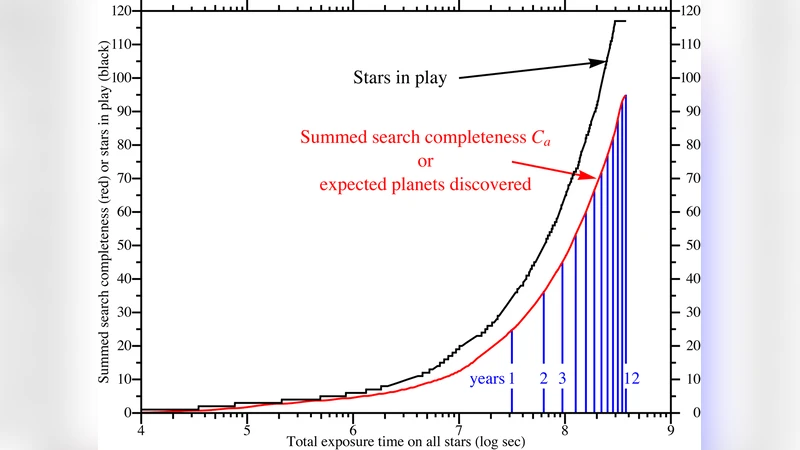
To optimize the limited mission time, a “reverse‑auction” algorithm is introduced. Each star initially receives its maximum allowable exposure τ_max; then, in 2200 s increments, exposure is removed from the star whose completeness loss per unit time is smallest. This process continues until the total allocated time is exhausted. The results show that with one year of 100 % duty‑cycle observing, 33 stars remain in play, giving a summed completeness ΣC ≈ 24.6. Assuming an Earth‑twin occurrence rate η = 0.05, the most probable outcome is the discovery of a single planet, with a 30 % chance of finding none. Extending the program to twelve years (or twelve one‑year SIM Lite missions) would bring all 117 astrometrically viable stars into the survey, raising ΣC to ≈ 94 and dramatically increasing the expected number of detections.
The paper highlights the complementary strengths and weaknesses of the two approaches. Direct imaging provides immediate spatial separation but suffers from low completeness due to the IWA and requires prior knowledge of the planet’s position for efficient spectroscopy. Astrometry yields orbital elements and masses, essential for confirming habitability, but at low SNR the least‑squares estimators become biased, reducing mass accuracy to ±25 % (and worse for tighter constraints).
In conclusion, the author argues that the AWA movement must embed Science‑Ops metrics into mission planning. Without explicit accounting for detection completeness, exposure budgeting, and the concatenated probability of moving from discovery to atmospheric characterization, even the most ambitious telescopes will fall short of delivering a statistically robust sample of Earth‑like worlds. The paper calls for a systematic, low‑risk series of missions that progress from detection (via astrometry or imaging) to orbit determination and finally to high‑resolution spectroscopy, guided by the quantitative metrics presented.
Comments & Academic Discussion
Loading comments...
Leave a Comment