Cascade and Damping of Alfven-Cyclotron Fluctuations: Application to Solar Wind Turbulence
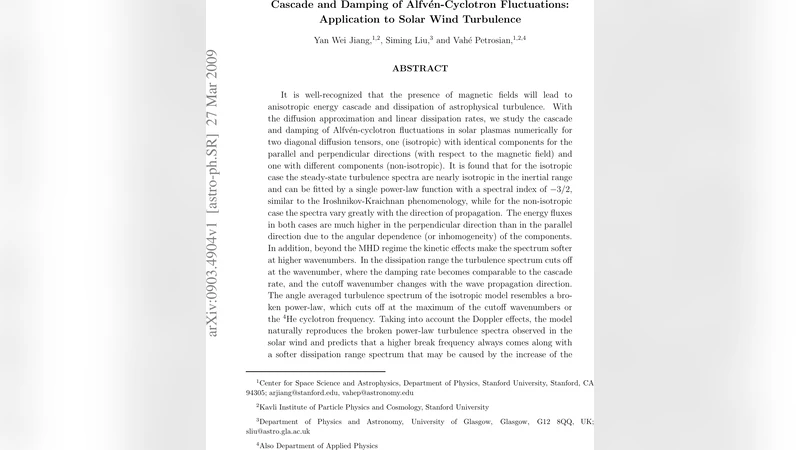
It is well-recognized that the presence of magnetic fields will lead to anisotropic energy cascade and dissipation of astrophysical turbulence. With the diffusion approximation and linear dissipation rates, we study the cascade and damping of Alfv'en-cyclotron fluctuations in solar plasmas numerically. For an isotropic case the steady-state turbulence spectra are nearly isotropic in the inertial range and can be fitted by a single power-law function with a spectral index of -3/2, similar to the Iroshnikov-Kraichnan phenomenology. Beyond the MHD regime the kinetic effects make the spectrum softer at higher wavenumbers. In the dissipation range the turbulence spectrum cuts off at the wavenumber, where the damping rate becomes comparable to the cascade rate, and the cutoff wavenumber changes with the wave propagation direction. The angle averaged turbulence spectrum of the isotropic model resembles a broken power-law. Taking into account the Doppler effects, the model naturally reproduces the broken power-law turbulence spectra observed in the solar wind and predicts that a higher break frequency always comes along with a softer dissipation range spectrum that may be caused by the increase of the turbulence intensity, the reciprocal of the plasma \beta, and/or the angle between the solar wind velocity and the mean magnetic field. These predictions can be tested by detailed comparisons with more accurate observations.
💡 Research Summary
This paper investigates how magnetic fields shape the anisotropic cascade and dissipation of turbulence in the solar wind by focusing on Alfvén‑cyclotron fluctuations. Using a diffusion‑approximation framework, the authors formulate a two‑dimensional diffusion equation in wave‑vector space (k‖, k⊥) that describes the transfer of turbulent energy across scales. Crucially, they embed linear kinetic damping rates γ(k,θ) derived from Vlasov‑Maxwell theory for the Alfvén‑cyclotron branch directly into the cascade model, allowing a continuous competition between nonlinear cascade and linear dissipation rather than imposing an abrupt spectral cutoff.
Two initial conditions are examined. The first is fully isotropic, assigning equal energy to all directions in k‑space; the second imposes a k⊥‑biased distribution to mimic the often observed perpendicular dominance in solar‑wind turbulence. In the isotropic case, the steady‑state solution in the inertial (MHD) range follows a –3/2 power law, matching the Iroshnikov‑Kraichnan phenomenology where counter‑propagating Alfvén waves interact weakly. When the cascade reaches kinetic scales (k ρi ≳ 1, with ρi the ion gyroradius), resonant ion cyclotron effects dramatically increase γ(k,θ). The spectrum steepens to slopes between –2.8 and –3.0, reflecting the stronger damping.
A key result is the pronounced angular dependence of the damping. For wavevectors nearly perpendicular to the mean magnetic field (θ ≈ 90°), the damping is weaker, pushing the wavenumber at which γ≈cascade rate to larger k; for quasi‑parallel propagation (θ ≈ 0°) the damping dominates earlier, producing a lower cutoff wavenumber. This anisotropic cutoff translates, after accounting for the Doppler shift of the solar‑wind flow, into a broken‑power‑law spectrum in the spacecraft frame. The break frequency f_b depends on the angle ψ between the solar‑wind velocity V_SW and the background field B0: larger ψ (more transverse flow) yields a higher f_b, while simultaneously the dissipation‑range slope becomes shallower.
The model also incorporates plasma β (ratio of thermal to magnetic pressure) and the turbulence amplitude δB/B0 as control parameters. Low β and high δB/B0 increase the nonlinear cascade rate relative to the linear damping, moving the spectral break to higher k (or higher f_b in the spacecraft frame). Consequently, the paper predicts a robust correlation: “higher break frequency always accompanies a softer dissipation‑range spectrum.” This prediction can be tested with high‑resolution measurements from missions such as Parker Solar Probe and Solar Orbiter.
Overall, the study provides a unified, physics‑based description of Alfvén‑cyclotron turbulence that bridges the MHD inertial range, the kinetic transition, and the dissipation range. By solving the cascade‑damping balance in a two‑dimensional k‑space and translating the results into observable frequency spectra, the authors reproduce the broken power‑law features commonly reported in solar‑wind data and offer clear, testable dependencies on plasma β, turbulence intensity, and flow‑field geometry. The work advances our understanding of how energy is transferred and ultimately thermalized in space plasmas, and it sets the stage for future quantitative comparisons with increasingly precise solar‑wind observations.
Comments & Academic Discussion
Loading comments...
Leave a Comment