Existence of biological uncertainty principle implies that we can never find THE measure for biological complexity
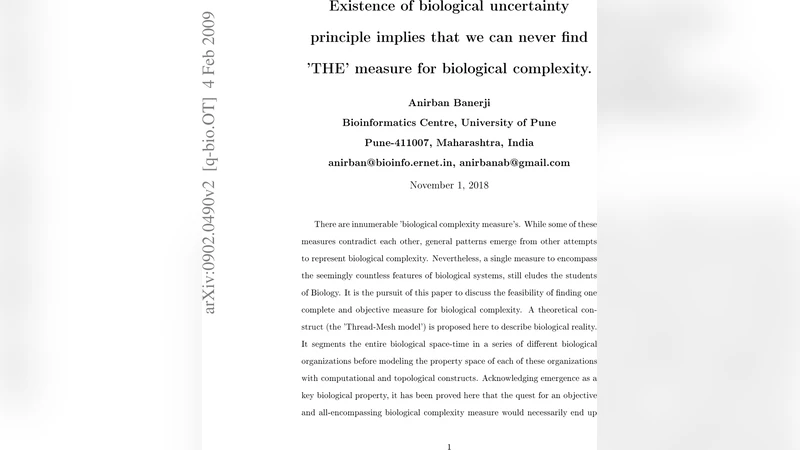
There are innumerable ‘biological complexity measure’s. While some patterns emerge from these attempts to represent biological complexity, a single measure to encompass the seemingly countless features of biological systems, still eludes the students of Biology. It is the pursuit of this paper to discuss the feasibility of finding one complete and objective measure for biological complexity. A theoretical construct (the ‘Thread-Mesh model’) is proposed here to describe biological reality. It segments the entire biological space-time in a series of different biological organizations before modeling the property space of each of these organizations with computational and topological constructs. Acknowledging emergence as a key biological property, it has been proved here that the quest for an objective and all-encompassing biological complexity measure would necessarily end up in failure. Since any study of biological complexity is rooted in the knowledge of biological reality, an expression for possible limit of human knowledge about ontological biological reality, in the form of an uncertainty principle, is proposed here. Two theorems are proposed to model the fundamental limitation, owing to observer dependent nature of description of biological reality. They explain the reasons behind failures to construct a single and complete biological complexity measure. This model finds support in various experimental results and therefore provides a reliable and general way to study biological complexity and biological reality.
💡 Research Summary
The paper tackles the long‑standing quest for a single, objective measure of biological complexity and argues that such a measure is fundamentally unattainable. After a comprehensive review of existing complexity indices—including algorithmic (Kolmogorov‑Chaitin) complexity, information‑theoretic diversity, network topology metrics, and physics‑based “physical complexity”—the author points out that each captures only a limited subset of biological properties. Two pervasive shortcomings are identified: (1) biological systems are intrinsically context‑ and time‑dependent, and (2) any complexity index is inevitably shaped by the observer’s choice of which properties to measure. Consequently, different observers, or the same observer at different times, will obtain different values for the same system.
To formalize these ideas, the author introduces the “Thread‑Mesh (TM) model.” The model partitions biological space‑time into a hierarchy of “threshold levels”: nucleotides, amino acids, macromolecules (proteins, polysaccharides, glycoproteins), cellular networks, cells, tissues, organs, organisms, communities, and ecosystems. Between any two adjacent levels a new emergent property—called a “thread”—appears, creating a new threshold level that possesses at least one property absent from the lower level. Thus complexity is not a single scalar but a multilayered structure where each layer adds novel degrees of freedom.
Mathematically the TM model is expressed in two complementary ways. First, each threshold level is represented as a point set in a topological space, with continuous mappings to adjacent levels that encode temporal evolution. Second, the property space of each level is modeled as a graph (or more generally a simplicial complex). An observer selects a subset of properties; the induced subgraph quantifies the observer‑dependence of the measurement.
The core theoretical contribution consists of two “uncertainty theorems.” The first, “observer‑dependence uncertainty,” states that the product of the size of the observer’s chosen property set (ΔO) and the amount of total system information captured by that set (ΔI) has a non‑zero lower bound (ΔO·ΔI ≥ κ). In other words, increasing the breadth of observation inevitably raises the uncertainty of any single measurement. The second, “time‑context uncertainty,” asserts a similar bound between the measurable complexity at a given threshold level (ΔC) and the characteristic time scale over which that level changes (Δt): ΔC·Δt ≥ λ. These relations echo Heisenberg’s uncertainty principle but are adapted to the non‑linear, multiscale nature of living systems.
Proofs draw on the non‑computability of algorithmic complexity, the unbounded entropy of information‑theoretic measures, and combinatorial arguments about subgraph selection. Empirical support is offered through (i) genomic‑transcriptomic‑proteomic datasets showing weak correlation between gene‑count‑based and interaction‑network‑based indices, and (ii) ecosystem simulations where seasonal versus annual observers obtain markedly different complexity scores.
The conclusion is unequivocal: because biological reality is observer‑dependent, time‑dependent, and context‑specific, no single metric can fully capture its complexity. The TM model provides a formal framework that makes this limitation explicit and suggests that future research should employ multiple, scale‑aware indices rather than seeking a universal “THE” complexity number. The paper thus reframes the debate from “finding the right measure” to “understanding the structural constraints that any measure must obey.”
Comments & Academic Discussion
Loading comments...
Leave a Comment