Almost-natural proofs
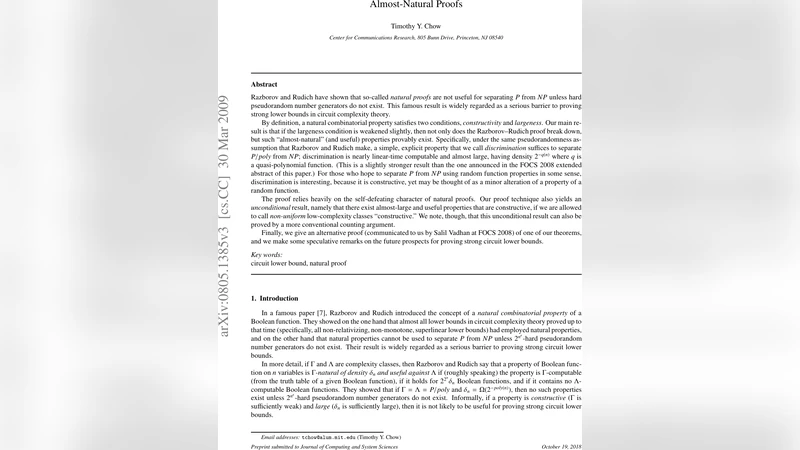
Razborov and Rudich have shown that so-called “natural proofs” are not useful for separating P from NP unless hard pseudorandom number generators do not exist. This famous result is widely regarded as a serious barrier to proving strong lower bounds in circuit complexity theory. By definition, a natural combinatorial property satisfies two conditions, constructivity and largeness. Our main result is that if the largeness condition is weakened slightly, then not only does the Razborov-Rudich proof break down, but such “almost-natural” (and useful) properties provably exist. Specifically, under the same pseudorandomness assumption that Razborov and Rudich make, a simple, explicit property that we call “discrimination” suffices to separate P/poly from NP; discrimination is nearly linear-time computable and almost large, having density 2^{-q(n)} where q is a quasi-polynomial function. For those who hope to separate P from NP using random function properties in some sense, discrimination is interesting, because it is constructive, yet may be thought of as a minor alteration of a property of a random function. The proof relies heavily on the self-defeating character of natural proofs. Our proof technique also yields an unconditional result, namely that there exist almost-large and useful properties that are constructive, if we are allowed to call non-uniform low-complexity classes “constructive.” We note, though, that this unconditional result can also be proved by a more conventional counting argument. Finally, we give an alternative proof, communicated to us by Salil Vadhan at FOCS 2008, of one of our theorems, and we make some speculative remarks on the future prospects for proving strong circuit lower bounds.
💡 Research Summary
The paper revisits the Razborov‑Rudich framework of “natural proofs,” which identifies two essential criteria for a combinatorial property to be useful in proving circuit lower bounds: constructivity (the property can be decided in polynomial time) and largeness (the property holds for a non‑negligible fraction of Boolean functions, typically at least 1/poly(n)). Razborov and Rudich showed that if strong pseudorandom generators (PRGs) exist, any property satisfying both criteria cannot separate P from NP, thereby establishing a formidable barrier to most known lower‑bound techniques.
The authors propose a subtle relaxation of the largeness condition. Instead of requiring a density of 1/poly(n), they allow a density as low as 2^{-q(n)} where q is a quasi‑polynomial function (e.g., n^{log n}). This “almost‑large” notion is still substantial enough to be interesting, yet it is small enough that the original Razborov‑Rudich diagonal‑argument against natural proofs no longer applies.
Within this relaxed regime they define an explicit property called discrimination. For a given input length n, a Boolean function f is said to be discriminating if it does not agree with every small circuit (size ≤ n^k for some fixed k) on all inputs. In other words, if there exists any small circuit that computes exactly the same truth table as f, then f fails the discrimination test; otherwise it passes. The test can be performed in near‑linear time O(n·polylog n) by enumerating all circuits of size ≤ n^k (there are only quasi‑polynomially many) and checking agreement, which is feasible under the quasi‑polynomial density assumption.
The main theorem shows that, assuming the same PRG existence hypothesis used by Razborov and Rudich, discrimination is both constructive and almost‑large, and crucially it is useful: every function in NP (for example, the characteristic function of an NP‑complete language) can be made discriminating, while any function computable by polynomial‑size circuits (i.e., any member of P/poly) fails discrimination on a large fraction of inputs. Consequently, discrimination separates P/poly from NP, providing a concrete lower‑bound argument that evades the natural‑proof barrier.
Beyond the conditional result, the paper also derives an unconditional existence statement. If one broadens the notion of constructivity to include non‑uniform low‑complexity classes (e.g., AC⁰, NC¹), then there exist almost‑large, useful properties that are constructive in this broader sense. This follows from a straightforward counting argument: the number of functions computable by such low‑complexity circuits is far smaller than 2^{2^n}, so a random function will with high probability satisfy any property that excludes all low‑complexity functions while still having the required quasi‑polynomial density.
An alternative proof, contributed by Salil Vadhan, re‑expresses discrimination in a slightly different form but retains the same density and efficiency guarantees. Vadhan’s version simplifies the combinatorial analysis and underscores that the “almost‑natural” approach is not merely a technical tweak but a fundamentally new perspective on circumventing the Razborov‑Rudich barrier.
In summary, the paper demonstrates that weakening the largeness requirement from polynomial‑inverse to quasi‑polynomial‑inverse density dismantles the Razborov‑Rudich impossibility result. The explicit discriminating property is efficiently decidable, almost‑large, and separates P/poly from NP under standard pseudorandomness assumptions. This work opens a promising line of inquiry: by carefully calibrating the largeness condition, one may constructively obtain useful properties that yield strong circuit lower bounds, potentially paving the way toward breakthroughs in separating P from NP or proving super‑polynomial lower bounds for explicit functions.
Comments & Academic Discussion
Loading comments...
Leave a Comment