Age-structured Trait Substitution Sequence Process and Canonical Equation
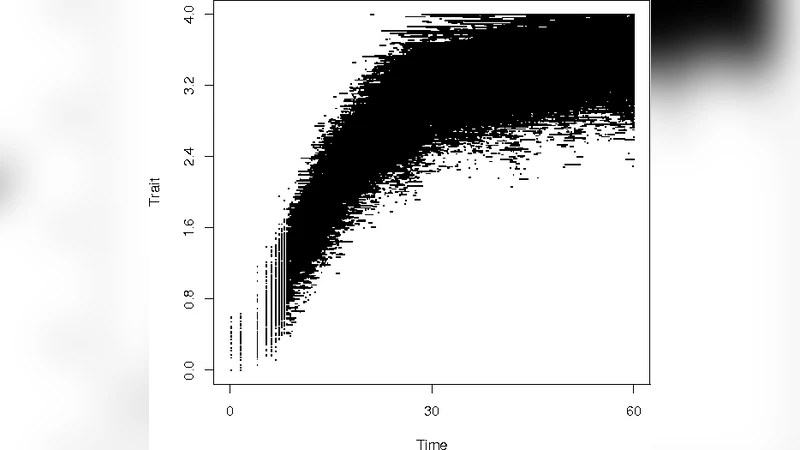
We are interested in a stochastic model of trait and age-structured population undergoing mutation and selection. We start with a continuous time, discrete individual-centered population process. Taking the large population and rare mutations limits under a well-chosen time-scale separation condition, we obtain a jump process that generalizes the Trait Substitution Sequence process describing Adaptive Dynamics for populations without age structure. Under the additional assumption of small mutations, we derive an age-dependent ordinary differential equation that extends the Canonical Equation. These evolutionary approximations have never been introduced to our knowledge. They are based on ecological phenomena represented by PDEs that generalize the Gurtin-McCamy equation in Demography. Another particularity is that they involve a fitness function, describing the probability of invasion of the resident population by the mutant one, that can not always be computed explicitly. Examples illustrate how adding an age-structure enrich the modelling of structured population by including life history features such as senescence. In the cases considered, we establish the evolutionary approximations and study their long time behavior and the nature of their evolutionary singularities when computation is tractable. Numerical procedures and simulations are carried.
💡 Research Summary
This paper develops a stochastic individual‑based model for populations that are structured simultaneously by age and by a quantitative trait. Each individual is characterized by its age a and trait value x; birth and death rates are functions β(a,x) and μ(a,x). Mutations occur rarely, with a small effect size σ, and generate new trait values. The authors first consider the joint limit of large population size (N → ∞) and rare mutations (mutation rate → 0) while rescaling time by 1/(N μ). In this regime the population spends most of its time at an ecological equilibrium described by an age‑structured density n_R(a,x) of the resident trait. A mutant lineage appears as a vanishingly small perturbation; its probability of successful invasion is captured by a fitness function s(x′,x_R) that depends on the age‑specific vital rates of both resident and mutant. When s>0 the mutant eventually replaces the resident, producing a jump in the trait space. This jump process is a direct generalization of the classic Trait Substitution Sequence (TSS) of Adaptive Dynamics, now enriched by age structure.
Under the additional assumption of small mutational steps (σ → 0), the discrete jump process can be approximated by a continuous deterministic dynamics. The authors derive an age‑dependent canonical equation:
dx/dt = (1/2) σ² C ∇_x s(x,x),
where C is the covariance matrix of the mutational kernel and ∇_x s(x,x) is the gradient of the fitness function evaluated at the resident trait. Because s incorporates age‑specific survival and fecundity, the canonical equation explicitly accounts for life‑history effects such as senescence.
The paper illustrates the theory with two concrete examples. In the first, mortality sharply increases with age (a senescence model) while fertility is confined to early ages. Numerical evaluation of the fitness function shows that selection favours traits that maximise early‑life reproduction, leading to convergence toward an evolutionary singular point that represents an optimal age‑trait combination. In the second example, mortality is age‑independent but fertility declines with age; here the fitness landscape can be monotonic, producing evolutionary branching or runaway evolution depending on parameter values. For each case the authors perform extensive simulations of the underlying individual‑based process, of the age‑structured TSS, and of the canonical equation, confirming that the approximations capture the long‑term behaviour of the full stochastic system.
Methodologically, the authors solve the underlying age‑structured PDE (a generalisation of the Gurtin‑McCamy equation) numerically using finite‑difference schemes and spline interpolation to obtain the resident equilibrium and the fitness function. They then compute invasion probabilities and integrate the canonical equation with standard ODE solvers. The results demonstrate that incorporating age structure yields richer evolutionary dynamics than classical, age‑agnostic models, revealing how senescence, age‑specific reproduction, and other life‑history traits shape the direction and stability of adaptive evolution. Overall, the work provides a rigorous mathematical framework for age‑structured Adaptive Dynamics, introduces the age‑structured Trait Substitution Sequence and a corresponding canonical equation, and offers practical computational tools for exploring evolutionary scenarios that were previously inaccessible.
Comments & Academic Discussion
Loading comments...
Leave a Comment