The behaviour of neurons under the influence of periodic external input has been modelled very successfully by circle maps. The aim of this note is to extend certain aspects of this analysis to a much more general class of forcing processes. We apply results on the fibred rotation number of randomly forced circle maps to show the uniqueness of the asymptotic firing frequency of ergodically forced pacemaker neurons. The details of the analysis are carried out for the forced leaky integrate-and-fire model, but the results should also remain valid for a large class of further models.
Deep Dive into Neuronal Coding of pacemaker neurons - A random dynamical systems approach.
The behaviour of neurons under the influence of periodic external input has been modelled very successfully by circle maps. The aim of this note is to extend certain aspects of this analysis to a much more general class of forcing processes. We apply results on the fibred rotation number of randomly forced circle maps to show the uniqueness of the asymptotic firing frequency of ergodically forced pacemaker neurons. The details of the analysis are carried out for the forced leaky integrate-and-fire model, but the results should also remain valid for a large class of further models.
Already in 1907, long before the molecular mechanisms of neural signal transduction had been clarified, Louis Lapicque proposed a simple model for the firing behaviour of a neuron [1,2,3]. A crucial feature of this so-called integrate-and-fire model (IFM) is the separation of time-scales: the stereotypical and extremely fast generation of an action potential is thought of as being concentrated in a single moment of time, whereas the much slower evolution of the membrane potential in the interspike intervals is modelled as a continuous process. For many questions concerning the behaviour of neural systems this level of abstraction turned out to be exactly the adequate one, such that even nowadays, more than a hundred years after Lapicque's original paper, the different variations of the IFM still play a central role in theoretical neuroscience [4]. One of their great achievements was the explanation of so-called 'paradoxical segments' that were discovered in the experimental investigation of pacemaker neurons in the nervous system of crayfish (Procambarus clarkii), sea slugs (Aplysia californica) and horseshoe crabs (Limulus polyphemus) [5,6]. The counter-intuitive observation that was made in these experiments was that an increase in the frequency of periodic inhibitory presynaptic input can lead to an increase of the post-synaptic firing frequency. This paradoxon was explained by relating the respective theoretical models to monotone circle maps whose rotation number equals the ratio between the input and the output frequency. When the circle map has a stable periodic orbit, then input and output frequency remain directly proportional on a small neighbourhood (the paradoxical segment), disrespective of whether the input is inhibitory or excitatory [5,7,8,9] (see also Section 2). Similar ideas have also been pioneered before by V. Arnold in the study of cardiac cells [10,11].
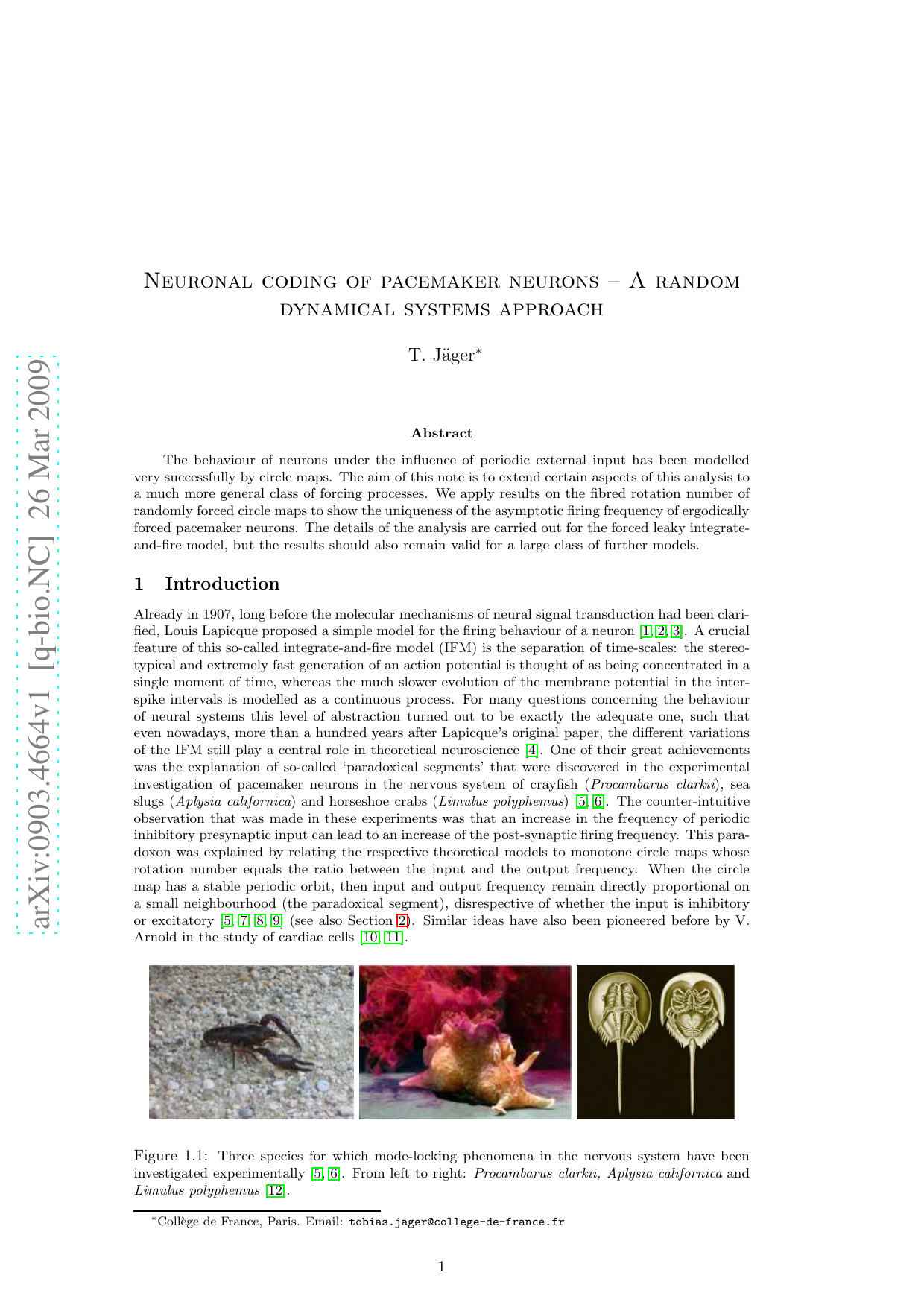
Three species for which mode-locking phenomena in the nervous system have been investigated experimentally [5,6]. From left to right: Procambarus clarkii, Aplysia californica and Limulus polyphemus [12].
It must be said, however, that despite the great success of IFMs and the long history of their investigation their rigorous mathematical description is still restricted to a few very special situations. In particular, the only types of external forcing that can be treated analytically so far are either periodic [13,14] or stationary stochastic input [15,16,17]. Even the superposition of the two -noisy periodic input -is mostly accessible only by numerical methods [18]. Our goal here is take up the ideas used in the analysis of the periodically forced IFM an to extend these to more general forcing processes. Thereby, we restrict ourselves to deterministic and/or random forcing, although it should be possible to adapt the approach to models generated by stochastic differential equations as well. In order to state the main results, we first recall the construction of the IFM.
The membrane potential V (t) of a neuron N1 remains between a lower threshold V l and an upper threshold Vu. V (t) can never drop below V l due to physiological constraints, whereas when it reaches Vu the neuron ‘fires’, meaning that an action potential is triggered and V (t) drops back to a rest potential Vr ∈ [V l , Vu). Between the two thresholds, the potential evolves according to an infinitesimal law
with right side F : R 2 → R that should satisfy F (t, V l ) ≥ 0 ∀t ∈ R. The dependence of F on t corresponds to the influence of external time-dependent factors. The reset procedure when V (t) reaches Vu is usually expressed as
where t + denotes the right-hand limit. Identifying the interval [V l , Vu) with the circle T 1 = R/Z, this gives rise to a non-autonomous circle flow (see Figure 1.1).
For fixed initial values V (t0) = x0, we denote by tn the time of the n-th firing of the neuron N1. Then a very basic and fundamental question is that of the existence and uniqueness of the asymptotic firing frequency: under what assumptions does the limit
exist and when is it independent of the initial values t0 and x0?
In the simplest case the external input is periodic in time with period p ∈ R + . As mentioned, this situation is quite well-understood and has been studied for a number of different versions of the IFM [13,14]. The analysis depends on the choice of a suitable Poincaré section for the flow, by which one obtains a circle map g : T 1 → T 1 whose lift G : R → R generates the rescaled sequence tn, that is tn+1/p = G n (tn/p). (We briefly recall the construction in Section 2.) Under suitable assumptions on the function F this map g has good monotonicity properties that ensure the existence and uniqueness of the rotation number
and thus of the asymptotic firing frequency. As indicated above, the existence of a stable periodic orbit for the map g yields an explanation for the ‘paradoxical segments’ in situations with inhibitory presynaptic input.
A good fra
…(Full text truncated)…
This content is AI-processed based on ArXiv data.