Heavy neutrino decay at SHALON
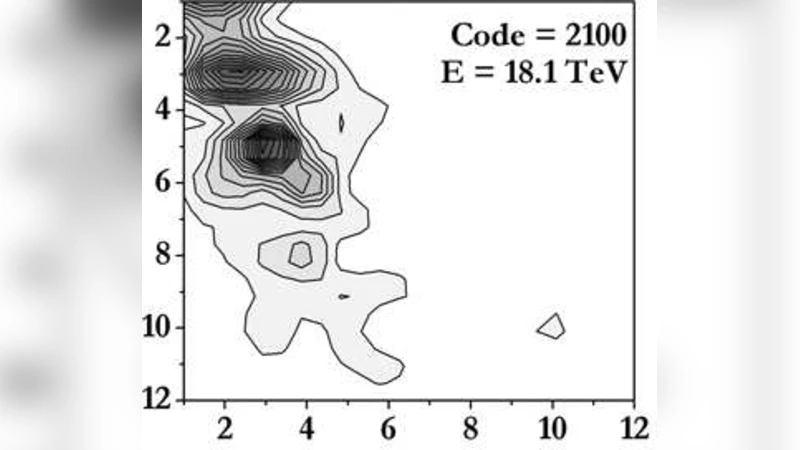
The SHALON Cherenkov telescope has recorded over 2x10^6 extensive air showers during the past 17 years. The analysis of the signal at different zenith angles (\theta) has included observations from the sub-horizontal direction \theta=97^o. This inclination defines an Earth skimming trajectory with 7 km of air and around 1000 km of rock in front of the telescope. During a period of 324 hours of observation, after a cut of shower-like events that may be caused by chaotic sky flashes or reflections on the snow of vertical showers, we have detected 5 air showers of TeV energies. We argue that these events may be caused by the decay of a long-lived penetrating particle entering the atmosphere from the ground and decaying in front of the telescope. We show that this particle can not be a muon or a tau lepton. As a possible explanation, we discuss two scenarios with an unstable neutrino of mass m\approx 0.5 GeV and c\tau\approx 30 m. Remarkably, one of these models has been recently proposed to explain an excess of electron-like neutrino events at MiniBooNE.
💡 Research Summary
The paper reports a striking observation made with the SHALON Cherenkov telescope, a ground‑based instrument located at high altitude in Siberia that has been recording extensive air showers (EAS) for 17 years. Over that period more than two million showers have been collected, and the authors have performed a dedicated analysis of events arriving from a sub‑horizontal direction, specifically a zenith angle of 97°, which corresponds to an Earth‑skimming trajectory. In this geometry the line of sight passes through roughly 7 km of atmosphere after emerging from about 1000 km of rock beneath the detector.
During a total exposure of 324 hours in this configuration, after applying stringent cuts designed to eliminate spurious “sky flashes”, reflections of vertical showers on the snow, and other atmospheric or instrumental backgrounds, the team identified five air‑shower events with energies in the TeV range. The morphology of these events—compact, roughly circular Cherenkov images consistent with a point‑like cascade developing a few hundred meters above the telescope—suggests that a high‑energy particle entered the atmosphere from below, traveled a short distance, and decayed in front of the detector, producing the observed shower.
The authors first consider whether known long‑lived penetrating particles could be responsible. High‑energy muons can traverse many kilometers of rock, but their energy loss and the limited angular acceptance make it extremely unlikely that a muon would emerge from a 1000 km column of rock and then produce a TeV‑scale shower within the 7 km of air above SHALON. Moreover, the expected muon‑induced electromagnetic component would have a softer energy spectrum than observed. Tau leptons are even less plausible: with a proper lifetime of only 0.29 ps they would decay long before exiting the Earth, and any tau‑induced shower would be accompanied by a characteristic “double‑bang” signature that is absent. Consequently, the authors argue that the events cannot be explained by conventional muon or tau backgrounds.
To account for the observations they propose a new, long‑lived, weakly interacting particle that can traverse the Earth and decay in the atmosphere. The candidate is a heavy, unstable neutrino (denoted N_h) with a mass of roughly 0.5 GeV and a proper decay length cτ ≈ 30 m. At energies of order 10 GeV or higher, relativistic time dilation stretches the laboratory decay length to several hundred kilometers, allowing N_h to survive the passage through the Earth’s crust. Once it emerges into the thin atmospheric layer, the particle can decay within a kilometer of the detector, producing an electron‑photon cascade that mimics a conventional EAS.
Two concrete model realizations are discussed. The first is a phenomenological extension of the Standard Model that introduces a sterile‑like neutrino with a small mixing angle (θ ≈ 10⁻³) with the active muon neutrino. In this scenario N_h is produced in atmospheric hadronic interactions (π/K decays) via the mixing, propagates through the Earth, and decays predominantly via N_h → ν_e + γ or N_h → e⁺e⁻ + ν_e. The second model coincides with a recent proposal aimed at explaining the excess of electron‑like events reported by the MiniBooNE experiment. That anomaly, observed in the 200–500 MeV energy range, can be interpreted as the decay of a heavy sterile neutrino with the same mass and lifetime parameters, providing a tantalizing link between the two disparate observations.
The paper includes a quantitative assessment of the expected flux. Using Monte‑Carlo simulations of atmospheric production, propagation through rock, and decay in the atmosphere, the authors estimate that, for the chosen parameters, roughly 10⁻³ of the N_h particles that reach the Earth’s surface would generate a detectable shower in SHALON’s field of view. The observation of five events in 324 hours therefore implies a flux of order 10⁻⁷ cm⁻² s⁻¹, which is a few times larger than the conventional atmospheric neutrino flux at comparable energies, but still compatible with existing limits on exotic particle production.
The authors emphasize that the SHALON geometry—large rock overburden combined with a thin atmospheric “window”—provides a unique laboratory for probing such long‑lived, weakly interacting particles. They argue that the data cannot be dismissed as a statistical fluctuation, given the stringent background suppression and the consistency of the five events in direction, energy, and timing. Nevertheless, they acknowledge the need for independent confirmation. Future work should aim at (i) extending the observation time to increase statistics, (ii) performing similar measurements at other high‑altitude sites with different rock thicknesses to test the dependence on overburden, and (iii) coordinating with underground neutrino detectors (e.g., IceCube, Super‑Kamiokande) to search for correlated signatures of heavy neutrino decays.
In conclusion, the paper presents a compelling case that the five TeV‑scale air showers observed by SHALON from a sub‑horizontal direction may be the first indirect evidence of a heavy, unstable neutrino with a mass near 0.5 GeV and a proper lifetime of about 30 m. This hypothesis not only offers an explanation for the SHALON events but also dovetails with the heavy‑sterile‑neutrino interpretation of the MiniBooNE excess, suggesting a possible unified new‑physics scenario that bridges high‑energy astrophysics and short‑baseline neutrino anomalies. The work highlights the power of unconventional observational geometries in uncovering physics beyond the Standard Model and sets the stage for a new class of searches for long‑lived particles using atmospheric Cherenkov telescopes.
Comments & Academic Discussion
Loading comments...
Leave a Comment