On the Goodness-of-Fit Testing for Ergodic Diffusion Processes
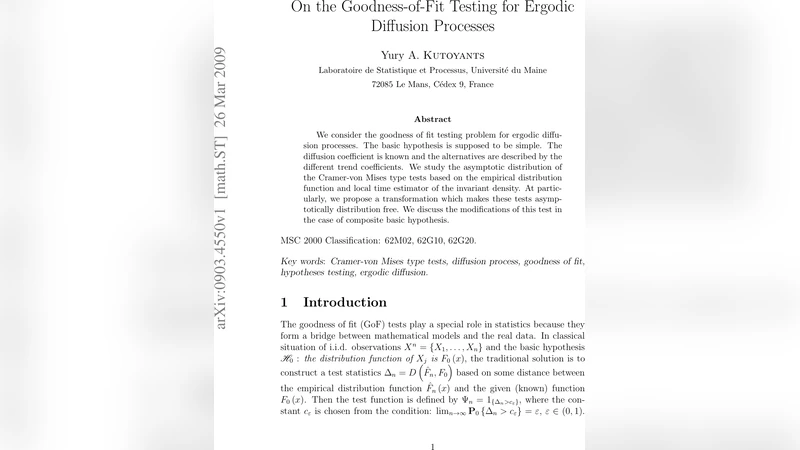
We consider the goodness of fit testing problem for ergodic diffusion processes. The basic hypothesis is supposed to be simple. The diffusion coefficient is known and the alternatives are described by the different trend coefficients. We study the asymptotic distribution of the Cramer-von Mises type tests based on the empirical distribution function and local time estimator of the invariant density. At particularly, we propose a transformation which makes these tests asymptotically distribution free. We discuss the modifications of this test in the case of composite basic hypothesis.
💡 Research Summary
The paper addresses the problem of goodness‑of‑fit testing for ergodic diffusion processes when the diffusion coefficient σ(·) is known and the null hypothesis specifies a simple drift function S₀(·). Alternatives differ only in the drift (trend) component. Using a continuous observation Xₜ, 0 ≤ t ≤ T, the authors construct two non‑parametric estimators: the empirical distribution function (\hat F_T(x)=\frac{1}{T}\int_0^T\mathbf 1_{{X_t\le x}}dt) and a density estimator based on the local time, (\hat\pi_T(x)=\frac{L_T(x)}{T\sigma^2(x)}), where (L_T(x)=\int_0^T\delta(X_t-x)dt). Both estimators are consistent and, after scaling by (\sqrt{T}), converge to Gaussian processes whose covariance structures depend on σ(·) and the invariant density π₀(x) associated with S₀.
Cramér‑von Mises type test statistics are defined as
\
Comments & Academic Discussion
Loading comments...
Leave a Comment