Sums of powers via integration
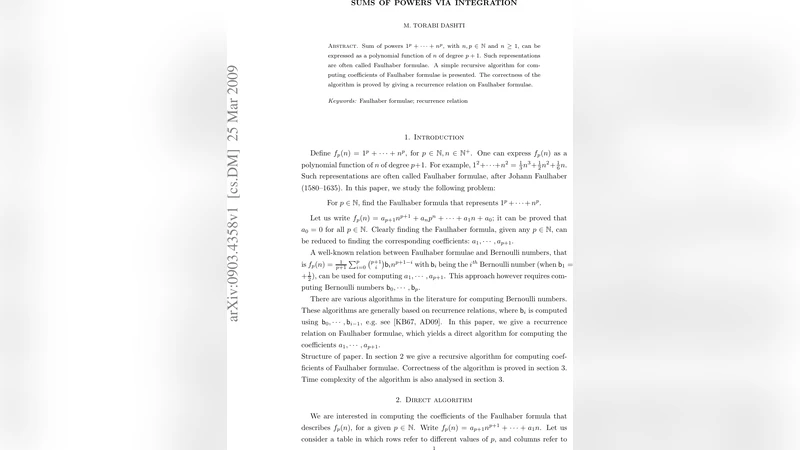
Sum of powers 1^p+…+n^p, with n and p being natural numbers and n>=1, can be expressed as a polynomial function of n of degree p+1. Such representations are often called Faulhaber formulae. A simple recursive algorithm for computing coefficients of Faulhaber formulae is presented. The correctness of the algorithm is proved by giving a recurrence relation on Faulhaber formulae.
💡 Research Summary
The paper addresses the classic problem of expressing the sum of p‑th powers of the first n positive integers,
(S_p(n)=1^{p}+2^{p}+…+n^{p}), as a polynomial in n of degree p + 1, commonly known as Faulhaber’s formula. While it is well‑known that such a polynomial exists, traditional methods for obtaining its coefficients rely on Bernoulli numbers or Stirling numbers, both of which require pre‑computation of special sequences and involve non‑trivial rational arithmetic. The authors propose a markedly simpler recursive algorithm that derives all coefficients directly from lower‑order sums, using only elementary integration and binomial identities.
The core insight is the observation that integrating the p‑th power sum polynomial yields the (p + 1)‑th power sum up to an additive constant. Formally, if
(F_p(n)=\sum_{k=1}^{n}k^{p}=a_{p+1}n^{p+1}+a_{p}n^{p}+…+a_{1}n),
then
(\int_{0}^{n}F_p(x),dx = F_{p+1}(n) - \frac{1}{p+2}).
By expanding the integral via the binomial theorem and substituting the known coefficients (a_j) (j ≤ p), the authors obtain the recurrence
\
Comments & Academic Discussion
Loading comments...
Leave a Comment