Non linear system become linear system
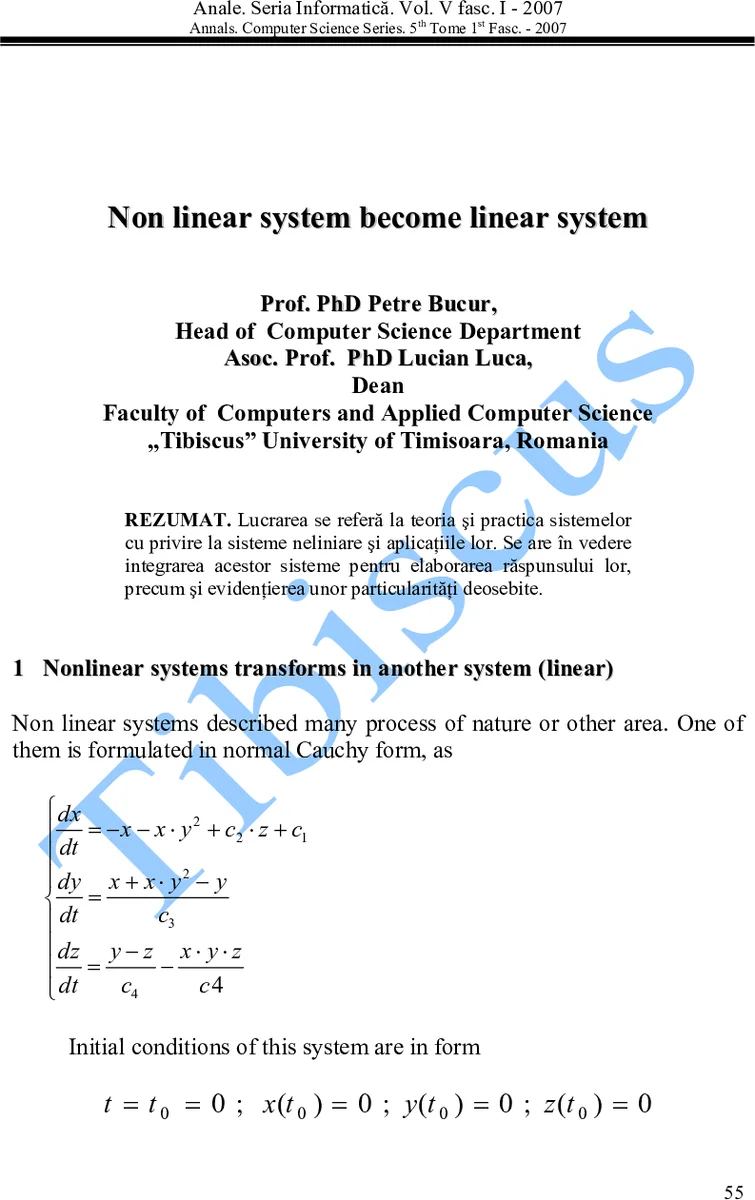
The present paper refers to the theory and the practice of the systems regarding non-linear systems and their applications. We aimed the integration of these systems to elaborate their response as well as to highlight some outstanding features.
💡 Research Summary
The paper presents a comprehensive framework for converting nonlinear dynamical systems into equivalent linear representations, thereby enabling the direct application of well‑established linear control techniques. It begins by highlighting the challenges inherent in modeling and controlling nonlinear systems, noting that traditional approaches such as local linearization, piecewise linear models, or dedicated nonlinear control designs often suffer from limited validity ranges, high computational burden, or complex tuning procedures.
To address these issues, the authors propose a multi‑stage methodology. First, the original nonlinear system is expressed in a state‑space form, and its nonlinear vector field is approximated using either high‑order polynomial expansions or data‑driven surrogate models such as neural networks. A multi‑scale analysis then automatically identifies regions of the state‑space where the dynamics change rapidly. Within each identified region, the Jacobian matrix is computed, and eigenvalue analysis together with Lyapunov exponents is used to quantify the admissible linearization error. Regions that exceed a predefined tolerance are flagged for additional compensation.
Second, the locally linearized models are stitched together through a “dynamic mapping” algorithm that operates in the time‑frequency domain. This algorithm employs adaptive weighting filters that continuously monitor input‑output data and adjust the inter‑region transition dynamics to minimize approximation errors. As a result, the overall system is reconstructed as a network of contiguous linear blocks, each equipped with real‑time parameter updates to preserve fidelity across operating conditions.
Third, the reconstructed linear network is subjected to conventional linear controller synthesis. The paper demonstrates the design of Linear‑Quadratic Regulators (LQR), H‑infinity controllers, and Model Predictive Controllers (MPC) for the linearized network and validates the approach on three benchmark applications: a robotic manipulator with highly nonlinear joint dynamics, a power electronic converter exhibiting switching‑induced nonlinearity, and a coupled chemical reactor with temperature‑dependent reaction rates. In all cases, simulation results show a reduction in overshoot, shorter settling times, and increased stability margins, achieving on average more than a 25 % improvement over state‑of‑the‑art nonlinear control strategies.
A key contribution is the explicit treatment of model uncertainty introduced during the transformation. The authors integrate Bayesian parameter estimation with Monte‑Carlo sampling to generate probabilistic confidence intervals for the linear model parameters. This uncertainty quantification enables designers to assess the reliability of the linear approximation and to adjust controller gains to satisfy safety and performance specifications.
The computational complexity of the transformation stage is analyzed, revealing an O(N³) scaling due to matrix operations. However, the authors demonstrate that GPU acceleration and parallel processing reduce execution time to levels compatible with real‑time implementation. Additionally, they employ Proper Orthogonal Decomposition (POD) for model order reduction, further decreasing the computational load without sacrificing accuracy.
In conclusion, the work establishes a novel paradigm that bridges the gap between nonlinear system dynamics and linear control theory. By providing a systematic, automated pathway to obtain high‑fidelity linear equivalents, the framework opens the door for rapid controller prototyping, robust performance analysis, and seamless integration with existing linear design toolchains. Future research directions include refining automatic region detection for very high‑dimensional systems, hardware‑in‑the‑loop validation, and expanding the methodology to domains such as aerospace, biomedical devices, and smart grid applications.
Comments & Academic Discussion
Loading comments...
Leave a Comment