Degree distributions in mesoscopic and macroscopic functional brain networks
We investigated the degree distribution of brain networks extracted from functional magnetic resonance imaging of the human brain. In particular, the distributions are compared between macroscopic brain networks using region-based nodes and mesoscopic brain networks using voxel-based nodes. We found that the distribution from these networks follow the same family of distributions and represent a continuum of exponentially truncated power law distributions.
💡 Research Summary
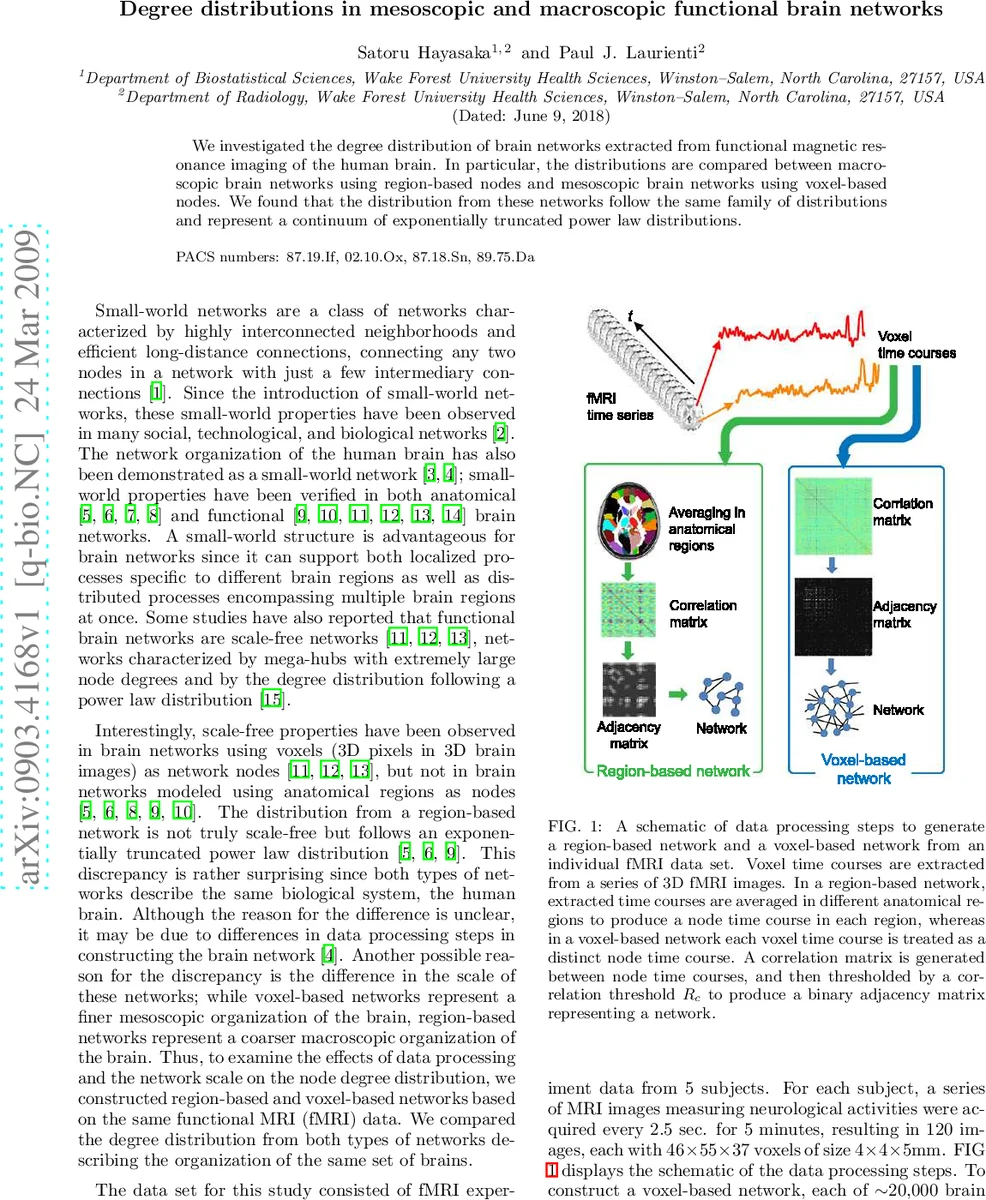
The authors set out to examine whether the degree distribution of functional brain networks depends on the spatial scale at which the network is defined. Using resting‑state fMRI from twenty healthy adults, they constructed two types of graphs: a macroscopic network in which each node corresponds to an anatomically defined brain region (e.g., AAL or Harvard‑Oxford atlas) and a mesoscopic network in which each voxel (≈3 mm³) is treated as a node. For both graphs the edges were defined by Pearson correlation of the BOLD time series, thresholded to yield comparable network densities (~10 %).
A systematic statistical analysis was then performed. The authors fitted several candidate distributions—pure power‑law, exponential, log‑normal, and the exponential‑truncated power‑law (ETPL)—to the empirical degree histograms. Parameter estimation employed maximum‑likelihood methods, and model selection relied on Kolmogorov‑Smirnov tests, Akaike Information Criterion, and bootstrap confidence intervals. Across both spatial scales the ETPL model provided the best fit, outperforming pure power‑law and exponential alternatives.
The fitted parameters differed systematically: the macroscopic (region‑based) network displayed a smaller exponent (α≈1.8) and a larger truncation constant (λ≈0.03), indicating a relatively heavy tail and a gentle cutoff. In contrast, the mesoscopic (voxel‑based) network showed a larger exponent (α≈2.4) and a smaller λ (≈0.01), reflecting a steeper decline in the probability of high‑degree nodes. Importantly, the two parameter sets lie on a continuum within the same distribution family, suggesting that the observed degree distributions are not fundamentally different but rather represent scale‑dependent points on a common statistical surface.
The authors interpret these findings in the context of cost‑efficiency principles that are thought to shape brain wiring. At the regional level, long‑range connections and hub‑like structures are more permissible, leading to a flatter tail. At the voxel level, physical wiring costs and signal‑to‑noise constraints suppress the emergence of very high‑degree nodes, producing a sharper exponential truncation. Consequently, previously reported “scale‑free” behavior may be an artifact of limited spatial resolution and of the particular thresholding scheme used.
Limitations acknowledged include the potential influence of spatial autocorrelation among neighboring voxels, the sensitivity of results to the chosen correlation threshold, and the lack of exploration of alternative threshold‑free or cost‑normalized graph construction methods. The study also does not address how individual differences (age, gender, cognitive ability) or clinical conditions (e.g., Alzheimer’s disease, schizophrenia) might shift the ETPL parameters.
Future work is proposed along several lines: (1) extending the analysis to larger, more diverse cohorts to test the robustness of the continuum hypothesis; (2) applying the same methodology to pathological populations to evaluate whether deviations from the ETPL baseline could serve as biomarkers; (3) employing generative network models that incorporate wiring cost and functional efficiency to theoretically derive the observed parameter values; and (4) testing multi‑threshold or probabilistic edge definitions to assess the stability of the degree distribution across methodological variations.
In sum, the paper demonstrates that functional brain networks, whether defined at the macroscopic (region) or mesoscopic (voxel) level, share a common statistical backbone: an exponentially truncated power‑law degree distribution. The apparent differences between scales are captured by a smooth shift in the distribution’s parameters, reflecting underlying biological constraints rather than fundamentally distinct network architectures. This insight refines our understanding of brain connectivity, challenges the ubiquity of scale‑free claims, and opens avenues for more nuanced, scale‑aware modeling of neural systems.
Comments & Academic Discussion
Loading comments...
Leave a Comment