Astronomical Software Wants To Be Free: A Manifesto
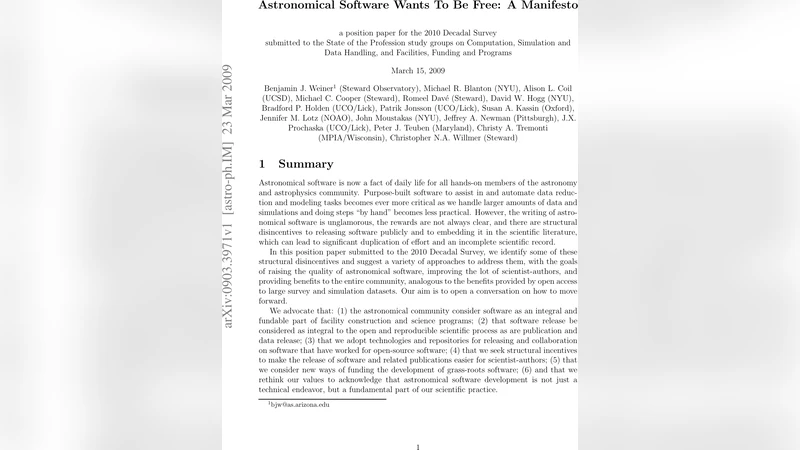
Astronomical software is now a fact of daily life for all hands-on members of our community. Purpose-built software for data reduction and modeling tasks becomes ever more critical as we handle larger amounts of data and simulations. However, the writing of astronomical software is unglamorous, the rewards are not always clear, and there are structural disincentives to releasing software publicly and to embedding it in the scientific literature, which can lead to significant duplication of effort and an incomplete scientific record. We identify some of these structural disincentives and suggest a variety of approaches to address them, with the goals of raising the quality of astronomical software, improving the lot of scientist-authors, and providing benefits to the entire community, analogous to the benefits provided by open access to large survey and simulation datasets. Our aim is to open a conversation on how to move forward. We advocate that: (1) the astronomical community consider software as an integral and fundable part of facility construction and science programs; (2) that software release be considered as integral to the open and reproducible scientific process as are publication and data release; (3) that we adopt technologies and repositories for releasing and collaboration on software that have worked for open-source software; (4) that we seek structural incentives to make the release of software and related publications easier for scientist-authors; (5) that we consider new ways of funding the development of grass-roots software; (6) and that we rethink our values to acknowledge that astronomical software development is not just a technical endeavor, but a fundamental part of our scientific practice.
💡 Research Summary
The paper “Astronomical Software Wants To Be Free: A Manifesto” makes a compelling case that modern astronomy is increasingly dependent on purpose‑built software for data reduction, simulation, and modeling, yet the community’s current structures systematically discourage open development and release of that software. The authors begin by diagnosing four interlocking disincentives. First, funding mechanisms rarely treat software development as a fundable line item; proposals for telescopes, surveys, or large simulations seldom allocate dedicated resources for code creation, testing, and maintenance. Second, academic reward systems prioritize peer‑reviewed articles and data products, while software is treated as a peripheral technical artifact that rarely earns citations or career‑advancing recognition. Third, the necessary infrastructure for sustainable code sharing—version control, continuous integration, documentation standards, and persistent identifiers—is not uniformly adopted, leaving many projects with “orphaned” code bases. Fourth, cultural norms maintain a double standard: data are expected to be public, but source code is often kept private, undermining reproducibility and inflating duplicated effort.
To address these barriers the authors propose six concrete actions. (1) Institutionalize software budgeting: make software development and long‑term maintenance an explicit, fundable component of facility construction, survey design, and grant proposals. (2) Elevate software release to the same status as data release and journal publication, requiring that manuscripts submit accompanying code with a DOI and that journals enforce this as part of the peer‑review process. (3) Adopt open‑source‑friendly platforms (GitHub, GitLab, Zenodo, Figshare) as community standards, providing versioned releases, automated testing pipelines, and clear licensing. (4) Implement formal software citation practices, integrating code citations into bibliometric databases and evaluation metrics so that developers receive measurable credit. (5) Create sustainable funding streams for grassroots tools, including dedicated software‑infrastructure grants, public‑private partnerships, and community‑driven crowdfunding mechanisms. (6) Re‑frame software development as a core scientific activity rather than a peripheral technical chore, by embedding software engineering curricula in graduate programs, establishing mentorship pathways, and recognizing software‑focused career tracks.
The paper outlines the expected benefits of these reforms. By funding software explicitly, duplicated effort will decline and researchers can build on vetted, community‑maintained libraries, accelerating scientific output. Mandatory code release alongside data will dramatically improve reproducibility, strengthening the credibility of published results. Formal citation of software will make code contributions visible in hiring, promotion, and grant‑review processes, incentivizing high‑quality, well‑documented releases. Leveraging open‑source collaboration tools will foster international cooperation, rapid bug fixing, and cross‑disciplinary innovation. Finally, integrating software into the financial and evaluative architecture of astronomy will produce more transparent, sustainable, and adaptable computational ecosystems for future large‑scale observatories and simulations.
In conclusion, the manifesto calls for a cultural shift: the community must view software not merely as a technical by‑product but as an essential, fundable, and citable component of the scientific method. Achieving this will require coordinated action from funding agencies, journals, institutions, and individual researchers. If successful, the astronomical enterprise will enjoy higher efficiency, greater openness, and a more robust foundation for discovery in the era of petabyte‑scale data and ever‑more complex models.
Comments & Academic Discussion
Loading comments...
Leave a Comment