Active Galaxies in the Sloan Digital Sky Survey II: galaxy and activity evolution
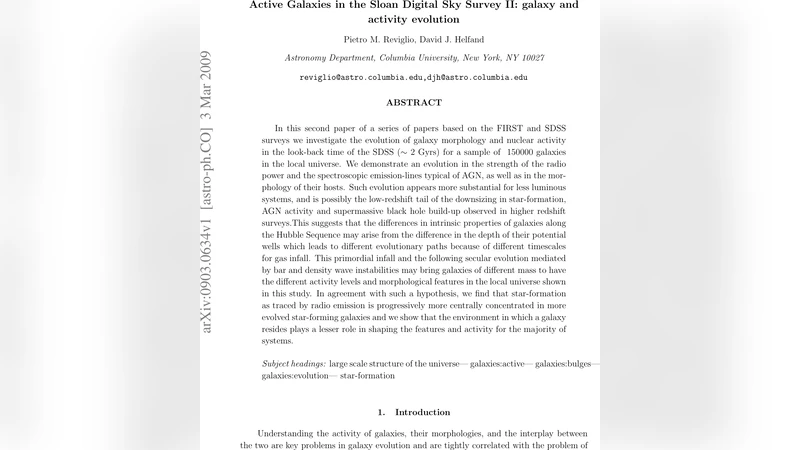
In this second paper of a series of papers based on the FIRST and SDSS surveys we investigate the evolution of galaxy morphology and nuclear activity in the look-back time of the SDSS (~2 Gyrs) for a sample of ~150000 galaxies in the local universe. We demonstrate an evolution in the strength of the radio power and the spectroscopic emission-lines typical of AGN, as well as in the morphology of their hosts. Such evolution appears more substantial for less luminous systems, and is possibly the low-redshift tail of the downsizing in star-formation, AGN activity and supermassive black hole build-up observed in higher redshift surveys.This suggests that the differences in intrinsic properties of galaxies along the Hubble Sequence may arise from the difference in the depth of their potential wells which leads to different evolutionary paths because of different timescales for gas infall. This primordial infall and the following secular evolution mediated by bar and density wave instabilities may bring galaxies of different mass to have the different activity levels and morphological features in the local universe shown in this study. In agreement with such a hypothesis, we find that star-formation as traced by radio emission is progressively more centrally concentrated in more evolved star-forming galaxies and we show that the environment in which a galaxy resides plays a lesser role in shaping the features and activity for the majority of systems.
💡 Research Summary
In this second installment of the “Active Galaxies in the Sloan Digital Sky Survey” series, the authors combine data from the Faint Images of the Radio Sky at Twenty‑centimeters (FIRST) survey with optical spectroscopy from the Sloan Digital Sky Survey (SDSS) to investigate how galaxy morphology and nuclear activity have evolved over the look‑back time accessible to SDSS, roughly two gigayears. The study utilizes a statistically robust sample of about 150,000 galaxies in the redshift interval 0 < z < 0.2. Galaxies are classified by absolute magnitude, colour, spectroscopic type (AGN, star‑forming, composite, LINER, etc.), and structural parameters such as Sersic index, bulge‑to‑disk ratio, and the presence of bars. Radio luminosities at 1.4 GHz (L₁.₄) serve as proxies for star‑formation and low‑level AGN activity, while optical emission‑line strengths (
Comments & Academic Discussion
Loading comments...
Leave a Comment