Active Galaxies in the Sloan Digital Sky Survey I: The Spectroscopically Unremarkable Population of the Local Universe
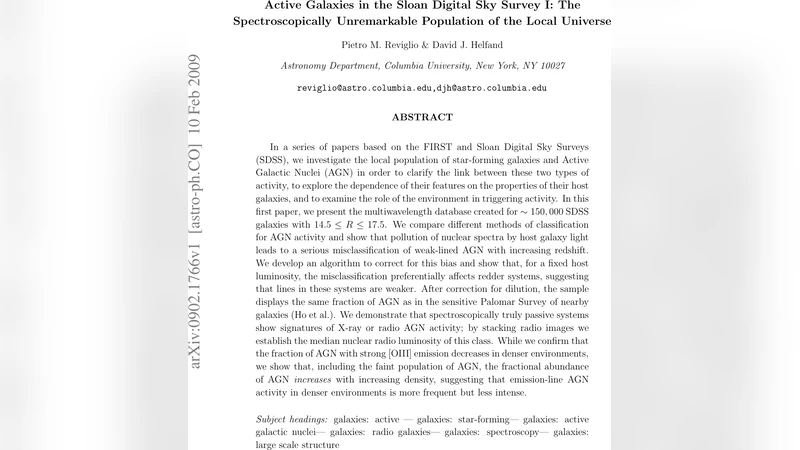
In a series of papers based on the FIRST and Sloan Digital Sky Surveys (SDSS), we investigate the local population of star-forming galaxies and Active Galactic Nuclei (AGN) in order to clarify the link between these two types of activity, to explore the dependence of their features on the properties of their host galaxies, and to examine the role of the environment in triggering activity. In this first paper, we present the multiwavelength database created for ~150,000 SDSS galaxies with 14.5 < R < 17.5. We compare different methods of classification for AGN activity and show that pollution of nuclear spectra by host galaxy light leads to a serious misclassification of weak-lined AGN with increasing redshift. We develop an algorithm to correct for this bias and show that, for a fixed host luminosity, the misclassification preferentially affects redder systems, suggesting that lines in these systems are weaker. After correction for dilution, the sample displays the same fraction of AGN as in the sensitive Palomar Survey of nearby galaxies (Ho et al.). We demonstrate that spectroscopically truly passive systems show signatures of X-ray or radio AGN activity; by stacking radio images we establish the median nuclear radio luminosity of this class. While we confirm that the fraction of AGN with strong [OIII] emission decreases in denser environments, we show that, including the faint population of AGN, the fractional abundance of AGN increases with increasing density, suggesting that emission-line AGN activity in denser environments is more frequent but less intense.
💡 Research Summary
In this first paper of a series that combines the Faint Images of the Radio Sky at Twenty‑centimeters (FIRST) survey with the Sloan Digital Sky Survey (SDSS), the authors construct a multi‑wavelength database for roughly 150,000 galaxies in the local Universe (14.5 < R < 17.5 mag). Using SDSS optical spectra they apply the classic Baldwin‑Phillips‑Terlevich (BPT) diagnostic to separate star‑forming galaxies from active galactic nuclei (AGN). They then subdivide the AGN population into “strong‑line” objects (clear Seyfert/LINER signatures), “weak‑line” objects (low‑equivalent‑width emission) and spectroscopically passive galaxies that show no obvious emission lines.
A central problem identified is the dilution of nuclear emission lines by host‑galaxy starlight that enters the 3‑arcsecond SDSS fiber. The effect grows with redshift, with host luminosity, and is strongest for redder, more massive galaxies. As a consequence, many weak‑line AGN are mis‑classified as star‑forming or passive systems. The authors quantify this bias by modelling the expected equivalent‑width (EW) decline as a function of absolute magnitude (M_r) and colour (g − r). They develop an algorithm that predicts the intrinsic line strength for each galaxy, compares it to the observed EW, and flags objects whose lines have been diluted below the detection threshold. After applying the correction, the fraction of AGN in the sample rises to ~10 %, matching the highly complete Palomar spectroscopic survey of nearby galaxies (Ho et al.).
To test whether spectroscopically passive galaxies truly lack nuclear activity, the authors turn to radio and X‑ray data. By stacking FIRST images at the positions of passive galaxies they measure a median nuclear radio luminosity of L₁.₄GHz ≈ 10²⁰ W Hz⁻¹, characteristic of low‑luminosity radio AGN. A similar stacking of ROSAT X‑ray counts reveals a modest hard‑X‑ray excess in a subset of these objects, indicating that a non‑negligible fraction host accreting black holes despite the absence of optical lines.
The environmental analysis uses the projected 5‑th‑nearest‑neighbour density (Σ₅) to separate low‑density field, intermediate‑density groups, and high‑density clusters. The authors confirm earlier findings that the proportion of strong‑line
Comments & Academic Discussion
Loading comments...
Leave a Comment