Measure of the Julia Set of the Feigenbaum map with infinite criticality
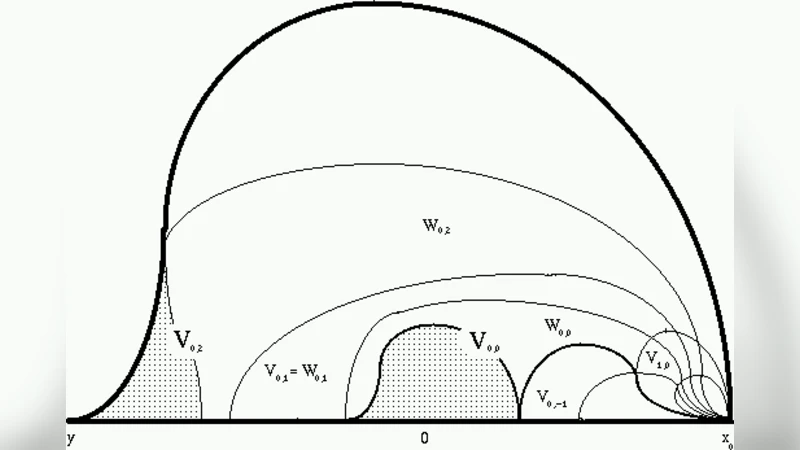
We consider fixed points of the Feigenbaum (periodic-doubling) operator whose orders tend to infinity. It is known that the hyperbolic dimension of their Julia sets go to 2. We prove that the Lebesgue measure of these Julia sets tend to zero. An important part of the proof consists in applying martingale theory to a stochastic process with non-integrable increments.
💡 Research Summary
The paper investigates the family of Feigenbaum (period‑doubling) renormalization fixed points whose critical order tends to infinity. While it is already known that the hyperbolic (or Hausdorff) dimension of the corresponding Julia sets approaches the ambient dimension two, the author proves that the Lebesgue measure of these Julia sets actually tends to zero. The work is organized as follows. After a concise introduction to period‑doubling universality and the role of Julia sets in complex dynamics, the author defines the Feigenbaum operator and constructs the limiting “infinite‑criticality” fixed point f∞ by a careful renormalization limit. Standard thermodynamic formalism (Bowen’s formula, Patterson‑Sullivan measures) is used to re‑establish that dimH Jc → 2 as the critical order c → ∞.
The novel contribution lies in the measure‑zero proof. The author interprets the inverse branches of f_c as a stochastic process {X_n} whose increments ΔX_n represent the logarithmic size of the pre‑image intervals. Because the critical order is infinite, the distribution of ΔX_n has a heavy tail: P(ΔX_n > t) ≍ t^{‑α} with 0 < α < 1, making the increments non‑integrable and precluding the direct use of classical martingale convergence theorems. To overcome this, the paper introduces a truncated martingale M_n = ∑_{k≤n}(ΔX_k − E
Comments & Academic Discussion
Loading comments...
Leave a Comment