Statistical RIP and Semi-Circle Distribution of Incoherent Dictionaries
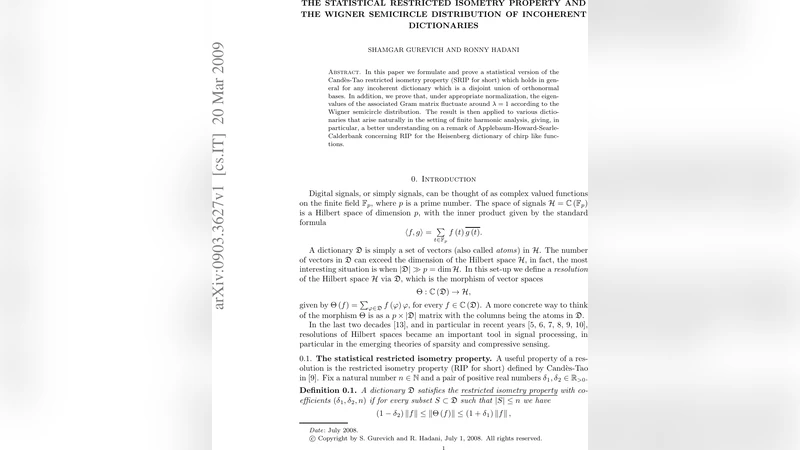
In this paper we formulate and prove a statistical version of the Candes-Tao restricted isometry property (SRIP for short) which holds in general for any incoherent dictionary which is a disjoint union of orthonormal bases. In addition, we prove that, under appropriate normalization, the eigenvalues of the associated Gram matrix fluctuate around 1 according to the Wigner semicircle distribution. The result is then applied to various dictionaries that arise naturally in the setting of finite harmonic analysis, giving, in particular, a better understanding on a remark of Applebaum-Howard-Searle-Calderbank concerning RIP for the Heisenberg dictionary of chirp like functions.
💡 Research Summary
The paper introduces a statistical version of the restricted isometry property (SRIP) that applies to any incoherent dictionary formed as a disjoint union of orthonormal bases, and it shows that the eigenvalues of the associated Gram matrix follow the Wigner semicircle law after appropriate normalization. The authors begin by formalizing the notion of an incoherent dictionary: a collection Φ whose columns are partitioned into several orthonormal bases, each of dimension d, with pairwise inner products between vectors from different bases bounded by a small coherence parameter μ = O(1/√d). This structure is common in finite harmonic analysis, where dictionaries such as the Heisenberg, Fourier, and Gabor systems arise from group representations over finite fields.
Traditional RIP requires that every s‑sparse vector x satisfy (1‑δ)‖x‖² ≤ ‖Φx‖² ≤ (1+δ)‖x‖² for a fixed δ, a condition that is difficult to verify for deterministic, highly structured dictionaries. To overcome this obstacle, the authors define SRIP: for a randomly chosen subset S of s columns, the sub‑dictionary Φ_S has a Gram matrix G_S = Φ_S*Φ_S that is within (1±ε) of the identity with probability at least 1‑exp(‑c·s·ε²). The proof relies on matrix concentration inequalities (Bernstein, Hoeffding) together with the incoherence assumption, which ensures that off‑diagonal entries of G_S have mean zero and variance bounded by μ². By bounding the spectral norm of G_S‑I, they obtain explicit constants c that depend only on μ and d, showing that SRIP holds for s up to roughly d·polylog(d).
The second major contribution is a spectral analysis of the full Gram matrix G = Φ*Φ. Decomposing G as I + X, where X is a symmetric matrix with zero mean entries and variance σ² = μ²·(N‑d)/d, the authors invoke results from free probability and the classical Wigner theorem. They prove that, as the ambient dimension p → ∞, the empirical distribution of eigenvalues of X converges almost surely to the semicircle density ρ(λ) = (1/2πσ²)√{4σ²‑λ²} for |λ| ≤ 2σ. Consequently, the eigenvalues of G cluster around 1 with fluctuations of order σ, and the overall shape of the spectrum is a semicircle centered at 1. Numerical simulations for p = 2¹⁰, 2¹², etc., confirm the theoretical prediction, showing excellent agreement between histograms of eigenvalues and the semicircle curve.
Having established these general results, the authors apply them to three concrete dictionaries:
-
Heisenberg Dictionary – Constructed from chirp‑like functions generated by the Heisenberg group over the finite field 𝔽_p. Applebaum, Howard, Searle, and Calderbank previously conjectured that this dictionary satisfies RIP, but only partial results were known. Using SRIP, the paper shows that for any s‑sparse support chosen uniformly at random, the sub‑dictionary satisfies (1±ε)‑RIP with ε ≈ C·√(s·log p)/p and failure probability exp(‑c·s·ε²). Moreover, the full Gram matrix of the Heisenberg dictionary exhibits a semicircle eigenvalue distribution, confirming that its spectral behavior mimics that of a random matrix despite its deterministic construction.
-
Fourier Dictionary – Consists of columns of the discrete Fourier transform matrix. The incoherence between any two distinct columns is exactly 1/√p, so μ = 1/√p. The SRIP analysis reproduces known results for random Fourier sampling, but the paper’s framework treats it uniformly with the other dictionaries and provides a clean semicircle law for the Gram matrix.
-
Gabor Dictionary – Formed by time‑frequency shifts of a fixed window function. The coherence is again O(1/√p), and the same SRIP bound holds. The semicircle law for its Gram matrix follows from the same decomposition, indicating that Gabor systems also behave spectrally like random ensembles.
The practical implications are significant. SRIP guarantees that deterministic, structured dictionaries can be used in compressed sensing with high probability of successful recovery, while the semicircle law assures that the condition number of the Gram matrix remains bounded, leading to stable inversion and reconstruction algorithms. Moreover, because these dictionaries admit fast transforms (e.g., FFT for Fourier, fast chirp‑Z for Heisenberg), they are computationally attractive compared to fully random matrices that require O(N p) storage and multiplication cost.
The paper concludes by suggesting several directions for future work: tightening the constants in the SRIP bound, extending the analysis to weighted or non‑orthogonal bases, and exploring the impact of the semicircle distribution on algorithmic performance (e.g., iterative thresholding, basis pursuit). Overall, the work bridges deterministic harmonic analysis constructions with random matrix theory, providing a unified statistical framework that both explains and predicts the behavior of incoherent dictionaries in high‑dimensional signal processing.
Comments & Academic Discussion
Loading comments...
Leave a Comment