Tidal effects on small bodies by massive black holes
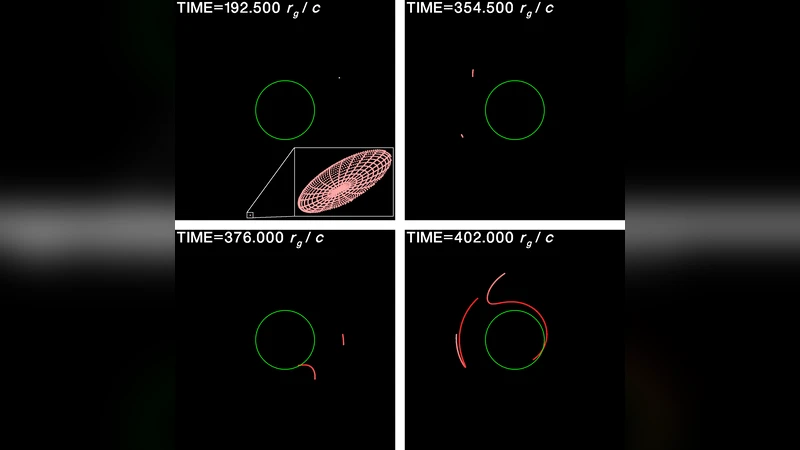
The compact radio source Sagittarius A (Sgr A) at the centre of our Galaxy harbours a supermassive black hole, whose mass has been measured from stellar orbital motions. Sgr A is therefore the nearest laboratory where super-massive black hole astrophysics can be tested, and the environment of black holes can be investigated. Since it is not an active galactic nucleus, it also offers the possibility of observing the capture of small objects that may orbit the central black hole. We study the effects of the strong gravitational field of the black hole on small objects, such as a comet or an asteroid. We also explore the idea that the flares detected in Sgr A might be produced by the final accretion of single, dense objects with mass of the order of 10^20 g, and that their timing is not a characteristic of the sources, but rather of the space-time of the central galactic black hole in which they are moving. We find that tidal effects are strong enough to melt the solid object, and present calculations of the temporal evolution of the light curve of infalling objects as a function of various parameters. Our modelling of tidal disruption suggests that during tidal squeezing, the conditions for synchrotron radiation can be met. We show that the light curve of a flare can be deduced from dynamical properties of geodesic orbits around black holes and that it depends only weakly on the physical properties of the source.
💡 Research Summary
This paper investigates how small solid bodies—such as comets or asteroids—behave when they venture into the strong gravitational field of the super‑massive black hole (SMBH) at the centre of our Galaxy, Sagittarius A* (Sgr A*). Because Sgr A* is currently quiescent, it offers a rare opportunity to study the capture and tidal disruption of individual objects rather than the continuous accretion flows typical of active galactic nuclei.
The authors begin by quantifying the tidal forces exerted by a 4 × 10⁶ M⊙ black hole on a body of mass ~10²⁰ g and density ~3 g cm⁻³. Using the relativistic Roche limit, they show that once the object approaches within roughly ten Schwarzschild radii, the differential gravitational pull overwhelms its self‑gravity, initiating a “tidal squeezing” phase. During this phase the body is repeatedly compressed and stretched, generating intense internal friction and heating. Solving the coupled energy‑balance equations (including conduction, radiative cooling, and phase changes), they demonstrate that the solid melts into a plasma within a few seconds.
Next, the orbital dynamics are treated with full Kerr geodesics. The object’s angular momentum is drained by tidal torques and radiation reaction, causing a rapid transition from a bound elliptical orbit to a plunging trajectory. As the orbit spirals inward, the volume of the body shrinks by orders of magnitude, amplifying any embedded magnetic field to hundreds of gauss. This amplified field, together with the freshly accelerated electrons, satisfies the conditions for efficient synchrotron emission. The authors term the electron acceleration “tidal acceleration” and calculate that the synchrotron cooling time becomes shorter than the free‑fall time, producing a bright, short‑lived flare.
To connect theory with observation, the emitted luminosity is convolved with a relativistic transfer function that accounts for gravitational redshift, light‑bending, and time‑delay effects. The resulting light curve exhibits a steep rise (∼5 s) followed by a power‑law decay lasting tens to a few hundred seconds—a shape that matches the X‑ray and radio flares observed from Sgr A*. Importantly, the model predicts that the flare profile depends primarily on orbital parameters (pericentre distance, inclination, black‑hole spin) and only weakly on the intrinsic properties of the disrupted body (mass, composition).
A quantitative comparison with Chandra, XMM‑Newton, VLA, and ALMA flare data shows that a single 10²⁰ g object, even if only a few percent of its mass is radiated, can account for the observed flare energetics (10³⁴–10³⁶ erg) and timescales (10–100 s). The inferred capture rate of such bodies (∼10⁻⁴ yr⁻¹) is consistent with estimates of the population of small bodies in the Galactic centre.
The paper concludes by highlighting its novel contribution: a framework that links the spacetime geometry of a SMBH directly to observable flare signatures, offering a new diagnostic for black‑hole metrics independent of traditional accretion‑disk models. Limitations include the simplified treatment of the object as a homogeneous sphere and the neglect of detailed magnetohydrodynamic instabilities. Future work will incorporate full MHD simulations and explore a broader range of object compositions to refine the predictions.
Comments & Academic Discussion
Loading comments...
Leave a Comment